
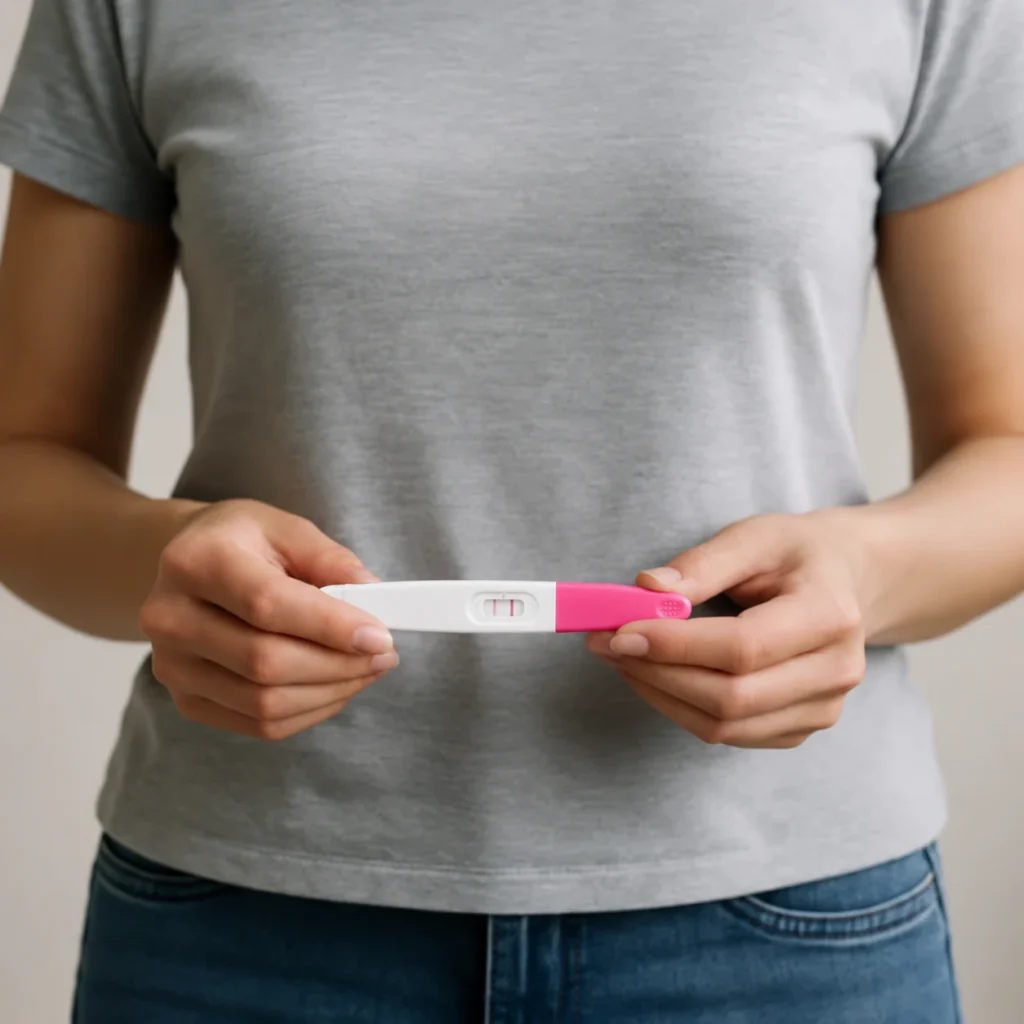

A positive pregnancy test after miscarriage can leave you wondering whether your body is recovering or something needs checking. hCG can remain detectable for days to several weeks after a miscarriage. There is no single date when everyone’s test turns negative: the starting hormone level, whether pregnancy tissue remains and the test being used all affect the result.
This guide explains follow-up after pregnancy loss; it cannot diagnose a suspected miscarriage from bleeding or a home test. If the loss has not been assessed, contact a healthcare professional. If you already have a follow-up plan, its review dates matter more than a general estimate of how long hCG takes to clear.
Quick answers about hCG after miscarriage
How long does hCG stay in your system after miscarriage?
hCG may remain detectable for days to several weeks. The time depends on the starting level, whether the pregnancy has fully resolved and the test’s detection limit. Being five or six weeks pregnant when the loss happened cannot, by itself, predict when a test will become negative.
Can a home pregnancy test show that hCG is zero?
No. A home test shows whether hCG is detected in that urine sample, not its exact concentration. A negative result does not prove that hCG is literally zero or that a miscarriage is complete. Ongoing symptoms and any planned blood tests or scans still need appropriate follow-up.
When should I report a positive test after miscarriage?
Report a positive result at your planned follow-up point, including a faint positive. If you were not given a testing plan, ask your GP or treating service for one. Severe pain, heavy bleeding, shoulder-tip pain or faintness need urgent assessment rather than waiting for another home test.
What does your hCG result after miscarriage mean for follow-up?
A numerical hCG chart for an ongoing pregnancy is not a recovery chart. The useful question is what your result means for your next step, not whether it matches someone else’s weekly number.
| Result or situation | What to do next | What the result cannot tell you |
|---|---|---|
| Positive at your planned follow-up | Tell the service managing your follow-up, even if the line is faint. | A positive urine test alone cannot show whether hCG is simply clearing or whether further assessment is needed. |
| Negative, but symptoms continue | Seek medical advice for ongoing pain, bleeding, fever or unusual discharge. Severe or worsening symptoms need urgent assessment. | A negative urine test does not establish that the symptoms are harmless or that the miscarriage is complete. |
| Falling blood hCG, but the pregnancy location was not confirmed | Continue the agreed blood-test and scan pathway until your clinician confirms follow-up can stop. | Falling hCG does not establish that the pregnancy was inside the uterus rather than ectopic. |
| Positive after a documented negative | Give your GP the dates and previous results if a new pregnancy is possible. | The result alone cannot establish whether this is a new pregnancy or where it is located. |
This guide helps with your next conversation; it does not diagnose a complication or replace your discharge instructions.
What does “back to zero” mean on an hCG blood test?
Human chorionic gonadotropin, or hCG, is produced by pregnancy tissue. After loss, circulating hormone takes time to clear. A positive can therefore detect hCG from a pregnancy that has ended, rather than indicate a faulty test.
A quantitative beta-hCG blood test reports a concentration. A home urine test is qualitative: it gives a positive, negative or invalid result according to the device’s rules. Blood testing can detect smaller amounts than many urine tests, so the two methods may become negative at different times.
“Back to zero” usually means returning to the laboratory’s non-pregnant range. For example, PathWest lists less than 5 IU/L for non-pregnant adults. Check the interval on your own report and ask how it applies to your follow-up. A result reported as “less than 5” does not need to show a literal zero.
A valid faint line on a pregnancy test can still mean hCG was detected. It cannot be converted into a blood value or a number of days until recovery is complete.
When should you take a pregnancy test after miscarriage in Australia?
Testing dates depend on how the miscarriage was managed and what still needs checking. Waiting for tissue to pass, medicine and surgery can involve different follow-up schedules.
For expectant management, which means waiting for tissue to pass, Queensland guidance includes review at 7–10 days for a stable, confirmed intrauterine miscarriage. This is a clinical review interval, not a universal instruction to take a home test on day seven.
For medical management, the Royal Hospital for Women describes a call two to three days after misoprostol to discuss symptoms, followed by another call at two weeks. Its leaflet asks patients to do a home urine pregnancy test before the later call. Your hospital may use a different pathway; this example shows why an early check and a later test serve different purposes.
After uncomplicated surgical management, routine repeat blood hCG or ultrasound is not always needed. Your clinician decides whether completion has been established and what further follow-up is needed.
What if you are still testing positive three, five or six weeks later?
Remaining hCG is one possibility, but elapsed time cannot identify the cause. Report a positive at your agreed checkpoint. If you are already five or six weeks past the loss without a follow-up plan, contact your GP or treating service now, not only if the line gets darker.
If your instructions simply say “test again”, ask which test, on what date, and who will review the result.
Why do the starting hCG level and type of loss affect the timeline?
The diagnosis, bleeding and passage or removal of tissue may happen on different dates. Distinguish how many weeks pregnant you were from how many weeks have passed since the loss or treatment when discussing results.
How quickly can hCG fall after a miscarriage at five or six weeks?
A very early loss, sometimes called a chemical pregnancy, may involve a lower starting hCG concentration and become urine-negative sooner. But being five or six weeks pregnant does not supply that starting value. Neither gestation nor a faint original test can give you a reliable clearance deadline.
How can a missed miscarriage affect hCG clearance?
In a missed miscarriage, the pregnancy has ended but remains in the uterus, sometimes without noticeable bleeding. hCG can still be detected while you wait for tissue to pass or for treatment.
How long can hCG remain detectable after a D&C or other surgical management?
Removing pregnancy tissue does not instantly remove circulating hCG. A positive test soon after surgery does not, by itself, show that treatment failed. Procedure findings, symptoms and any planned investigations provide the context. The guide to recovery and trying to conceive after a D&C addresses the separate pregnancy-planning decision.
What can a slow fall, plateau or rise in hCG mean?
Dated blood results can show whether hCG is falling, staying at a similar level or rising. Clinicians sometimes compare samples around 48 hours apart when an early-pregnancy situation is uncertain. That is not a schedule everyone needs, and no single number establishes the diagnosis.
A fixed “halving every two days” rule cannot predict your negative-test date: decline patterns depend on the starting concentration and clinical circumstances. The hCG doubling-time guide explains rising levels in early pregnancy, rather than providing a recovery calculator after loss.
A plateau or rise may prompt assessment for remaining pregnancy tissue, an ectopic pregnancy or a new pregnancy. Less commonly, abnormal pregnancy tissue associated with molar pregnancy can keep producing hCG and needs specialist monitoring. These possibilities cannot be distinguished by a home-test line.
Why does the previous ultrasound matter when hCG is falling?
If no earlier scan confirmed a pregnancy inside the uterus, an empty uterus after bleeding does not prove a completed miscarriage. The pregnancy may have been too early to locate, may have resolved or may be ectopic. Pregnancy of unknown location describes this unresolved situation; it is not a final diagnosis.
Even low or falling blood hCG cannot exclude an ectopic pregnancy by itself. Continue follow-up until the clinician responsible confirms it can stop, and seek assessment if symptoms change.
How should you use a home pregnancy test during miscarriage follow-up?
For a planned home test, check the expiry date, sample method, control indicator and reading window. Drinking extra water to obtain a lighter line can dilute urine, not speed hCG clearance.
Fertility2Family’s pregnancy test strip instructions specify reading at five minutes and ignoring changes after ten minutes. Other devices may differ. An absent control line means the result is invalid, not negative, and needs a fresh test.
A mark first noticed after the reading window is a different problem from an on-time positive. The guide to evaporation lines on pregnancy tests explains that distinction. If repeated testing is becoming distressing, discuss how to complete follow-up without spending each day comparing photographs.

Could a new pregnancy or fertility medicine explain a positive result?
Can a new pregnancy happen before the first period?
Fertility can return before the first period after miscarriage. A positive following a documented negative result is useful information, but a test that never became negative cannot separate a new pregnancy from residual hCG. Tell your GP the previous results and whether intercourse could have led to pregnancy.
Once a new pregnancy has been assessed, next steps after a positive pregnancy test in Australia explains the move into pregnancy care.
Can an hCG trigger injection affect pregnancy tests?
Ovidrel contains choriogonadotropin alfa, a form of hCG. Australian product information states that it may interfere with serum or urine hCG testing for up to ten days after administration. Count from the injection date, not the miscarriage. An injection many weeks earlier should not automatically be used to explain a persistent positive now.
Give your clinic the medicine and injection date, and use its planned test date. The Ovidrel and trigger shot guide explains this testing context. Do not change prescribed fertility medicines without advice.
When will your next period return and when can you try again?
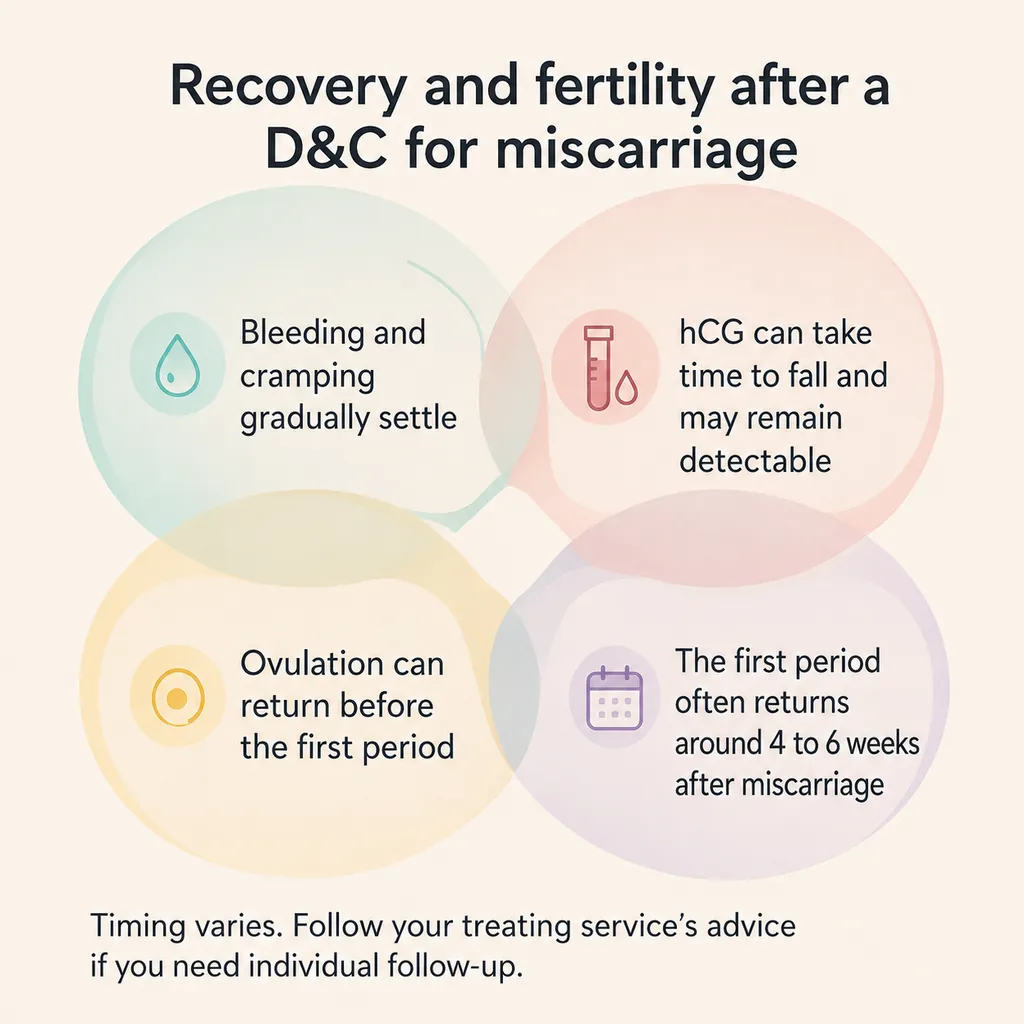
The first period commonly returns around four to six weeks after miscarriage, although timing varies. That describes cycle recovery, not an hCG deadline. If follow-up is complete but your period remains absent, speak with your GP; no period with a negative pregnancy test covers the separate question of a delayed cycle.
The Royal Women’s Hospital advises avoiding vaginal sex until bleeding has stopped and you feel comfortable. Trying for pregnancy is a further decision: ongoing positive tests, complications, ectopic treatment or molar pregnancy monitoring may require different advice. Use contraception if you are not ready. A negative test does not set a deadline for emotional recovery.
Which symptoms should not wait for another pregnancy test?
Seek urgent assessment for severe or worsening abdominal or pelvic pain, particularly one-sided pain, shoulder-tip pain, heavy bleeding, marked dizziness or faintness. Fever, chills or unpleasant-smelling discharge also need urgent review after miscarriage. These symptoms matter even when a urine test is negative or faint.
Call 000 for an ambulance if you collapse, have very heavy bleeding or severe pain, or feel seriously unwell. For other urgent symptoms, contact your treating service immediately or attend an emergency department if prompt assessment is not available. Do not wait for a routine appointment.

Frequently asked questions about hCG after miscarriage in Australia
Does heavier bleeding mean hCG is dropping faster?
No. Bleeding amount does not measure the rate of hormone decline. Symptoms can settle while further follow-up is still needed. Heavy bleeding should be assessed rather than treated as evidence of faster recovery, especially when there is significant pain, fever or faintness.
Why is a digital pregnancy test negative when a strip is faintly positive?
Different devices may have different detection limits, and urine concentration or technique can affect results. Check that both tests were valid and read correctly. Do not use a negative digital result to dismiss a positive result that your clinician has asked you to report.
Can I compare hCG blood results from different laboratories?
Tell your clinician if different laboratories tested the samples, because methods can give different results. Using the same laboratory where practical makes serial comparisons easier. Do not calculate recovery from the numbers alone or delay urgent testing to keep using one laboratory.
Can I use ovulation tests to check recovery after miscarriage?
No. Ovulation tests detect LH, not whether miscarriage follow-up is complete. Clearblue’s digital ovulation-test guidance warns that a recent pregnancy can produce misleading results. An ovulation test should not be used to decide that hCG has cleared; ask when cycle tracking would be appropriate.
Can I lower hCG naturally after a miscarriage?
The clinical guidance reviewed here does not recommend food, supplements or detoxes to make hCG clear faster. Looking after your general health is worthwhile, but it does not replace follow-up. Persistent hCG needs its cause assessed rather than an unproven hormone-clearing remedy.
Can hCG results tell me why I miscarried?
Not by themselves. hCG results help assess a pregnancy and its resolution, but do not establish why a loss happened. Your clinician may discuss other findings or investigations when appropriate. Often no exact cause is identified, and most miscarriages are not caused by something you did.
Next Steps in Australia
Ask your GP or treating service to confirm the next step. Bring the results you have; an incomplete record should not delay contact.
What should you record before your miscarriage follow-up appointment?
Copy these headings into a note using information you already have. No extra tests are needed to complete it.
Later, when follow-up is complete, the guide to ovulation tests when pregnancy may affect the result can help separate cycle tracking from pregnancy testing. You do not need to start tracking again before it is useful to you.
For help deciding where to seek care, call Healthdirect on 1800 022 222. For emotional support, Red Nose’s Grief and Loss Support Line, 1300 308 307, is available 24 hours a day. These services do not replace emergency care for severe symptoms.
You deserve a clear plan and an explanation you understand. Support is appropriate while results are being checked, and after follow-up has finished.
Last reviewed: 5 September 2026
Next scheduled review: September 2027
References
Fertility2Family articles are researched using Australian Government health guidance, professional clinical recommendations and peer-reviewed medical literature. The references below were used to research and medically review this article and provide additional reading for readers who want to explore the evidence in more detail.
RANZCOG. Miscarriage, Recurrent Miscarriage and Ectopic Pregnancy (C-Gyn 38)
Version 1, March 2025, covers miscarriage assessment, treatment choices, ectopic pregnancy and follow-up, including shared decisions and individual counselling after pregnancy loss.
Queensland Health. Early pregnancy loss
The 2025 Queensland guideline, MN22.29-V8-R27, describes management-specific follow-up, blood hCG and ultrasound, including precautions when an intrauterine pregnancy has not previously been confirmed.
Healthdirect Australia. hCG test
Australian consumer information explaining urine and blood hCG tests, sample preparation, urine dilution and the distinction between detecting the hormone and measuring its concentration.
PathWest. HCG (Quantitative)
Western Australian laboratory information describing quantitative hCG testing, reporting units and clinical uses, including a non-pregnant reference interval below five international units per litre.
Obstetrics and Gynecology International. β‐Human Chorionic Gonadotropin Dynamics in Early Gestational Events: A Practical and Updated Reappraisal
A clinical review of hCG measurement and changing concentrations in early pregnancy events, explaining why results need interpretation alongside symptoms, pregnancy history and ultrasound.
Healthdirect Australia. Miscarriage
Australian guidance on miscarriage types, assessment, treatment and follow-up, with advice about urgent symptoms, pregnancy loss at home and uncertainty about why a loss happened.
The Royal Women’s Hospital. Treating miscarriage
Hospital guidance covering recovery after miscarriage, warning symptoms, the return of periods, resuming vaginal sex and the different emotional responses people may experience.
Healthdirect Australia. Ectopic pregnancy
Australian information on pregnancy outside the uterus, symptoms requiring urgent assessment and the roles of blood hCG, ultrasound and continued follow-up in clinical care.
The Royal Women’s Hospital. Hydatidiform mole
Hospital information explaining molar pregnancy, persistent trophoblastic disease and hCG monitoring, including why another pregnancy should wait until the specialist follow-up programme is complete.
Australian Commission on Safety and Quality in Health Care. Ovidrel Pen
Australian medicine information for choriogonadotropin alfa, including potential interference with serum or urine hCG testing for up to ten days after administration.
Clearblue Australia. Frequently asked questions – Digital Ovulation Tests
Manufacturer guidance on digital ovulation testing, warning that recent pregnancy and fertility medicines containing hCG or LH may produce misleading results on this device.
Red Nose Australia. Grief and Loss Support
Australian pregnancy and infant loss support information describing counselling, peer support and the round-the-clock Grief and Loss Support Line for people affected by loss.
Fertility2Family. Pregnancy Test Strip Instructions: How to Dip and Read
Pregnancy strip directions covering sample collection, dipping limits, timed reading and control-line validity, with explanations of positive, negative and invalid urine hCG results.
Better Health Channel. Miscarriage
Victorian consumer information discussing physical and emotional recovery after miscarriage, returning fertility and contraception while deciding whether to try for another pregnancy.
Royal Hospital for Women, South Eastern Sydney Local Health District. Medical Management of Miscarriage
Hospital patient information explaining medical miscarriage management and follow-up, including early telephone contact, a two-week review and a home urine pregnancy test before that review.