


If your fertility clinic has given you an exact Ovidrel trigger time, it can feel as though a small timing mistake could undo the whole cycle. The important part is to follow that exact instruction rather than a generic countdown. Ovidrel is a prescription trigger shot containing choriogonadotropin alfa, a recombinant form of hCG. After follicles have developed, it helps trigger final egg maturation and luteinisation and, in ovulation-induction cycles, ovulation.
The injection may be timed around intercourse, intrauterine insemination (IUI) or egg retrieval, and those plans are not interchangeable. Ovulation is often expected around the following day to day and a half after an hCG trigger, but the exact treatment schedule belongs to the monitored cycle rather than a universal 36-hour rule.
Ovidrel can also make serum or urine pregnancy tests positive for up to ten days after administration. If a dose was late, missed, leaked or uncertain, call the clinic rather than repeating it. Severe or worsening abdominal pain, rapid swelling or weight gain, repeated vomiting, reduced urine or shortness of breath need prompt medical advice.
Quick answers about Ovidrel trigger shots
What does the Ovidrel trigger shot do?
Ovidrel supplies recombinant hCG after follicles have developed. It triggers final follicular maturation and luteinisation and, in ovulation-induction cycles, helps trigger ovulation. Clinics time it around intercourse, IUI or egg retrieval; it does not guarantee egg release, fertilisation or pregnancy.
How long does Ovidrel stay in your system?
Ovidrel is cleared gradually rather than on one exact day. The practical testing boundary is that it may interfere with serum or urine hCG tests for up to ten days after administration, so use the clinic’s test date rather than a personal countdown.
What should you do if Ovidrel was late, missed, leaked or uncertain?
Contact the fertility clinic or prescribing service as soon as you notice the problem. Tell them the planned time, what actually happened and which device you used. Do not repeat, top up or replace the dose unless the prescriber specifically tells you to.
What is Ovidrel and what does the trigger shot actually do?
Ovidrel contains choriogonadotropin alfa, a laboratory-made form of human chorionic gonadotrophin (hCG). After follicle development, it acts at the ovarian LH/hCG receptor to support final egg maturation, follicular rupture and formation of the progesterone-producing corpus luteum.
That makes Ovidrel one timed step in a wider fertility-treatment plan. It does not improve egg quality, unblock fallopian tubes, treat a sperm factor or guarantee fertilisation, implantation or pregnancy. The trigger makes more sense when it is placed alongside FSH, LH, oestrogen and progesterone, because these hormones change together across follicle development, ovulation and the luteal phase.
Ovidrel is prescription-only and is not suitable for everyone. Australian information lists contraindications including primary ovarian failure, uncontrolled thyroid or adrenal disease, some hypothalamic or pituitary tumours, unexplained gynaecological bleeding, active thromboembolic disorders and some ovarian, uterine or breast conditions. Give the prescriber your complete medical and medicine history.
Which Ovidrel product might you receive in Australia?
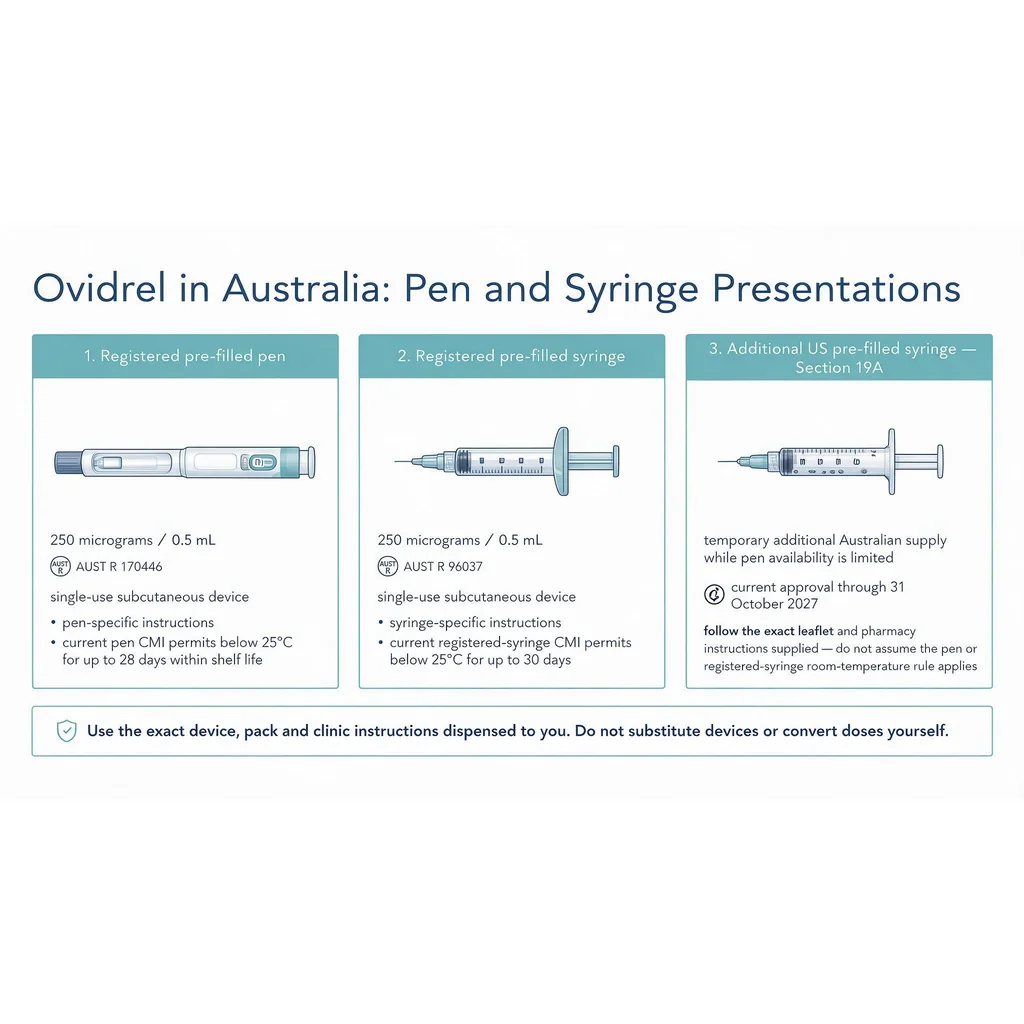
Australia currently has both a registered Ovidrel pre-filled pen and a registered Ovidrel pre-filled syringe, each containing 250 micrograms in 0.5 mL. The pen is AUST R 170446 and the registered syringe is AUST R 96037.
Because the pen is in short supply, the TGA has also authorised an additional US pre-filled syringe under Section 19A through 31 October 2027. Patients may therefore receive different presentations. Use the instructions for the exact device and pack dispensed to you.
Registered pen: refrigerate at 2°C to 8°C, protect from light and do not freeze. The current pen CMI permits storage below 25°C for up to 28 days within shelf life.
Registered syringe: refrigerate at 2°C to 8°C, protect from light and do not freeze. The current Australian syringe CMI permits storage below 25°C for up to 30 days.
Additional US syringe: follow the leaflet and pharmacy instructions supplied with that exact Section 19A product. Do not assume the room-temperature rule for the registered pen or registered syringe applies to it.
The PBS IVF Program currently lists separate choriogonadotropin alfa pen and syringe items for eligible assisted reproductive treatment. Eligibility, availability and the amount you pay can vary, so confirm the current arrangement with the clinic and pharmacy.
How is Ovidrel injected?
Ovidrel is given as a single injection under the skin, usually near the stomach. Preparation and dose-confirmation steps depend on the device supplied, so your clinic, nurse or pharmacist should train you before self-injection.
Do not transfer a pen’s needle or dose-window instructions to a syringe, or a syringe’s fixed-needle steps to a pen. Check the pack, expiry date and written trigger time, and call the clinic if the full dose cannot be confirmed.
When does Ovidrel work, and when might ovulation happen?
“About 36 hours” is a useful orientation, not a personal deadline. In a small ultrasound-monitored study of 37 stimulated IUI cycles, first follicular rupture occurred at a mean 38.3 hours after hCG, with an observed range from 34 to 46 hours. The study illustrates biological variation; it does not predict the exact hour for an individual Ovidrel cycle.
The clinic may schedule intercourse or IUI around likely ovulation, while egg retrieval is planned before spontaneous ovulation. Follicle development, hormone results and treatment purpose can change the timing.
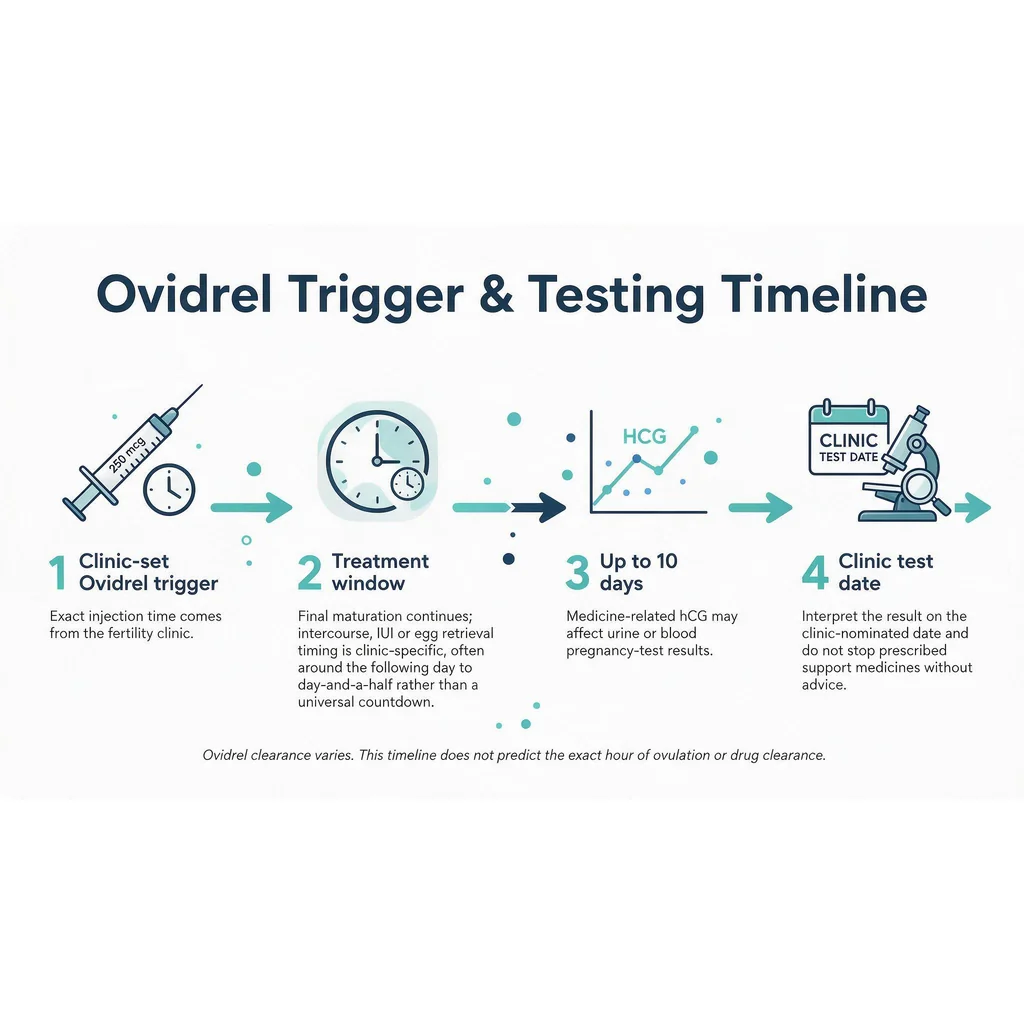
Ovidrel trigger and testing timeline
Clinic-set trigger time: Ovidrel is given after the clinic has assessed follicle development. Use the exact device, dose, date and time on the treatment instruction.
Roughly the next day to day and a half: final maturation continues and, in ovulation-induction cycles, ovulation may occur around this period. The intercourse, IUI or retrieval time still comes from the clinic.
Up to ten days after Ovidrel: medicine-related hCG may interfere with serum or urine pregnancy-test interpretation. An early positive cannot reliably distinguish the trigger from pregnancy-derived hCG.
Clinic-nominated pregnancy-test date: this is the date your fertility service wants the result interpreted within your treatment protocol. Continue prescribed support medicines until the clinic advises otherwise.
How does Ovidrel timing differ for timed intercourse, IUI and IVF?
Timed intercourse or ovulation induction
The clinic coordinates intercourse with likely ovulation after reviewing follicle development and the number of follicles present. This matters because ovarian stimulation can also change multiple-pregnancy risk.
IUI
For IUI, the trigger is coordinated with prepared sperm and the clinic’s insemination protocol. The wider IUI treatment pathway in Australia includes monitoring, sperm preparation, insemination timing and the later pregnancy-test plan, so the Ovidrel time should stay attached to those instructions.
IVF or egg collection
In IVF, Ovidrel supports final oocyte maturation before retrieval. Egg collection is deliberately scheduled before spontaneous ovulation is intended to occur, which is why an IVF trigger time should not be borrowed for a timed-intercourse or IUI cycle.

What should you do if the Ovidrel injection was late, missed, leaked or uncertain?
Contact the fertility clinic or prescribing service as soon as you notice the problem. Have the planned time, actual time, device and what happened ready, and keep the device and packaging in case the clinic or pharmacist wants to review them.
If the dose was late or missed, tell the clinic both the planned and actual times so it can decide whether the intercourse, IUI or retrieval plan needs changing. Do not recalculate the rest of the cycle yourself.
If medicine leaked or the dose is uncertain, describe what you saw and whether the device appeared to complete the injection. Do not inject another device or top up the dose without direct instruction.
If an extra dose may have been used, contact the clinic and the Poisons Information Centre on 13 11 26, a doctor or an emergency department even if you feel well.
If you think you ovulated before the trigger, tell the clinic before changing the plan. Pelvic sensations, apps and home LH results cannot identify the exact moment of ovulation, particularly after fertility medicines have altered the cycle.
How can you tell whether Ovidrel worked?
Symptoms cannot confirm that the trigger worked. Pelvic pressure, abdominal discomfort, bloating or no noticeable change can all occur; none proves follicular rupture, egg quality, fertilisation or pregnancy.
A home LH test is not a confirmation tool after the injection either. The TGA has reported that hCG can cross-react with some home-use LH devices, so an unexpectedly positive OPK can reflect the medicine rather than a natural LH surge. If your clinic asks you to use ovulation tests in another cycle, use them for the purpose and timing it specifies rather than to overrule an Ovidrel schedule.
When confirmation would change care, the clinic may use ultrasound or other protocol-specific markers of ovulation and luteal activity. Whether confirmation is required depends on the treatment plan.
Why does Ovidrel’s half-life not give you an exact safe pregnancy-test date?
The Australian Product Information reports a mean terminal half-life of about 38 hours after subcutaneous Ovidrel. A half-life describes how quickly drug concentration falls; it does not mean the medicine is gone after one or two half-lives.
For pregnancy testing, the useful medicine-specific boundary is that Ovidrel may interfere with serum or urine hCG tests for up to ten days. Clearance, urine concentration and test sensitivity vary, so day eleven is not automatically definitive.
An early negative also does not settle the cycle. Trigger-related hCG can fall below a home test’s threshold before a new pregnancy has produced enough urine hCG to detect.
How should you interpret pregnancy tests after Ovidrel?
| Result and timing | Possible explanation | Useful next step |
|---|---|---|
| Positive within ten days of the injection | Medicine-related hCG, pregnancy-derived hCG or both. | Do not use the result alone; follow the clinic’s test plan. |
| Negative before the clinic date | The trigger may be clearing while pregnancy hCG remains below the test threshold. | Wait for the scheduled test unless the clinic advises otherwise. |
| Line fades, stays similar or darkens | hCG concentration may be changing, but urine dilution, device variation and reading conditions also affect appearance. | Do not diagnose implantation, pregnancy loss or viability from line progression. |
| Positive on or after the clinic date | Pregnancy is possible. | Report the result and follow the clinic’s blood-test, medicine and ultrasound plan. |
| A new mark appears after the reading window | The device is outside its valid interpretation time and the mark may be a drying artefact. | Set the old test aside and repeat only when advised. |
A coloured line inside the valid window may indicate hCG, but during the interference period it cannot identify the source. A faint pregnancy-test line still needs to be interpreted using the trigger date, valid reading window and clinic test plan rather than line darkness alone.
A mark first noticed after the permitted reading time is different. Evaporation lines and other late test changes should not be used to turn a dried device into a new positive result.
Should you test out the Ovidrel trigger shot?
Some people test every day to watch the medicine-related line fade. This is not routine care and cannot prove implantation, pregnancy health or treatment failure.
Urine dilution, test batches, lighting, photographs and reading time can create apparent progression. If the clinic asks you to test at home, use its date and method and do not change progesterone or another support medicine because of an early home result.
What are the common Ovidrel side effects, and when could symptoms be OHSS?
Current Australian medicine information lists headache, abdominal pain or distension, nausea and vomiting among common effects, with diarrhoea and abdominal discomfort reported less commonly. Injection-site reactions can also occur. Because Ovidrel is usually given after ovarian stimulation, not every symptom can be attributed to the trigger alone.
Mild symptoms such as injection-site discomfort, headache, mild nausea or abdominal discomfort can be monitored if they are settling. Contact the clinic if they persist, worsen or concern you.
Possible ovarian hyperstimulation syndrome (OHSS) needs more attention. Severe or increasing pelvic or abdominal pain, rapidly increasing swelling or weight, repeated vomiting or diarrhoea, reduced urine or shortness of breath are reasons to contact the fertility clinic promptly. Attend an emergency department if symptoms are severe or the clinic cannot be reached.
Severe breathing difficulty, facial or tongue swelling, collapse, severe chest or abdominal pain or another life-threatening symptom requires emergency care. Call 000.
OHSS is a complication of ovarian stimulation involving enlarged ovaries and fluid shifts. It can worsen rapidly over hours or several days and may be more severe or prolonged if pregnancy occurs.

What is the Ovidrel injection success rate?
There is no single Ovidrel pregnancy or live-birth rate that applies across timed intercourse, IUI and IVF. The injection coordinates final maturation within a monitored treatment cycle; it is not an independent probability of having a baby.
Outcomes depend on age, diagnosis, ovarian response, sperm, tubal and uterine factors, treatment type, embryo factors and the denominator. A Cochrane review comparing recombinant with urinary hCG in IVF or ICSI found no clear difference in live birth or ongoing pregnancy; its evidence search was current to April 2015.
Clinic percentages are easier to compare when the denominator is clear. IVF success rates in Australia can be reported per cycle, retrieval, transfer, clinical pregnancy or live birth, and those measures should not be treated as interchangeable.
What can Ovidrel reviews and success stories tell you?
Personal accounts can show how treatment felt, but they cannot estimate your chance of ovulation, pregnancy or live birth. Reviews often omit age, diagnosis, follicle number, sperm factors, other medicines and the outcome denominator.
Ovidrel vs Pregnyl: are they the same?
No. Ovidrel contains recombinant choriogonadotropin alfa and is prescribed in micrograms. Former Australian Pregnyl 5000 IU products were hCG powder-and-diluent preparations, and the TGA records the 5000 IU vial registration as cancelled in August 2023. They are not dose-for-dose interchangeable, and hCG product availability can change.
Do not convert between micrograms and international units or substitute one trigger product for another using an old online protocol. The prescribed product, current pack and fertility-clinic instruction should govern the dose and administration.
How does Ovidrel fit with Clomid, letrozole, FSH or progesterone?
Ovidrel may follow clomifene, letrozole or injectable FSH after these medicines support follicle development. The trigger supplies the final-maturation step; it does not replace the stimulation medicine or its separate risks.
If clomifene is part of your plan, keep its separate Clomid side effects and risks in mind rather than attributing every symptom to Ovidrel. Letrozole-and-trigger and FSH-and-trigger cycles also do not have one universal pregnancy rate; monitored response and wider fertility factors still matter.
Progesterone may be prescribed after ovulation, IUI, egg retrieval or embryo transfer. Do not start, stop or change it because of symptoms or an early home test. Give the clinic and pharmacist a complete list of medicines, vitamins and supplements.
Frequently Asked Questions about Ovidrel Trigger Shots in Australia
Can Ovidrel make an ovulation test positive?
It can. The TGA has reported that hCG can cross-react with some home LH tests, so a positive ovulation test after Ovidrel may reflect the medicine rather than a natural LH surge. It cannot confirm exact ovulation or prove the trigger worked.
Does Ovidrel guarantee ovulation?
No. Ovidrel is prescribed to trigger final maturation and ovulation in selected monitored cycles, but individual response varies. Symptoms and home tests cannot prove follicular rupture, and the trigger does not guarantee fertilisation, implantation or pregnancy.
How long do Ovidrel side effects last?
Mild injection-site, headache or gastrointestinal effects are often temporary, but duration varies. Contact the clinic if symptoms persist, worsen or concern you, and seek prompt assessment for severe pain, rapid swelling or weight gain, reduced urine or breathlessness.
Does Ovidrel increase progesterone?
Ovidrel triggers luteinisation and supports formation of the corpus luteum, which produces progesterone after ovulation. Symptoms or one progesterone result still cannot confirm treatment success; the result needs interpretation within the monitored cycle.
Can Ovidrel increase the chance of twins?
Ovarian stimulation can increase multiple-pregnancy risk, and Australian Ovidrel information notes that most multiple pregnancies are twins. The important drivers include follicle number, eggs or embryos and the overall treatment protocol, not the trigger shot alone.
How much does Ovidrel cost in Australia?
Cost varies by presentation, pharmacy, prescription, treatment arrangement and PBS eligibility. The current PBS IVF Program lists separate choriogonadotropin alfa pen and syringe items for eligible assisted reproductive treatment. Confirm availability, eligibility and the current charge with the clinic and dispensing pharmacy.
Next Steps in Australia
Keep one simple treatment record with the Ovidrel presentation, dose, exact injection time, intercourse or procedure instruction, pregnancy-test date and clinic after-hours number. If the dose was late, missed, leaked, repeated or uncertain, use those details when you call the clinic rather than trying to correct the schedule yourself.
During the days after the trigger, watch for worsening pain, swelling, vomiting, reduced urine, rapid weight gain or breathlessness. Continue prescribed support medicines and use the pregnancy-test date supplied by your clinic.
When home testing is part of the clinic plan, pregnancy tests are available in strip and midstream formats, but the format does not remove Ovidrel interference. If the scheduled result is positive, the next decisions usually involve your fertility service’s blood-test, medicine and ultrasound plan, with the broader Australian steps after a positive pregnancy test becoming relevant once the clinic has interpreted the treatment result.
Last reviewed: 4 September 2026
Next scheduled review: September 2027
References
Fertility2Family articles are researched using Australian Government health guidance, current Australian medicine information, professional clinical recommendations and peer-reviewed fertility research. These references support the medicine, timing, pregnancy-testing and safety boundaries in this article.
Australian Commission on Safety and Quality in Health Care Ovidrel Pen
Current Australian CMI and PI for the Ovidrel pen covering indications, 250 microgram single-dose use, missed injections, storage, side effects, OHSS, pharmacokinetics and ten-day hCG-test interference.
Therapeutic Goods Administration OVIDREL choriogonadotropin alfa (rch) 250 microgram/ 0.5mL solution for injection pre-filled syringe (96037)
Australian Register of Therapeutic Goods record confirming active registration of the 250 microgram/0.5 mL Ovidrel pre-filled syringe, sponsor, medicine status and linked product information.
Medicines.org.au OVIDREL® Consumer Medicine Information (CMI)
Current Australian syringe CMI covering the 250 microgram single dose, subcutaneous use, device instructions, 2 to 8°C refrigeration, 30-day below-25°C storage allowance, OHSS warnings and adverse effects.
Therapeutic Goods Administration OVIDREL choriogonadotropin alfa 250 mcg / 0.5mL solution for injection pre-filled syringe (USA)
Current TGA approval for an additional US Ovidrel syringe while the pen is in short supply, including indication, approval holder and approval through 31 October 2027.
Therapeutic Goods Administration Medicine Shortages Information Initiative
Current TGA shortage record listing the Ovidrel 250 microgram/0.5 mL pre-filled pen as limited availability, with expected supply disruption through 30 September 2027 and Section 19A support.
Pharmaceutical Benefits Scheme IVF Program
Current PBS IVF Program table listing separate 250 microgram choriogonadotropin alfa pen and syringe items for eligible assisted reproductive treatment under the Section 100 program.
Therapeutic Goods Administration Medical Devices Safety Update Volume 6, Number 4, July 2018
Australian device-safety bulletin showing that hCG can cross-react with some home LH ovulation tests and cause apparent positive results that do not confirm ovulation.
Healthdirect Australia hCG test
Australian guidance on urine and blood hCG testing, early false negatives, medicine-related false positives, sample concentration and when clinician-directed confirmation may be appropriate.
Victorian Assisted Reproductive Treatment Authority Ovarian hyperstimulation syndrome
Victorian fertility guidance describing OHSS symptoms, clinic contact, emergency-department escalation, hospital treatment and why pregnancy can prolong or worsen the syndrome.
Human Reproduction Time interval from human chorionic gonadotrophin (HCG) injection to follicular rupture
Ultrasound-monitored study of 37 stimulated IUI cycles reporting first follicular rupture a mean 38.3 hours after hCG, with an observed 34 to 46-hour range.
Cochrane Database of Systematic Reviews Recombinant versus urinary human chorionic gonadotrophin for ovulation induction in assisted reproduction
Systematic review of 18 randomised studies comparing recombinant or urinary hCG for final oocyte maturation, including live birth or ongoing pregnancy, OHSS and adverse events.
Therapeutic Goods Administration PREGNYL gonadotrophin – chorionic human 5000IU powder for injection vial with diluent vial Cancelled under Section 30(1)(c) of the Act
Australian regulatory record documenting cancellation of the former Pregnyl 5000 IU powder-and-diluent registration in August 2023, supporting caution with old product-substitution and injection instructions.