On this page
At 8 DPO, it is understandable to want an answer now while also dreading a negative that may not mean much. A home pregnancy test can be positive this early, but a negative may only show that hCG was not detected by that device in that urine sample at that time. Cramps, spotting, breast changes, tiredness or no symptoms cannot settle the question.
The practical choice is whether to test today and accept that the answer may still be incomplete, or wait for a later point that is more likely to be informative. Follow your product instructions and any fertility-clinic plan when making that choice.
Quick answers about 8 DPO symptoms and pregnancy testing
Can a pregnancy test be positive at 8 DPO?
Yes, a positive is possible, but not every pregnancy will be detectable this early. Use the test only within the timing and method stated for that exact product. A valid positive shows that hCG was detected, but it does not show when implantation occurred or make the estimated DPO exact.
Does a negative test at 8 DPO rule pregnancy out?
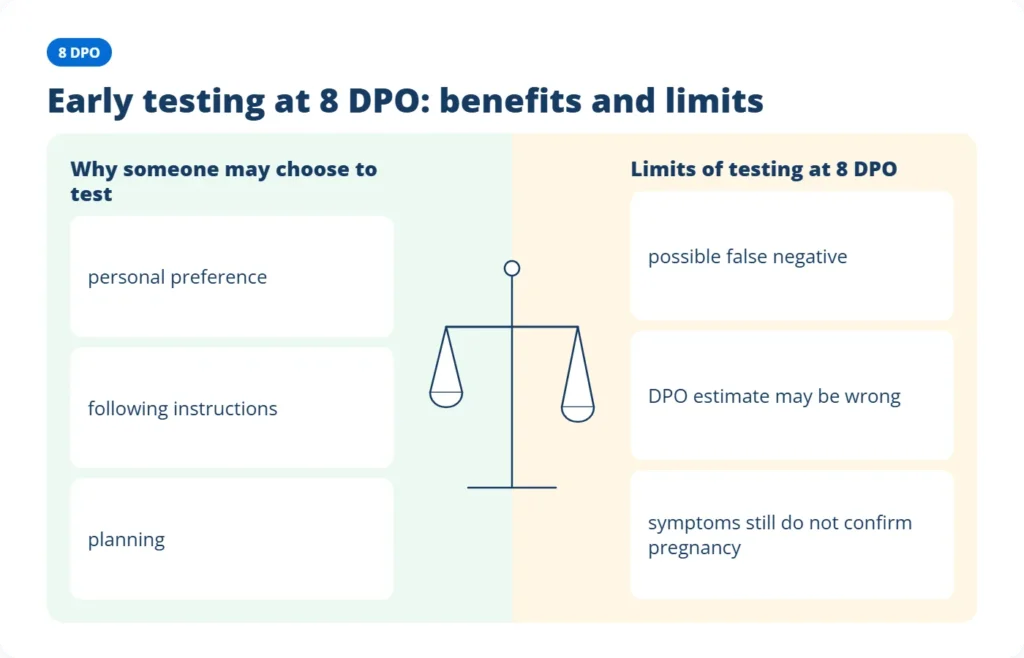
No. A valid negative means hCG was not detected by that device in that sample at that time. Estimated ovulation, implantation timing, urine concentration and device performance can all affect an early result.
Should you test today or wait?
Test today only if your exact product permits use at your current point relative to the expected period and you can accept an inconclusive negative. Otherwise choose a later point allowed by its instructions. A fertility clinic’s test date takes priority.
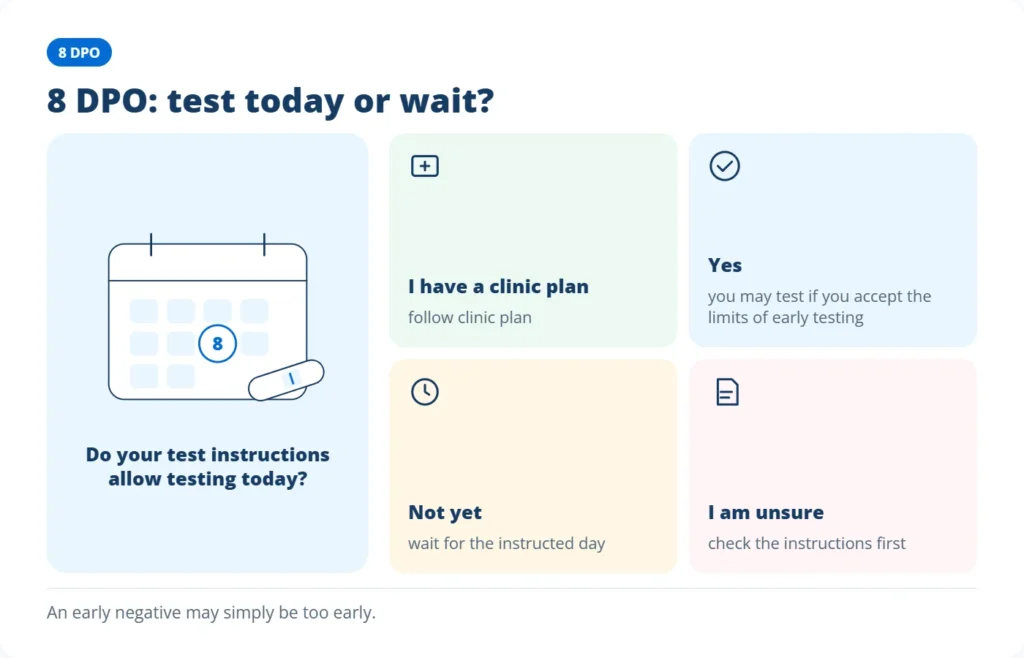
Should you take a pregnancy test at 8 DPO or wait?
When might testing at 8 DPO be a reasonable choice?
Choose this option only after checking whether your current test permits use at this point relative to the expected period. Being inside the earliest labelled window means the product allows use there. It does not guarantee that hCG will be detectable or that a negative result will settle the pregnancy question. Follow the collection, timing, control and result instructions for that device.
If you decide to test and need a device, you can compare Australian home pregnancy-test formats before testing. The label for the chosen product still controls when and how it is used.
When might waiting to test be more useful?
Choose a later point allowed by the same product, such as the expected-period date or another later date stated in its instructions, or follow the date supplied by your fertility clinic. Waiting aims for a more informative sample rather than applying a universal interval or fixed DPO rule. If you are not in a treatment cycle, the timing calculator for comparing later test dates can help you choose one practical date from the timing information you know.
How can you choose an 8 DPO testing plan you feel prepared for?
Testing today and waiting can both be reasonable choices when the exact instructions allow them. Choose the path you feel prepared to handle, including an answer that may still be uncertain.
Check the clinic or device timing, consider how you would handle a negative that leaves uncertainty, and decide what you would do next.
Our free DPO calculator can work out how many days past ovulation you are and when a pregnancy test is more likely to give a clear answer.
Why can an 8 DPO pregnancy test be uncertain?
DPO is counted from an ovulation date that is often estimated rather than observed. An app predicts from cycle history, while a positive urine LH test identifies a hormone rise that usually comes before ovulation rather than the exact moment the egg is released. If your timing clues do not line up, the DPO calculator can place them on a range without treating the estimate as exact.
Pregnancy tests detect human chorionic gonadotrophin, or hCG. After implantation begins, hCG can start to appear, but the first detectable signal varies. In a US prospective study using daily urine samples, 141 pregnancies continued for at least six weeks from the first day of the last menstrual period, and first urinary hCG detection varied across several days after ovulation. This supports biological timing variation. It was not a study of current Australian home-test performance and cannot provide your personal chance of a positive result today.
An analytical sensitivity claim tells you how little hCG a test may detect under defined conditions. It does not tell you which cycle day the product is designed to be used. Australian device evidence must support the use stated for the test, so an estimated DPO and a sensitivity figure should not be combined into a new timing rule.
If your estimate may be a day earlier, the 7 DPO guide to coping with uncertainty explains why uncertainty is still expected at that stage.
What can 8 DPO symptoms actually tell you?
Many 8 DPO sensations overlap with the usual post-ovulation phase and with early pregnancy. Cramping, spotting, breast tenderness, tiredness and discharge changes can occur for several reasons. Their presence, absence or intensity cannot confirm pregnancy or show when implantation occurred.
What if you have no symptoms at 8 DPO?
Feeling completely normal does not confirm or exclude pregnancy. Early-pregnancy experiences vary, and there is no medically useful symptom count or symptom-free pattern that can predict an 8 DPO result.
What do 8 DPO symptom stories ending in a BFP tell you?
BFP is trying-to-conceive shorthand for a positive pregnancy test. Someone may remember cramps, spotting, tiredness or no symptoms at 8 DPO and later receive a positive result. The later result does not prove that the earlier sensation was caused by pregnancy.
These self-selected stories cannot give you personal odds or identify a predictive symptom. Use your device instructions, rather than a symptom story, to decide whether to test today. The two-week-wait testing roadmap places symptom changes in the wider timeline.
How can you prepare and read one early pregnancy test correctly?
Correct technique cannot make hCG appear sooner, but it can reduce avoidable uncertainty.
- Check the intended timing, expiry date and packaging. Confirm when the product says it may be used in relation to the expected period. Do not substitute another brand’s timing claim.
- Collect the sample exactly as directed. If you are testing early, first-morning urine may be more concentrated. Avoid drinking a large amount of fluid immediately beforehand.
- Use a timer and check the control. Read the result only inside the stated window. If the required control is missing or invalid, discard that result and repeat with a fresh device according to its instructions.
- Record the useful details. Note the product, sample time, estimated DPO and when the result appeared if you may need to discuss an unexpected or unclear result with a GP or fertility clinic.

How should you interpret a positive, negative or unclear result?
What should you do after a valid positive result at 8 DPO?
If the control is valid and the product instructions classify the result as positive, contact your GP or fertility clinic for advice about confirmation and next steps.
What does a valid negative result at 8 DPO mean?
Treat a valid 8 DPO negative as non-detection in that sample at that time. Use the next testing date stated for the exact product, or the date supplied by your fertility clinic. There is no single repeat interval that applies to every device, cycle or treatment plan.
How should you handle a faint, late or unclear result at 8 DPO?
Use the product’s stated reading window, control and result definitions rather than line darkness alone. A new mark first noticed after the reading window should not be interpreted as a positive result. The guide to a faint line on a pregnancy test explains valid in-window lines, late marks and invalid results in more detail.
When should you seek medical care in Australia?
Arrange routine advice from a GP or fertility clinic when results remain unclear after following the product instructions, fertility treatment may be affecting the result, or you need help choosing a useful test date. A clinician can decide whether another urine test, blood hCG or other assessment would answer a useful question. Bleeding between periods or after sex should also be discussed with a GP, even when it is light.
Seek urgent medical attention if abdominal or pelvic pain is worsening, lasts several hours, or occurs with fever or persistent vomiting.
Severe symptoms should be assessed on their own merits, not interpreted from the DPO label. If you have severe abdominal or pelvic pain, shoulder-tip pain, heavy bleeding, marked dizziness, fainting or feel very unwell, go to the nearest emergency department or call 000 for an ambulance. Do not wait for a positive home test. A negative result does not override symptoms that need urgent assessment, and an 8 DPO estimate cannot diagnose or exclude an ectopic pregnancy.
Frequently asked questions about 8 DPO symptoms and pregnancy testing in Australia
Can cramping or spotting prove implantation at 8 DPO?
No. Cramping and spotting cannot confirm or date implantation. Use the care guidance above to assess symptoms that need medical attention.
Can an 8 DPO positive tell whether the pregnancy is healthy or whether it is twins?
The test cannot confirm either outcome. Pregnancy location, viability, gestational age and the number of embryos require different clinical information and assessment when relevant.
Why can two early pregnancy tests give different results?
Different devices, urine samples or how a test was used or read can change the result. Check each against its own instructions. If you already have two results, the 11 DPO guide to comparing changing test results explains what can be compared.
What if you do not know when your period is due?
An LH result or another ovulation clue may help estimate when ovulation occurred, but it does not establish your expected-period date or prove that a product’s early-use window applies. If the instructions depend on a date you cannot estimate, do not invent one. Ask a GP or fertility clinic when testing would answer a useful question, and arrange GP review if periods are repeatedly irregular or absent.
What if you used Ovidrel or another hCG trigger?
Use the test date given by your fertility clinic. Ovidrel may interfere with urine or serum hCG testing for up to ten days after administration, so an early positive may reflect the medicine rather than a new pregnancy. Do not change prescribed treatment without clinic advice.
Does a negative 8 DPO test change what you should do about severe pain or bleeding?
No. A negative home result, even if valid, does not exclude a serious cause of pain or bleeding. If symptoms are severe or you feel very unwell, go to the nearest emergency department or call 000 for an ambulance.
Next Steps in Australia
Keep the test or waiting date chosen under your device or clinic instructions. If you later need to interpret an early negative, the 9 DPO early-negative checklist explains the next checks without promising that another day will settle the result. A new symptom should change the plan when it needs care, not because it predicts pregnancy.
Either choice can leave uncertainty. The aim is to make one informed decision you feel prepared for, then use the chosen timing and medical-care guidance rather than repeated checking.
✓ Medically reviewed by Evan Kurzyp, RNLast reviewed Next review September 2027
References12 sources
Fertility2Family articles are researched using Australian Government health guidance, professional clinical recommendations and peer-reviewed medical literature. The references below were used to research and medically review this article and provide additional reading for readers who want to explore the evidence in more detail.
You can read how we research, write and check our health information in our editorial and medical review policy, and see who reviews our articles and their clinical credentials.
- Pregnancy, Birth and Baby.
Ovulation and fertility
Australian consumer guidance on menstrual-cycle timing, urinary LH tests and the limits of using home signs to identify an exact ovulation day.
- Healthdirect Australia.
hCG test
Australian guidance on urine and blood hCG tests, early false negatives, first-morning urine, fluid dilution, device instructions and medical follow-up for unexpected results.
- Pregnancy, Birth and Baby. Pregnancy tests
Australian consumer guidance explains that home tests detect hCG, advises following the device instructions and expiry date, and says testing is generally more reliable from the day the period is due. - Better Health Channel.
Pregnancy stages and changes
Victorian public-health guidance explaining that early-pregnancy experiences vary and may include many, few or no symptoms, so symptoms alone cannot confirm pregnancy.
- Pregnancy, Birth and Baby. Early signs of pregnancy
Australian consumer guidance describes missed periods, nausea, breast changes and tiredness as possible early signs, while noting that some people may not feel different from usual. - Healthdirect Australia.
Bleeding between periods
Australian guidance on possible causes of spotting and bleeding between periods, advice to discuss intermenstrual or post-sex bleeding with a doctor, and emergency action for very heavy bleeding or faintness.
- Therapeutic Goods Administration.
Meeting clinical evidence requirements for in-vitro diagnostic (IVD) medical devices
Australian regulatory guidance explaining that analytical and clinical evidence must support intended use, and that a missing pregnancy-test control makes the result invalid and requires retesting with another device.
- New England Journal of Medicine.
Time of implantation of the conceptus and loss of pregnancy
US prospective daily-urine study showing variation in first hCG detection; the analysed continuing-pregnancy cohort lasted at least six weeks from the first day of the last menstrual period.
- Healthdirect Australia.
Irregular periods
Australian guidance on unpredictable or absent periods, cycle recording and GP assessment when irregularity persists or makes pregnancy timing difficult to interpret.
- Australian Commission on Safety and Quality in Health Care.
Ovidrel Pen
Current Australian medicine information stating that Ovidrel may interfere with serum or urine hCG measurement for up to ten days after administration and cause a false-positive pregnancy test.
- Healthdirect Australia.
Abdominal pain
Australian guidance separating severe-pain emergency care from urgent attention for worsening pain, pain lasting several hours, or abdominal pain with fever or persistent vomiting.
- Healthdirect Australia.
Ectopic pregnancy
Australian guidance on ectopic-pregnancy symptoms, diagnostic assessment and emergency access, including heavy bleeding, strong pain, shoulder-tip pain, dizziness, faintness and feeling unwell.