
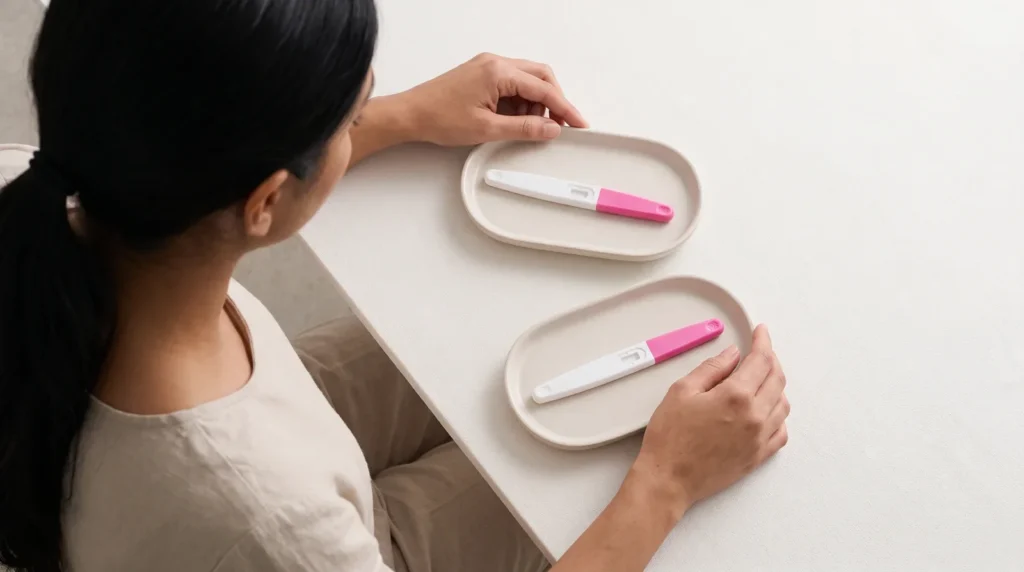

An 11 DPO pregnancy test may be negative, positive or unclear, and it may not match an earlier result. A valid negative at an estimated 11 DPO can still be early. A valid positive is a reason to move from home testing to GP or fertility-clinic follow-up, not to build a series of darker lines.
When results differ, first establish whether both tests were fresh, in date, valid and read on time. Check what the two results can tell you, what they cannot show and whether the sequence changes the next care step.
Symptoms can be real without settling the pregnancy question. The next decision depends on the test sequence, confidence in the ovulation estimate, device instructions, fertility-treatment context and whether pain or bleeding changes the care pathway.
Quick answers about 11 DPO pregnancy tests
What can changing 11 DPO pregnancy-test results mean?
An earlier negative followed by a later valid positive can fit hCG becoming detectable. A later negative or unclear result does not automatically cancel an earlier valid positive. That reverse sequence needs prompt GP or fertility-clinic advice rather than delaying contact to build a longer home-test series.
What makes two home pregnancy tests comparable?
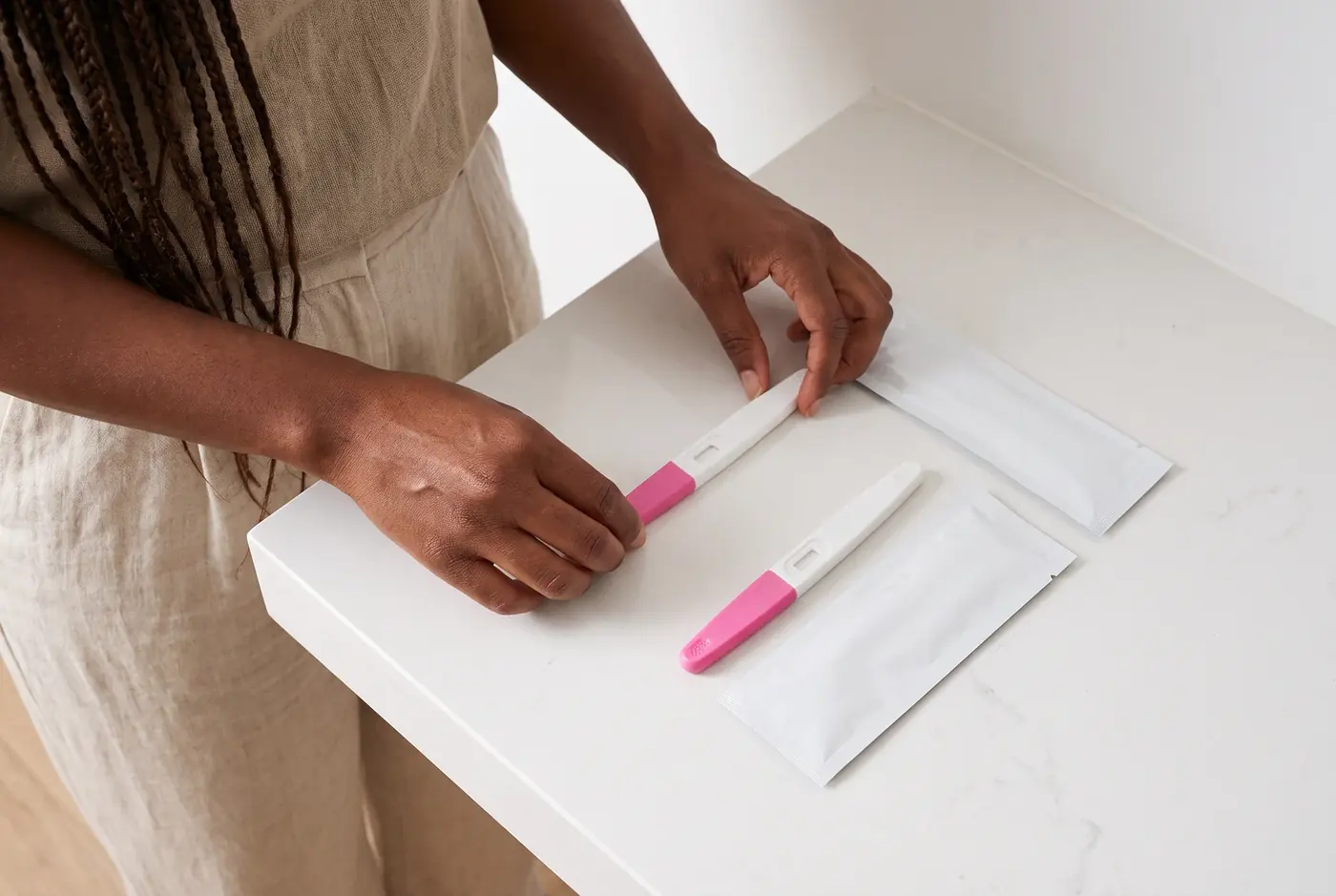
Both tests should be fresh, in date, used correctly, show the required control and be read within the stated window. Different devices and sample conditions can produce different appearances. Line darkness and photographs cannot establish an hCG trend, pregnancy location or viability.
When should changing results lead to medical care?
After any valid positive, including a faint positive, arrange GP or fertility-clinic confirmation. Contact them promptly after a positive-then-negative or unclear sequence, or when treatment-related hCG may affect interpretation. Seek urgent medical attention for worsening or several-hour abdominal or pelvic pain, or pain with fever or persistent vomiting. For severe pain, heavy bleeding, shoulder-tip pain, marked dizziness, faintness or feeling very unwell, go to an emergency department or call 000.
What does 11 DPO mean, and how certain is the date?
DPO means days past ovulation. Ovulation day is 0 DPO, so 11 DPO is eleven calendar days after the best available estimate of ovulation. It is a trying-to-conceive timing label, not the gestational-age system used in Australian pregnancy care.
The estimate may come from an app, a positive LH test, a basal body temperature shift or clinic monitoring. These methods provide different levels of confidence, and none should be treated as proof of one exact ovulation hour. Fertility2Family’s DPO calculator can organise those clues without turning a range into false precision.
Why can an 11 DPO result differ from an earlier test?
Home pregnancy tests are qualitative devices. They show whether hCG reached the device threshold in that urine sample. Near the detection limit, biological timing, device performance and sample conditions can contribute to different valid results, but they cannot diagnose the reason one person’s result changed.
Two analyses published in 2026 from the North American PRESTO cohort used self-reported testing data collected from 2018 to 2024. One associated very early testing with more negative-before-positive and positive-before-negative sequences. The companion analysis estimated sensitivity by timing relative to reported expected menstruation and cycle length among participants who detected pregnancy, with missing daily results imputed. They analyse the same underlying cohort, not independent replication, and do not provide a personal probability or validate current Australian devices.
How should you compare an earlier and later fresh test?
What can an earlier negative and a later positive at 11 DPO show?
Earlier fresh test: The control is valid and the result is negative within the stated reading window.
Later fresh test: The control is valid and a positive result appears within the stated reading window.
What the pair supports: The later result supports that hCG was detected in the later sample. It does not prove why the earlier result was negative, identify implantation timing or show that a pregnancy is developing normally.
If the sequence is reversed: An earlier valid positive followed by a negative or unclear test should lead to prompt GP or fertility-clinic contact. Do not wait for repeated conflict or assume the later result is correct because it is newer. A clinician can decide whether repeat urine testing, blood hCG or another assessment is useful.
Only results with a valid control and an on-time reading belong in this comparison. A mark first noticed after the reading window is not a new valid result.
A result from the 10 DPO guide to checking a test result may be the first half of the pair. If you test again, use the 12 DPO expected-period decision grid and keep the original test details rather than assuming that a new calendar date automatically settles the sequence.
How should you record changing pregnancy-test results at 11 DPO?
It is understandable to compare two tests when the results seem to change. Recording the conditions around each fresh test is more useful than judging line darkness or trying to read a biological trend from a photo.
Record the date, sample conditions, device validity, reading time and actual result for each fresh test so you can compare the two records.
This interactive guide keeps answers in the browser and does not diagnose pregnancy or replace medical care.
[f2f_dpo_tool id=”10″]
How do you check whether a pregnancy test is valid?
Check the expiry date, collection method, required control and reading window for that exact device. If the required control is absent or the device reports an error, the result is invalid, not negative. Discard it and use a fresh, unexpired device according to its instructions.
A faint line that appears on time can be positive when the device instructions classify it that way. Arrange GP or fertility-clinic confirmation and use the dedicated guide to valid within-window faint lines for help interpreting that device’s result. A mark noticed only after the window should be set aside; the evaporation-line guide explains that out-of-window result.
A photograph can document appearance, but images and line darkness cannot establish an hCG trend, pregnancy location or viability.

What does a negative pregnancy test at 11 DPO mean?
A valid negative means that device did not detect hCG in that sample. At an estimated 11 DPO, the result can still be early.
Follow the repeat-testing instructions for the exact device. Use the expected-period date to place testing in context and choose the next step, not to reinterpret what the sample measured. Actual timing since ovulation and implantation, sample conditions and device performance matter.
If another device is needed, you can compare pregnancy-test formats before your planned repeat. Different formats are not directly interchangeable, so follow the replacement device’s own instructions.
Sample conditions can affect detectability, but they cannot identify why a particular result was negative. If your period is late and fresh tests remain negative, review the main false-negative pregnancy-test causes, then use the no-period and negative-test pathway for the next clinical decision.
If your period remains absent and negative results persist to an estimated 16 DPO, use the 16 DPO guide to a negative test and no period.
What should you do after a positive result at 11 DPO?
After any valid positive, including a faint positive interpreted according to the device instructions, arrange confirmation and follow-up with a GP or fertility clinic. The result supports that hCG was detected, but it cannot establish pregnancy location, gestational age, viability or progression.
A positive result can bring relief, excitement or new uncertainty. Fertility2Family’s positive-pregnancy-test pathway explains the next Australian care steps after you make contact.

What can 11 DPO symptoms, or no symptoms, tell you?
Cramping, breast tenderness, bloating, tiredness, headache and constipation can occur before a period and may also be noticed in early pregnancy. Nausea can have non-pregnancy causes, while discharge changes are not a validated way to identify pregnancy or implantation. None of these experiences can confirm pregnancy at 11 DPO.
Feeling no different cannot answer the pregnancy question either. Having no symptoms does not make an early negative final, and a long symptom list does not establish that a later result will be positive. Light spotting cannot confirm implantation from timing or appearance alone.
If you prefer to follow the wider post-ovulation pattern without turning each sensation into a pregnancy score, the two-week-wait guide to timing and next steps places symptoms and testing in context.
What changes after embryo transfer or an hCG trigger?
General DPO advice should not override a fertility clinic’s testing plan. Days after embryo transfer are counted from a procedure that occurs after several days of embryo development, so 11 DPO is not interchangeable with 11dp5dt or another transfer-day label.
Some trigger medicines contain hCG. Current Australian Ovidrel information states that it may interfere with serum or urine hCG testing for up to ten days after administration and produce a false-positive result. Keep the medicine date with the test sequence, follow the clinic’s nominated test date and do not stop progesterone or another prescribed medicine unless the treating team advises it. The Ovidrel and trigger-shot guide provides the medicine-specific context.
When should you get medical advice in Australia?
When should you contact a GP or fertility clinic about changing results?
Contact a GP or fertility clinic promptly when an earlier valid positive is followed by a negative or unclear result, fresh tests remain inconsistent, a period is late despite negative tests, or fertility treatment could be affecting the result. A clinician can decide whether repeat urine testing, blood hCG testing or another assessment would answer the actual question.
Which symptoms need urgent medical assessment at 11 DPO?
Seek urgent medical attention for abdominal or pelvic pain that is worsening, has lasted several hours, or occurs with fever, persistent vomiting or feeling increasingly unwell. These symptoms have several possible causes and should be assessed on their own merits rather than explained by a DPO label.
Which symptoms need emergency care at 11 DPO?
For severe abdominal or pelvic pain, heavy bleeding, shoulder-tip pain, marked dizziness, faintness or feeling very unwell, go to the nearest emergency department or call triple zero on 000 for an ambulance. These symptoms do not diagnose ectopic pregnancy from an 11 DPO label. A negative home test must not delay symptom-based assessment.

Frequently asked questions about 11 DPO pregnancy tests in Australia
Does the expected-period date change what an 11 DPO test measured?
No. The expected-period date helps place testing in context and choose the next step under the device instructions. It does not alter the measured result or, by itself, establish different pregnancy likelihood at the same well-supported DPO.
Can a digital test disagree with a line test at 11 DPO?
Yes. The formats and detection thresholds can differ, and a digital display removes the need to interpret test lines rather than adding biological certainty. Check each device’s validity. If one result was a valid positive and the other is negative or unclear, contact a GP or fertility clinic promptly.
Is first-morning urine essential for every 11 DPO test?
Not for every test, but it can make low hCG easier to detect when testing early. A valid later-day negative is still a negative result for that sample. It should not be called invalid solely because it was not taken in the morning.
Should you use the same pregnancy-test brand when repeating?
It is not essential. Using the same format can remove one avoidable difference, but it does not turn line darkness into a clinical measurement. Follow the current instructions for every test, even when the brand is unchanged.
What do BFN and BFP mean at 11 DPO?
BFN means a negative pregnancy test and BFP means a positive pregnancy test in trying-to-conceive shorthand. Other people’s BFN-to-BFP stories describe possible sequences, but they cannot predict your result or explain why a test changed.
Can a blood hCG test settle changing home-test results?
It can add useful information, and a clinician may use one or more blood tests depending on the timing, symptoms and question being investigated. One blood hCG value alone cannot establish pregnancy location or answer every question about development.
Next Steps in Australia
Keep the details that improve the next decision: the date and time of each test, device format, control result, reading time, expected-period date and any hCG trigger date. Use that short sequence, rather than photographs of dried tests, when you follow the device instructions or contact a GP or fertility clinic. Concerning symptoms take priority over the testing calendar.
Changing results can be hard to interpret from memory. A short record gives you something concrete to use without asking line darkness to answer questions it cannot settle.
Last reviewed: 5 September 2026
Next scheduled review: September 2027
References
Fertility2Family articles are researched using Australian Government health guidance, professional clinical recommendations and peer-reviewed medical literature. The references below were used to research and medically review this article and provide additional reading for readers who want to explore the evidence in more detail.
Healthdirect Australia. Human chorionic gonadotropin (hCG) test – pregnancy
Australian guidance on qualitative and quantitative hCG testing, early false-negative results, first-morning urine and clinical assessment when a home result appears incorrect or needs confirmation.
Better Health Channel, Victorian Department of Health. Pregnancy testing
Victorian guidance on home-test timing, instructions, device sensitivity, faint positive results and arranging medical confirmation after a positive or apparently inaccurate result.
Pregnancy, Birth and Baby. Ovulation and fertility
Australian guidance on ovulation timing, urinary LH testing, cervical mucus and basal body temperature, supporting cautious interpretation of an estimated DPO date.
Obstetrics & Gynecology. Pregnancy Test Use and Timing of Pregnancy Detection in a Prospective Cohort of Pregnancy Planners
A 2026 analysis of self-reported 2018 to 2024 PRESTO data linking very early testing with more negative-before-positive and positive-before-negative sequences, without predicting an individual’s outcome.
Fertility and Sterility. Home Pregnancy Test Sensitivity by Test Timing and Cycle Length with Real-World Use Among Pregnancy Planners who Conceived
A second 2026 analysis from the same 2018 to 2024 PRESTO cohort estimating sensitivity by reported expected menstruation and cycle length, with missing daily results imputed.
Better Health Channel, Victorian Department of Health. Pregnancy – signs and symptoms
Victorian guidance describing early pregnancy symptoms while emphasising that nausea, breast changes, tiredness and other symptoms can also have non-pregnancy causes.
Better Health Channel, Victorian Department of Health. Premenstrual syndrome (PMS)
Victorian guidance on premenstrual cramping, breast tenderness, bloating, headache, constipation and tiredness, supporting the symptom overlap near an expected period.
Healthdirect Australia. Abdominal pain – causes, self-care and treatments
Australian triage guidance for worsening or several-hour abdominal pain, pain with fever or persistent vomiting, and severe pain requiring emergency-department or 000 access.
Healthdirect Australia. Ectopic pregnancy
Australian guidance on bleeding, abdominal or shoulder-tip pain, nausea, dizziness and faintness, including emergency-department or ambulance access for concerning symptoms.
Therapeutic Goods Administration. Meeting clinical evidence requirements for in-vitro diagnostic (IVD) medical devices
Australian regulatory guidance on IVD performance, user verification and instructions, supporting the requirement to treat a missing control or device error as an invalid result.
Australian Commission on Safety and Quality in Health Care. Ovidrel Pen
Current Australian medicine information stating that Ovidrel may interfere with serum or urine hCG testing for up to ten days after administration and cause a false-positive result.
Better Health Channel, Victorian Department of Health. Assisted reproductive technology – IVF and ICSI
Victorian guidance showing that embryos develop in the laboratory before transfer, supporting separate interpretation of post-transfer dates and spontaneous-conception DPO.