


Taking prenatal vitamins when not pregnant is usually possible, but that does not mean you need one. If you are standing in the supplement aisle comparing bottles, the useful question is whether the label gives you nutrients you actually need, at a suitable dose, without unnecessary duplication. For Australians planning pregnancy, folic acid and iodine are the clearest routine priorities. Iron, vitamin D and other nutrients are more individual. If pregnancy is not planned, a pregnancy-specific multivitamin may offer little benefit and can add cost, side effects or nutrients you do not need.
Quick answers about prenatal vitamins when not pregnant
Can I take prenatal vitamins if I am not pregnant?
Usually, yes, but that does not mean you need one. If you are planning pregnancy, a suitable prenatal or targeted folic acid and iodine can cover important preconception needs. If you are not planning pregnancy, check whether the extra iron and other pregnancy-focused nutrients are useful for you before taking one long term.
What are the benefits of prenatal vitamins when not pregnant?
The clearest evidence-backed benefit is preconception nutrition. Folic acid taken before conception reduces neural tube defect risk, and Australian guidance recommends iodine when considering pregnancy. Claims that prenatal vitamins improve fertility, hair or nails are not a reason to choose them.
What side effects can prenatal vitamins cause when not pregnant?
Side effects depend on the formula. Iron can cause nausea or constipation, excessive or duplicated nutrients can create avoidable exposure, and iodine needs individual advice when thyroid disease is present. A pharmacist can also check medicines and supplement combinations.
Prenatal vitamin label checker
Prenatal vitamin label quick audit
Check prescribed plans, core nutrients, duplicate products and vitamin B6 symptoms before the full multi-product audit.
About 2 minutes
Prenatal vitamin label quick audit
Check prescribed plans, core nutrients, duplicate products and vitamin B6 symptoms before the full multi-product audit.
Private: answers are processed only in this browser.
When a prenatal makes sense, and when it may not
A prenatal multivitamin is a format, not a diagnosis or a treatment. The reason for taking it matters more than the label on the front of the bottle.
| Your situation | What usually matters most |
|---|---|
| You are actively planning pregnancy | Start preconception folic acid and check iodine. A prenatal can be convenient if its complete label suits your needs. |
| Pregnancy is possible but not currently planned | Discuss folic acid needs and your overall supplement routine rather than assuming a high-iron prenatal is the best everyday multivitamin. |
| You are not pregnant and are not planning pregnancy | A prenatal may be unnecessary. Compare the formula with your diet, deficiencies, medicines and a standard multivitamin if you use one. |
| You have thyroid disease, anaemia, malabsorption, previous bariatric surgery or regular medicines | Get individual advice before changing iodine, iron, folic acid or multiple supplements. |
Use the six-point Australian prenatal label audit
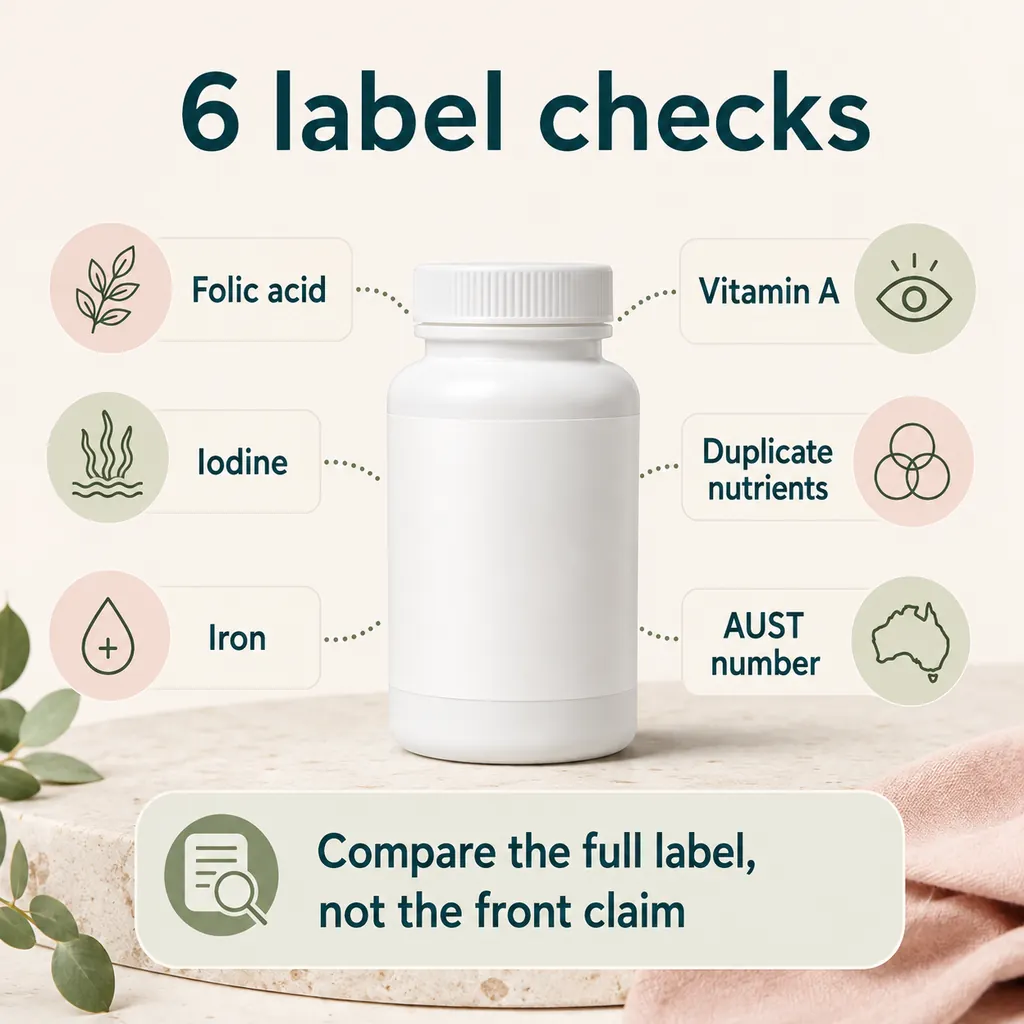
The ingredient panel is where the useful decision happens. Use the interactive audit above, then check these six items before buying or combining products.
| Check | What to look for | Why it matters |
|---|---|---|
| 1. Folic acid | The daily micrograms from every supplement combined | Australian guidance recommends folic acid before conception and through early pregnancy. Higher prescribed doses are for selected clinical situations, not for self-stacking tablets. |
| 2. Iodine | Usually 150 micrograms daily when considering pregnancy | Australian guidance recommends supplementation around pregnancy planning, but thyroid disease can change the advice and kelp products can deliver variable iodine. |
| 3. Iron | The amount included and whether you have a reason to need extra iron | Iron needs rise in pregnancy, but more is not automatically better. Blood results, diet, symptoms and clinical history help guide treatment decisions. |
| 4. Vitamin A | Whether vitamin A is present as preformed vitamin A or retinol, and the total amount across products | Excess preformed vitamin A can be harmful around pregnancy. Avoid stacking separate vitamin A or liver-oil supplements without professional advice. |
| 5. Duplication | Folic acid, iodine, iron, vitamin D, vitamin B6, zinc and other repeated nutrients | A prenatal plus a general multivitamin, beauty supplement, powder or separate mineral can unintentionally duplicate doses. |
| 6. Australian regulation and extras | AUST L, AUST L(A) or AUST R, complete ingredients, directions, warnings and herbal blends | An AUST number identifies the medicine pathway. It does not mean every fertility marketing claim has the same level of pre-market efficacy assessment. |
Folic acid: start before conception, even though Australian pages use different lead times
Australian sources agree on the important point: folic acid should begin before conception when possible. FSANZ advises at least 400 micrograms daily from at least one month before conception through the first three months. Pregnancy, Birth and Baby also uses preconception guidance, with some current planning material encouraging people to begin about 12 weeks before trying. These are not competing biological cut-offs. They are different practical lead times built around the same goal: have folic acid on board before the earliest weeks of pregnancy.
If you are already trying, or you have already had a positive pregnancy test, do not delay simply because you missed a three-month lead-in. Start appropriate folic acid as soon as practical and ask whether your health history means you need a prescribed higher dose. Do not create a 5 mg dose by taking multiple over-the-counter prenatal tablets.

Iodine: usually recommended before pregnancy, with an important thyroid exception
Australian guidance recommends a supplement containing 150 micrograms of iodine each day for people who are considering pregnancy, pregnant or breastfeeding. The reason is not that every Australian diet is deficient. It is that pregnancy and breastfeeding increase iodine requirements, while food intake can vary.
If you have a thyroid condition, seek individual advice before starting or changing iodine. FSANZ also advises against relying on kelp or seaweed supplements because their iodine content can vary. This is a good example of why “natural” and “prenatal” are not enough information on their own.
Iron: check the reason for the dose, not just the number on the label
Iron is important for making haemoglobin and iron requirements increase during pregnancy. That does not make the highest-iron prenatal the best choice for every person before pregnancy. Australian care commonly uses history and blood testing to identify anaemia or iron deficiency, and iron supplements can cause nausea or constipation.
Research on routine iron supplementation shows potential benefits for reducing iron deficiency and iron-deficiency anaemia, including in populations starting pregnancy with normal iron status. For an Australian consumer choosing a prenatal, the practical conclusion is more modest: do not add extra iron or choose a high-dose product simply because “more” sounds safer. If you have heavy periods, a history of anaemia, a restrictive diet, gastrointestinal disease or symptoms that concern you, ask whether blood tests are appropriate.

Vitamin A and duplicate supplements are easy places to make an avoidable mistake
Vitamin A is essential, but excess preformed vitamin A can be harmful around pregnancy. Read the ingredient form and the total daily amount rather than treating every form of vitamin A as identical. Avoid casually stacking a prenatal with separate retinol or liver-oil supplements.
Duplication is not limited to vitamin A. Folic acid, iodine, iron, vitamin D, vitamin B6, zinc and selenium can appear in several products at once. If you use a prenatal, a general multivitamin, a hair or skin supplement, magnesium, protein powder or another “wellness” product, add the daily totals before assuming the combination is harmless.

What AUST L, AUST L(A) and AUST R actually tell you
Australian medicine labels can display AUST L, AUST L(A) or AUST R. The identifiers connect products with the Australian Register of Therapeutic Goods, but the pathways differ.
- AUST L: the sponsor self-certifies that the listed medicine meets relevant legislative requirements. The product is not pre-market assessed by the TGA for efficacy.
- AUST L(A): the assessed listed pathway includes pre-market assessment of efficacy evidence for the product indications, while the sponsor certifies quality and safety requirements.
- AUST R: registered medicines undergo a higher level of pre-market assessment and are also assessed for efficacy.
An AUST number is useful regulatory information, not proof that every fertility or pregnancy marketing phrase has proven clinical benefit.
Review medicines, thyroid history and other conditions at the same time
Bring the complete supplement list to a pharmacist or GP if you use prescription medicines, have a thyroid condition, have been treated for anaemia or nutrient deficiency, have malabsorption or previous bariatric surgery, or are receiving fertility treatment. Include gummies, powders, herbal products and products you only take occasionally.
A pharmacist can review ingredients, side effects and medicine interactions using Australian information. Do not stop a prescribed medicine abruptly because a supplement label or online article mentions pregnancy. The benefit of treating the underlying condition and the risks of changing treatment need to be considered together.

Do prenatal vitamins improve fertility, hair or nails?
A prenatal vitamin can help meet nutrient needs, but it is not an infertility treatment. Australian infertility guidance uses clinical assessment and appropriate investigations when conception is taking longer than expected.
Clinical consumer guidance does not support taking a prenatal simply for thicker hair or stronger nails. If hair loss, brittle nails or persistent fatigue is the concern, investigate the cause rather than using a pregnancy-specific multivitamin as a substitute for assessment.
A six-step shopping checklist before you buy
- Confirm why you are taking the supplement: pregnancy planning, a diagnosed deficiency, or another reason.
- Check the total daily folic acid and iodine across every product you use.
- Check whether iron is included and whether that amount fits your history, diet and blood results.
- Check the vitamin A form and avoid unnecessary duplicate retinol or liver-oil products.
- Check every extra ingredient, warning, direction and AUST identifier rather than relying on the front-label promise.
- If medicines, thyroid disease, anaemia, malabsorption or fertility treatment apply, ask a pharmacist, GP or treating team before combining products.
Frequently Asked Questions about prenatal vitamins when not pregnant in Australia
Can I take prenatal vitamins if I am not trying to conceive?
Usually, there is no pregnancy-specific reason to use a prenatal if you are not pregnant and are not trying to conceive. Compare the formula with your diet, medicines and any diagnosed deficiencies; a prenatal may add iron or other nutrients you do not need.
Are pregnancy vitamins better than a regular multivitamin when not pregnant?
Not automatically. Pregnancy or prenatal vitamins are formulated around pregnancy-related nutrient needs and often contain more folic acid and iron. The better choice depends on why you are supplementing and the complete daily dose.
How long can I take prenatal vitamins if I am not pregnant?
There is no single useful time limit for everyone. If pregnancy is not planned, review long-term use rather than continuing by default, especially if the product contains iron or overlaps with other supplements.
When should I start prenatal vitamins before pregnancy?
Start appropriate preconception supplementation as soon as pregnancy is being planned. Current Australian sources use lead times from at least one month to about 12 weeks before trying.
Can I take prenatal vitamins with other supplements?
Sometimes, but add up folic acid, iodine, iron, vitamin A, vitamin D, vitamin B6, zinc and other repeated nutrients first. A pharmacist can check duplication and medicine interactions.
Do prenatal vitamins help you get pregnant?
They can support nutrient intake, but they are not an infertility treatment and cannot guarantee ovulation, conception or pregnancy. Fertility concerns need an appropriate assessment pathway.
Next Steps in Australia
Photograph the front label, ingredient panel and directions of every supplement you use. Run the six-point audit and add up duplicated nutrients before deciding whether the product solves a real need.
If conception is taking longer than expected, use the Australian fertility-referral guide, female fertility assessment guide or male fertility assessment guide rather than treating a supplement as the next diagnostic step.
Last reviewed: 14 August 2026 Next scheduled review: August 2027
References
Fertility2Family articles are researched using Australian Government health guidance, professional clinical recommendations and peer-reviewed medical literature. The references below were used to research and medically review this article and provide additional reading for readers who want to read the evidence in more detail.
Pregnancy, Birth and Baby Vitamins and supplements during pregnancy Australian Government-funded guidance on folic acid, iodine, iron, vitamin D, calcium, vitamin A safety, pregnancy multivitamins and when individual clinical advice is appropriate.
Pregnancy, Birth and Baby Planning for your pregnancy Australian preconception guidance covering preparation before pregnancy, folic acid and iodine, medicines, health conditions, vaccinations, lifestyle factors and when to arrange a pre-pregnancy health review.
Pregnancy, Birth and Baby Preconception health for females Australian consumer guidance on preconception health, supplements, medicines, health conditions, testing and pregnancy preparation, including reasons some people need individualised advice before conception.
Pregnancy, Birth and Baby Medicines during pregnancy Australian guidance on prescription, over-the-counter and complementary medicines, including the need to review benefits, risks and medicine changes with a doctor or pharmacist.
Pregnancy, Birth and Baby Pharmacists – what do they do? Australian guidance explaining how pharmacists can review medicines, supplements, side effects, local dosing information and drug interactions for people planning pregnancy, pregnant or breastfeeding.
Pregnancy, Birth and Baby Anaemia in pregnancy Australian guidance on anaemia and iron deficiency in pregnancy, blood-test assessment, treatment with iron when indicated, and common gastrointestinal side effects such as nausea and constipation.
Food Standards Australia New Zealand Folic acid/folate and pregnancy Australian and New Zealand food authority guidance recommending at least 400 micrograms of folic acid before conception, explaining timing, fortification and why general multivitamins can create unnecessary nutrient exposure.
Food Standards Australia New Zealand Iodine and pregnancy Australian and New Zealand food authority guidance recommending 150 micrograms of iodine when considering pregnancy, pregnant or breastfeeding, with thyroid-condition cautions and advice against kelp supplements.
Food Standards Australia New Zealand Pregnancy and healthy eating Current Australian nutrition guidance covering folate, iodine and iron needs, food sources, supplement context and the importance of beginning healthy pregnancy nutrition as early as practical.
Healthdirect Australia Vitamin A and your health Australian Government-funded health information on vitamin A forms, dietary sources, toxicity risk and why excess preformed vitamin A is an important safety consideration around pregnancy.
Queensland Health During pregnancy Queensland clinical guidance covering folic acid, iodine, iron, vitamin D and nutrition in pregnancy, including Australian practice considerations around iron testing and supplementation.
Therapeutic Goods Administration AUST numbers on medicine labels TGA guidance explaining AUST R, AUST L and AUST L(A) identifiers, their connection with the Australian Register of Therapeutic Goods and differences in efficacy assessment.
Therapeutic Goods Administration About assessed listed medicines TGA guidance explaining assessed listed medicines, AUST L(A), low-risk ingredients, intermediate indications and the pre-market efficacy assessment that distinguishes this pathway from ordinary listed medicines.
Therapeutic Goods Administration Listed and assessed listed medicines: application and submission user guide Current TGA guidance describing sponsor self-certification for AUST L medicines and the additional pre-market efficacy evidence assessment required for AUST L(A) assessed listed medicines.
Seminars in Reproductive Medicine (2022) A Systematic Review of Clinical Guidelines for Preconception Care Peer-reviewed systematic review of clinical guidelines for preconception care, including recommendations relevant to nutritional supplementation, medicines, chronic conditions and preparation before pregnancy.
JAMA (2023) Folic Acid Supplementation to Prevent Neural Tube Defects: Updated Evidence Report and Systematic Review for the US Preventive Services Task Force Peer-reviewed systematic review evaluating benefits and harms of periconceptional folic acid supplementation for prevention of neural tube defect-affected pregnancies and contemporary preventive recommendations.
Acta Obstetricia et Gynecologica Scandinavica (2023) Iron supplements in pregnant women with normal iron status: A systematic review and meta-analysis Peer-reviewed systematic review and meta-analysis examining benefits and harms of iron supplementation among pregnant women who began pregnancy with normal iron status.
Journal of Trace Elements in Medicine and Biology (2023) Effects of iodine supplementation on thyroid function parameter: Systematic review and meta-analysis Peer-reviewed systematic review and meta-analysis examining iodine supplementation and thyroid function parameters, including pregnancy-related evidence relevant to cautious, individualised iodine advice.
The Medical Journal of Australia (2024) Recommendations from the 2024 Australian evidence-based guideline for unexplained infertility: ADAPTE process from the ESHRE evidence-based guideline on unexplained infertility Australian evidence-based guideline summary covering infertility definition, diagnostic work-up and treatment, supporting a clear boundary between preconception nutrition advice and fertility assessment or therapy.
Mayo Clinic Prenatal vitamins: OK for women who aren’t pregnant? Clinical consumer guidance directly addressing prenatal vitamins when not pregnant, including limited reasons for use outside pregnancy planning, nutrient excess concerns and unproven hair or nail claims.