
Is my prenatal vitamin right for Australia?
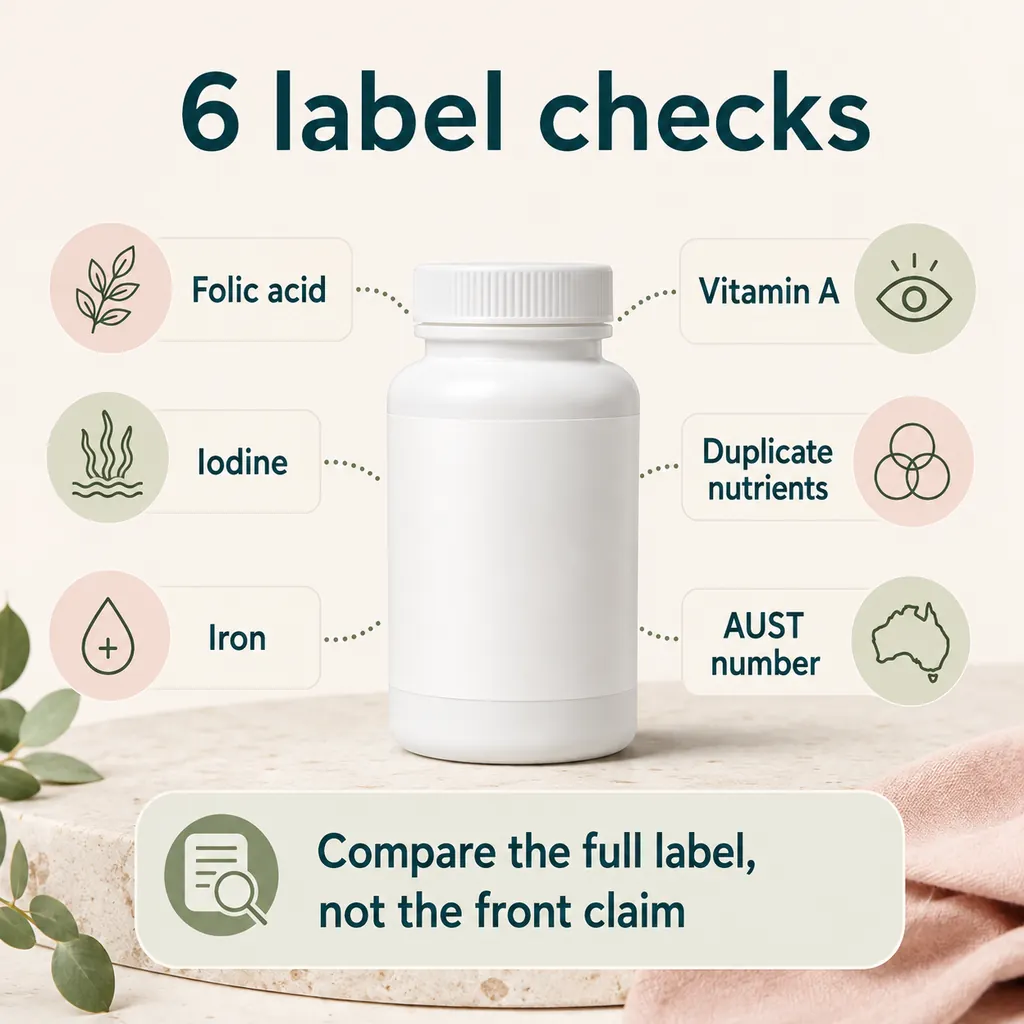
Australian guidance centres on 400 micrograms of folic acid and 150 micrograms of iodine daily before and during early pregnancy. Check those two lines first, then vitamin A and duplicates.

Prenatal Vitamin Label Checker
Use this checker to read a prenatal vitamin label against Australian guidance.
Everything behind the result
 How this tool worksWhy two lines on the label matter more than the other twenty
How this tool works
Why two lines on the label matter more than the other twenty
Australian guidance centres on two numbers: 400 micrograms of folic acid and 150 micrograms of iodine daily, starting a month before trying. Most labels bury them among twenty other lines.
Enter what your label says and the checker marks each key nutrient against the Australian recommendation and flags vitamin A and duplication risks.
The full data tableEvery row this tool reads from.

Prenatal supplement thresholds this audit checks
The exact daily amounts this audit compares your combined labels against. Upper levels are age-based and include all sources, not one product.
| Nutrient | Usual amount when planning or in early pregnancy | Upper level, 14 to 18 years | Upper level, 19 years and over | What the audit flags |
|---|---|---|---|---|
| Folic acid | 400 micrograms | 800 micrograms | 1,000 micrograms | Below 400 mcg, or reaching the upper level without a prescribed plan |
| Iodine | 150 micrograms | 900 micrograms | 1,100 micrograms | Below 150 mcg, or at or above the upper level from supplements alone |
| Vitamin B6 | No routine target | Review above 10 mg | Review above 10 mg | Above 10 mg daily, or appearing in more than one product |
| Preformed vitamin A (retinol) | No routine target | 2,800 micrograms | 3,000 micrograms | At or above the upper level, or an unclear unit or form |
| Iron | Individual | Individual | Individual | Recorded as a total; need depends on diet, blood results and pregnancy stage |
Upper levels follow the NHMRC Nutrient Reference Values for Australia and New Zealand and include folic acid from fortified foods. NHMRC is currently revising the vitamin B6 upper level. Do not reduce, stop or replace a prescribed dose based on this screen: take the combined labels to a pharmacist or prescriber. For a possible overdose call the Poisons Information Centre on 13 11 26, and triple zero (000) in an emergency.
The full referenceEverything this tool draws on, in detail.Show the detail
A safer way to compare labels
Add every product before deciding whether the routine is appropriate
The audit keeps folic acid separate from other folate forms, distinguishes preformed vitamin A from beta-carotene, checks Australian label details and flags when a pharmacist or pregnancy-care clinician should review the combined routine.
Combine every daily product
The safest label check is based on totals, forms and personal context
Marketing terms such as “prenatal”, “fertility” or “natural” do not establish that a product is suitable for every person. The audit combines the amounts taken from each product’s actual daily serving and keeps nutrient forms separate when a direct comparison would be misleading.
Use the serving you actually take
Enter the amount supplied by the complete daily serving, not the amount in one tablet when the label directs two or more. Include multivitamins, fertility supplements, magnesium products, vitamin B complexes, iron products and other complementary medicines used on the same day.
Keep folic acid separate from other folate forms
Australian prevention guidance uses a specific folic acid amount for most people planning pregnancy and in early pregnancy. The tool therefore totals confirmed folic acid separately from methylfolate, folinic acid and unclear or mixed forms. A prescribed high-dose plan always overrides an online screen and should not be changed without the prescriber.
Check duplication, not only one high dose
Vitamin B6 may appear in prenatal, magnesium, zinc, iron and stress products. The TGA warns that peripheral neuropathy can occur with supplementary vitamin B6 and that risk cannot be excluded at lower doses. Tingling, burning or numbness needs prompt review rather than reassurance from a total below a single threshold.
Use age-specific upper levels carefully
The audit applies the Australian upper level for synthetic folic acid from supplements and fortified foods as 800 micrograms for ages 14 to 18 and 1,000 micrograms for adults. It separately applies age-based limits for iodine and preformed vitamin A. These are review prompts, not personal prescribing instructions.
Checks that should remain separate
Folic acid
The usual prevention amount for most people does not apply to every individual risk profile. A clinician may prescribe a different dose for specific medical or medicine-related reasons.
Iodine
Australian guidance generally recommends a 150 microgram supplement when planning pregnancy, during pregnancy and while breastfeeding. Thyroid history and all iodine sources require individual review.
Vitamin A
Preformed vitamin A, including retinol and retinyl forms, is handled differently from beta-carotene. An unclear IU entry is not automatically converted because the form matters.
Iron and herbs
Iron need depends on diet, blood results, tolerance and health history. Herbs and proprietary blends need ingredient-by-ingredient review; an AUST number identifies a medicine but does not establish pregnancy suitability.
Choose the right next tool
Continue with the question you actually need answered
Australian next steps
Use the audit to support, not replace, medicine review


Australian evidence and resources
These sources provide general Australian or product context. They do not replace advice from a qualified clinician.
- Vitamins and supplements during pregnancy
Pregnancy, Birth and Baby Australian guidance on folate, iodine, vitamin A, thyroid history and professional supplement advice.
- Folate and pregnancy
Pregnancy, Birth and Baby General folic-acid guidance and situations where a clinician may prescribe a different dose.
- Iodine and pregnancy
Food Standards Australia New Zealand Australian and New Zealand iodine guidance and the need for individual thyroid review.
- Nutrient reference values
Food Standards Australia New Zealand The published Australian and New Zealand nutrient-reference framework and its version boundary.
- Nutrient reference values and consultation boundary
NHMRC The current published NRV baseline and the distinction between current guidance and draft consultation material.
- Vitamin B6 peripheral-neuropathy safety update
Therapeutic Goods Administration The current Australian safety warning about supplementary B6, including combined exposure across products.
- Withania or ashwagandha liver-injury safety update
Therapeutic Goods Administration Product and symptom boundaries for Withania, including liver-risk escalation advice.
- Poisoning and the Poisons Information Centre
Healthdirect Australia Australian poisoning advice, 13 11 26 and immediate-emergency escalation to 000.
Frequently asked questions
- Do I need a prenatal if I eat well?
- Folic acid and iodine are recommended for everyone trying to conceive, regardless of diet.
- Is folate the same as folic acid?
- Folic acid is the supplement form. Some labels list methylfolate; both are acceptable.
- Should I take iron?
- Only if your GP finds low iron. Excess iron causes constipation and nausea.
- Can men take a prenatal?
- Men benefit from folate, zinc and antioxidants, but a men's preconception formula is a better fit.

Australian evidence and resourcesShow sources
This is an educational timing aid, not a diagnosis.
Sources: Pregnancy, Birth and Baby · Food Standards Australia New Zealand · NHMRC
Folate, iodine, vitamin A and professional advice.pregnancybirthbaby.org.au ↗
General folic-acid guidance and higher-dose situations.pregnancybirthbaby.org.au ↗
Australian and New Zealand iodine guidance.foodstandards.gov.au ↗
Published Australian and New Zealand nutrient baseline.nhmrc.gov.au ↗