


Several unsuccessful IVF cycles do not automatically prove that implantation is the problem. The most useful review starts earlier: identify the exact stage where each cycle lost potential, compare the same denominator across cycles, and decide which finding would genuinely change the next plan. This is more informative than ordering a large “implantation failure” panel or adding unproven treatments.
A failed cycle can mean no eggs retrieved, low maturity, poor fertilisation, embryos stopping before blastocyst, no transferable embryo, transfer without implantation, biochemical pregnancy or miscarriage. Those outcomes need different questions. A warm, honest review should also include the emotional, physical and financial limits that shape whether another cycle is acceptable.
Quick answers after repeated IVF failure
What should be reviewed after several failed IVF cycles?
Review each cycle stage: stimulation response, egg maturity, fertilisation, embryo development, transfer details, progesterone timing, uterine cavity, relevant pelvic disease, semen findings and the outcome denominator. Ask which proposed change is supported and how it would alter care.
Does repeated failure mean implantation is the problem?
Not necessarily. Embryo factors, age at egg collection, laboratory attrition, uterine or pelvic factors, semen factors and chance all contribute. Recurrent implantation failure should be considered using individual predicted implantation probability, not a fixed number of transfers alone.
Should I add more tests or treatments?
Only when a result is likely to change management and the test or treatment has a sound evidence base. Many immune, microbiome, receptivity and laboratory add-ons remain uncertain and should not be automatic.
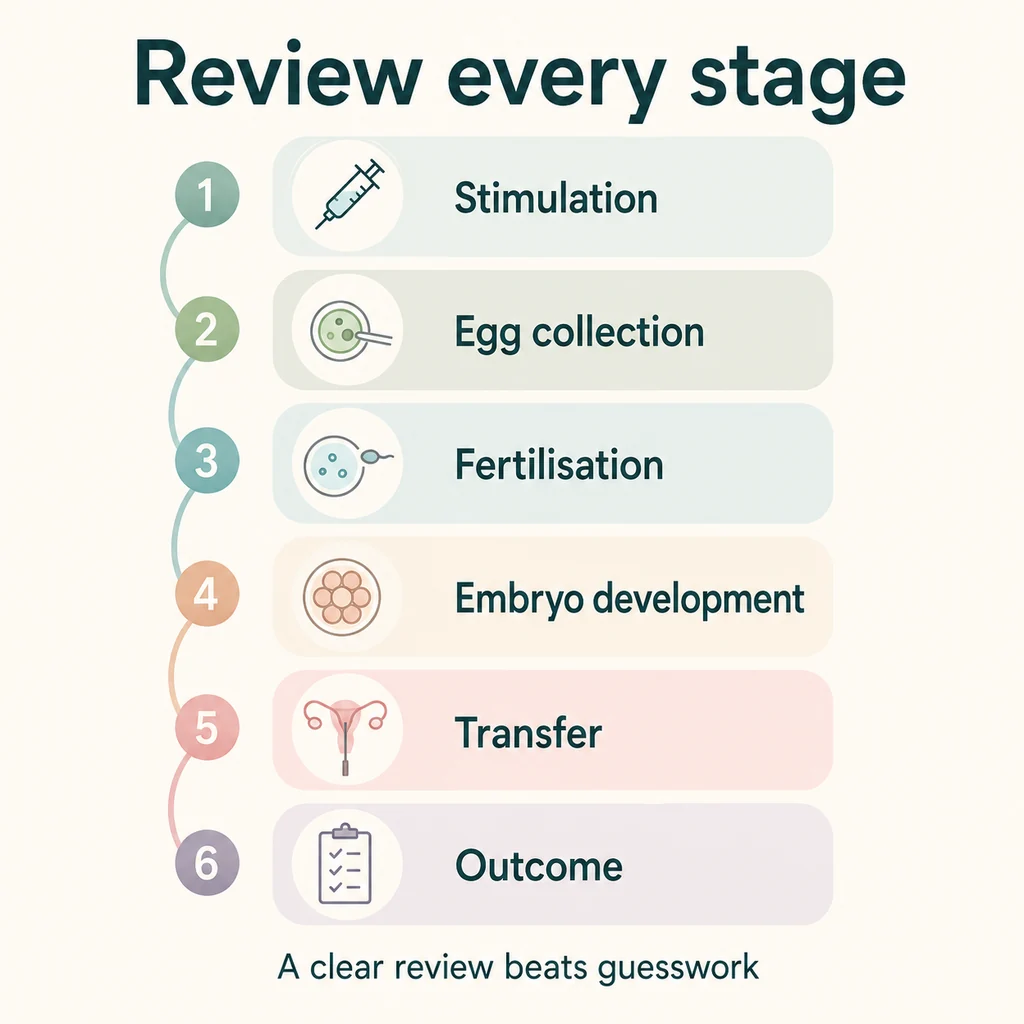
Build one complete cycle map before choosing another treatment
Ask the clinic for a written report for every egg-collection and transfer cycle. A useful report lets you see where attrition occurred and prevents a disappointing final pregnancy test from hiding a different upstream problem.
| Stage | Questions to ask | Possible next decision |
|---|---|---|
| Before stimulation | Were diagnosis, ovarian reserve, age at egg collection, medicines and previous response considered? | Adjust expectations, protocol or whether another egg collection is reasonable. |
| Stimulation and trigger | How many follicles developed? Were dose changes, trigger timing and hormone results appropriate? | Review protocol, adherence, trigger choice or risk of repeating the same response. |
| Egg collection and maturity | How many eggs were collected and mature? | Separate low retrieval from low maturity and discuss whether a protocol change has a plausible rationale. |
| Fertilisation | Was IVF or ICSI used? What proportion fertilised normally? | Review semen, egg factors, laboratory observations and whether ICSI is indicated, not assume it fixes every problem. |
| Embryo development | How many embryos reached each stage? Were they transferred, frozen, tested or arrested? | Discuss age-related embryo competence, culture observations and realistic cumulative options. |
| Transfer and luteal support | Was transfer technically straightforward? Was progesterone timing and route appropriate? | Review transfer documentation and medicine adherence before adding tests. |
| Pregnancy outcome | Was the outcome no implantation, biochemical pregnancy, clinical loss or later miscarriage? | Direct the investigation towards the actual outcome rather than one broad label. |
Use the correct denominator
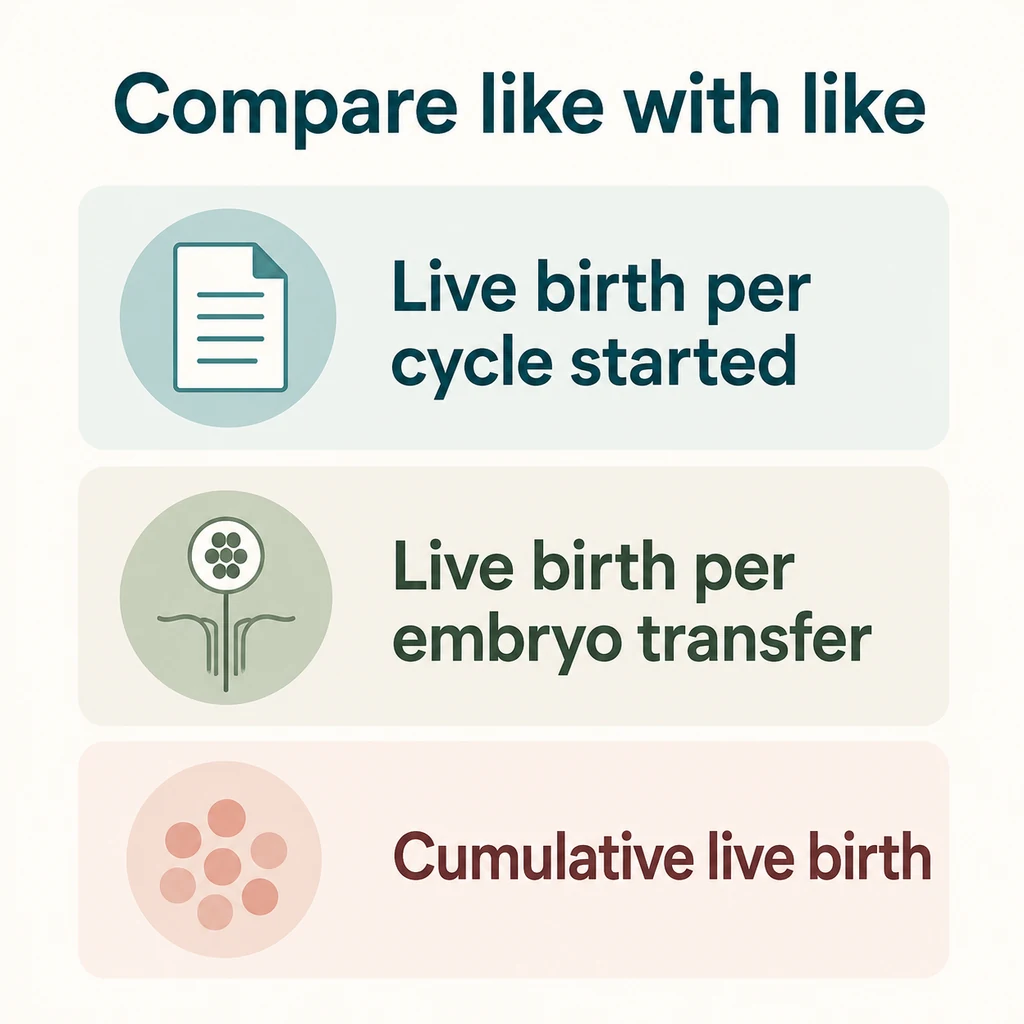
“Success rate” can mean live birth per cycle started, per egg collection, per embryo transfer or cumulative live birth from all fresh and frozen embryos created in one collection. These are not interchangeable. Ask the clinic to compare your outcome with people of a similar age using the same denominator and treatment stage.
The Australian IVF success-rate guide explains how to read national and clinic data without treating one percentage as a prediction. YourIVFSuccess uses Australian registry data and is more useful than an overseas clinic’s promotional headline.
Embryo factors and age at egg collection
Embryo chromosome errors become more common as age at egg collection rises, but age does not explain every failed cycle and a visually good embryo is not guaranteed to be chromosomally normal. Conversely, morphology alone cannot identify every embryo capable of live birth.
PGT-A may be discussed in selected situations, but it is not automatically beneficial after every failed transfer. It tests sampled cells for the chromosome findings included in the platform; it does not improve the underlying embryo, test every genetic condition or guarantee implantation. Ask whether it is expected to improve cumulative live birth, shorten time to pregnancy, reduce miscarriage or simply change embryo selection in your specific situation.

Uterine cavity and pelvic factors
A review may consider whether the uterine cavity has been assessed appropriately, particularly after abnormal bleeding, previous uterine surgery, a difficult transfer or a finding on ultrasound. Saline ultrasound or hysteroscopy may be appropriate in selected cases; routine repeated invasive testing is not automatically useful.
Endometriosis, adenomyosis, fibroids, hydrosalpinx and intrauterine adhesions can influence treatment decisions in some people. The relevant question is whether there is a symptom, scan or history that makes further assessment likely to change care. Use the focused guides to endometriosis and ovulation pain and intrauterine adhesions for those specific decisions.
Male fertility and fertilisation patterns
A standard semen analysis is one part of the picture. Concentration, motility, morphology, volume, vitality, collection conditions, fever and the pattern of fertilisation across cycles can all matter. A single abnormal result does not explain every embryo outcome, and a normal result does not exclude every sperm contribution.
Use the male fertility assessment guide for the complete pathway and sperm motility interpretation for that named parameter. Sperm DNA fragmentation testing may be considered in selected contexts, but it should not be ordered as a reflex without asking how the result would change treatment.
Transfer, progesterone and laboratory review
Ask whether the transfer was easy or difficult, whether the catheter placement was documented, whether progesterone was started at the intended time and whether doses were missed or affected by vomiting or another issue. If progesterone testing was used, the clinic should explain the timing, assay and threshold rather than treating one number as a universal measure of luteal quality.
Laboratory performance is difficult for a patient to judge from one cycle. A second opinion can be useful when fertilisation or blastocyst development is repeatedly much lower than expected, when explanations change between appointments, or when the clinic cannot provide stage-by-stage data.
Tests and add-ons that should not be automatic
A treatment can be biologically interesting and still lack evidence that it improves live birth. ESHRE recommends limiting recurrent-implantation-failure investigations and interventions to those with a clear rationale and adequate evidence. Examples often marketed after failed IVF include endometrial receptivity tests, immune panels, intralipids, corticosteroids, colony-stimulating factors, microbiome tests, endometrial scratching and numerous laboratory add-ons.
| Question | Why it protects you |
|---|---|
| What exact problem is this meant to address? | Prevents one treatment being offered for every type of failed cycle. |
| What outcome improves? | Separates a laboratory marker from ongoing pregnancy or live birth. |
| What is the evidence in people like me? | Avoids extrapolating from a small or different population. |
| What are the harms and opportunity costs? | Includes side effects, false positives, delay and money that could fund another evidence-based step. |
| What will we do if the result is positive or negative? | A test without a management consequence rarely adds value. |
When a second opinion is reasonable
- The clinic cannot provide complete cycle reports or explain the denominator behind its success claim.
- The same protocol is proposed despite repeated similar attrition, without a rationale.
- Multiple add-ons are recommended together, making it impossible to know what is useful.
- You feel rushed into another cycle before results and options are reviewed.
- Donor eggs, donor sperm, surgery, IUI, preservation or stopping treatment are discussed without balanced alternatives.
- Communication or trust has broken down.
The Australian fertility specialist comparison guide provides questions for credentials, costs, success denominators and communication. A second opinion does not commit you to changing clinics.
Emotional and financial limits belong in the plan
Another cycle is not automatically the medically “strongest” choice if the physical, emotional or financial cost is unacceptable. Ask for the expected chance of success from one more collection or transfer, the cost of the complete plan, the stop points, and what alternatives remain.
Options may include another transfer, another collection, protocol change, treatment of a defined condition, donor eggs, donor sperm, IUI in a suitable diagnosis, fertility preservation, a treatment break or stopping. The donor-egg guide explains one pathway without presenting it as the inevitable next step.
Prepare for the review appointment
- Request the embryology, medication, procedure and transfer reports for each cycle.
- Write one line describing where each cycle lost potential.
- List tests or treatments already tried and whether they changed the plan.
- Ask for the estimated live-birth chance using the relevant denominator.
- Ask for the strongest evidence-based change, the uncertain options and the no-change option.
- Set personal limits for cost, number of cycles, time and side effects before the appointment.

Frequently Asked Questions about repeated IVF failure in Australia
Do three failed embryo transfers mean recurrent implantation failure?
Not by a universal rule. ESHRE recommends an individualised assessment based on the cumulative predicted chance of implantation and the type and quality of embryos transferred, rather than a fixed transfer count alone.
Should I change IVF clinics after repeated failure?
Not automatically. A second opinion is reasonable when explanations are unclear, stage-specific outcomes are repeatedly unexpected, records are not available or the proposed plan lacks a rationale.
Is PGT-A always recommended after failed IVF?
No. Its value depends on age, embryo number, miscarriage history, previous results and the outcome being targeted. It does not improve an embryo or guarantee live birth.
Can immune treatment fix recurrent implantation failure?
Evidence for routine immune testing and treatment is limited, and some options carry harm. Ask what diagnosis is being treated and whether live birth improves in a comparable population.
Can sperm problems contribute to repeated IVF failure?
Yes, in selected cases, but the pattern needs assessment across semen results, fertilisation and embryo development. One abnormal motility or morphology result should not be treated as the sole explanation.
When should I stop IVF?
There is no universal number. The decision should combine expected benefit, age at egg collection, available embryos, diagnosis, health, cost, emotional impact, alternatives and your own limits.
Next Steps in Australia
Request the complete records and book a dedicated review rather than beginning another cycle by default. Ask the clinic to identify the failed stage, use a live-birth denominator, rank proposed changes by evidence and explain the no-add-on option. Obtain a second opinion when the rationale or communication remains unclear.
If IUI is being considered as an alternative, use the Australian IUI cost and suitability guide. If the next step may involve storing eggs or embryos before another treatment, review fertility preservation in Australia.
Last reviewed: 31 July 2026
Next scheduled review: July 2027
References
Fertility2Family articles are researched using Australian Government health guidance, professional clinical recommendations and peer-reviewed medical literature. The references below were used to research and medically review this article and provide additional reading for readers who want to explore the evidence in more detail.
UNSW National Perinatal Epidemiology and Statistics Unit.
Australian and New Zealand Assisted Reproduction Database (ANZARD)
Explains how assisted reproductive technology cycles and outcomes across Australia and New Zealand are collected, validated and used for national quality monitoring and reporting.
UNSW National Perinatal Epidemiology and Statistics Unit.
Assisted reproductive technology in Australia and New Zealand 2023
Reports national assisted reproductive technology use and outcomes for 2023, including cycle-based and cumulative measures across Australian and New Zealand fertility clinics.
Australian Government YourIVFSuccess.
Your IVF Success glossary
Defines Australian assisted reproductive technology terminology and outcome measures used when interpreting clinic information, treatment stages and public IVF success-rate data.
Australian Government YourIVFSuccess.
IVF Clinic Success Rates & Costs
Provides an Australian Government clinic finder for comparing accredited fertility clinics, including success-rate information, treatment services, estimated costs and locations.
Pregnancy, Birth and Baby / Healthdirect Australia.
Fertility tests and treatments
Outlines fertility assessment and treatment options, including medicines, intrauterine insemination and IVF, while explaining when specialist review may be appropriate.
Human Reproduction Open.
ESHRE good practice recommendations on recurrent implantation failure
Provides contemporary definitions, investigation principles and evidence limitations for recurrent implantation failure, including caution against applying a universal embryo-transfer threshold.
American Society for Reproductive Medicine.
American Society for Reproductive Medicine recurrent implantation failure: a committee opinion (2026)
Reviews evidence-based evaluation after repeated unsuccessful embryo transfers and distinguishes possible recurrent implantation failure from isolated failed transfers or other cycle losses.
Human Reproduction.
Good practice recommendations on add-ons in reproductive medicine
Examines potential benefits, harms, uncertainty and counselling requirements for investigations and treatment add-ons used in reproductive medicine before routine clinical use.
American Society for Reproductive Medicine.
The use of preimplantation genetic testing for aneuploidy: a committee opinion (2024)
Summarises evidence limitations and patient-selection considerations for preimplantation genetic testing for aneuploidy, including why routine benefit is not established for every patient.
National Health and Medical Research Council.
Ethical guidelines on the use of assisted reproductive technology in clinical practice and research, 2017 (updated 2023)
Sets out Australia’s ethical framework for assisted reproductive technology, including consent, information provision, donor conception, preimplantation genetic testing and clinic responsibilities.
Fertility Society of Australia and New Zealand.
RTAC
Explains Australian assisted reproductive technology accreditation, the audited RTAC Code of Practice and the standards applied to organisations delivering fertility services.
Human Reproduction.
Cumulative live birth rates of 31,478 untested embryos from 11,463 women challenge traditional recurrent implantation failure definitions
Reports cohort evidence on cumulative live-birth outcomes across repeated embryo transfers and the limitations of defining recurrent implantation failure by a fixed transfer count.
Human Reproduction.
Does recurrent implantation failure exist? Prevalence and outcomes of five consecutive euploid blastocyst transfers in 123 987 patients
Reports multicentre retrospective outcomes after up to five consecutive euploid blastocyst transfers, examining how fixed transfer-count definitions may overstate unexplained recurrent implantation failure.
International Journal of Gynecology & Obstetrics.
Interventions for recurrent embryo implantation failure: An umbrella review
Assesses evidence strength across systematic reviews of interventions for recurrent implantation failure, including immunological, uterine, endometrial and laboratory approaches and live-birth outcomes.
Randomised clinical trial comparing receptivity-timed with standard frozen embryo transfer, finding no significant live-birth improvement from routine endometrial receptivity testing in the studied population.
Multicentre randomised trial comparing ICSI with conventional IVF for non-severe male-factor infertility, finding no live-birth advantage and supporting selective rather than routine ICSI use.