15 min read
Apr 15, 2026
Pregnancy Test Accuracy by DPO: Home Urine Test Sensitivity from 1 to 14 Days Past Ovulation

Written by
Fertility2Family Team

Medically reviewed by
Evan Kurzyp, RN (AHPRA), BSN, Master of Nursing
Knowing when a home pregnancy test is likely to turn positive can be confusing, especially when product packaging, online advice, and fertility tracking terms do not always use the same timing system. Some brands describe accuracy by the number of days before an expected period, while many people trying to conceive think in days past ovulation, or DPO. These are not identical measures, and that difference matters when interpreting an early negative or positive result. This article explains how home urine pregnancy test sensitivity changes across the luteal phase using a DPO-based framework grounded in published urinary hCG data. It also compares this biologic approach with common manufacturer claims and discusses how test cutoff, timing, implantation, and very early pregnancy loss can influence what a user sees on a home test. The aim is to provide a clearer evidence-based explanation for readers in Australia who want to understand early pregnancy testing more accurately.
The summary below outlines the main clinical takeaways before the full evidence review.
Executive overview
Home urine pregnancy tests detect human chorionic gonadotropin (hCG) in urine once implantation has occurred. A negative test result is common in very early pregnancy. Sensitivity rises sharply between about 10 and 12 days past ovulation (DPO) in most pregnancies [1,3]. Manufacturer claims indexed to “days before expected period” are not the same as DPO-based timing because ovulation day may vary [3]. A negative early test does not rule out pregnancy, and people with symptoms, such as pain or bleeding, need prompt clinical evaluation regardless of test result. Testing from the first day of the missed period is generally advised for best accuracy. This report provides DPO-by-DPO sensitivity estimates for 10 mIU/mL and 25 mIU/mL cutoffs and compares them with major brands’ early-testing claims.
Key findings
- Many pregnancies cannot be detected before about 10 DPO. Early tests before 10 DPO often return negative results [1,4].
- Sensitivity rises rapidly around 10 to 12 DPO. By 12 DPO, a few days before a typical expected period, most pregnancies exceed a 10 mIU/mL cutoff [1].
- Tests with a 10 mIU/mL cutoff detect pregnancy earlier than 25 mIU/mL tests, but very low hCG levels before the period may reflect transient early conceptions, including chemical pregnancies [26,16].
- Manufacturer “days before expected period” claims do not directly map to DPO unless ovulation date is known [3].
- A negative early home test is not definitive. Pregnancy should be confirmed, or excluded, with follow-up testing or clinical evaluation, especially if symptoms are concerning [18,19].
Plain-English summary
- 9 DPO: A positive result is possible, but most pregnancies will still test negative.
- 10 DPO: A high-sensitivity 10 mIU/mL test may detect about half of pregnancies in the modeled dataset, while a 25 mIU/mL test still misses most.
- 11 to 12 DPO: Detection rises quickly, especially for lower-cutoff tests.
- 13 to 14 DPO: Most ongoing pregnancies in the modeled dataset are detectable, especially with more sensitive tests.
- Expected period day or later: Testing is much more reliable, but a negative result still needs caution if symptoms are present or ovulation timing is uncertain.
Structured abstract
Background: Home pregnancy tests detect hCG in urine once implantation has occurred. Early in pregnancy, hCG rises rapidly, but test sensitivity depends on the hCG threshold [1].
Objective: To estimate day-by-day sensitivity of home urine pregnancy tests by days past ovulation, DPO 1 to 14, and by the day of the expected missed period if different, using published DPO-aligned urinary hCG data and common device cutoffs.
Design: Quantitative modeling study using published urinary hCG reference percentiles aligned to ovulation and Monte Carlo simulation for uncertainty.
Data sources: Urinary intact hCG reference percentiles by DPO from a prospective cohort [1], manufacturer instructions and FDA documents for device cutoffs and early detection claims [12,13,14,15,16], and Australian and other clinical guidance for testing timing [18,19,21].
Outcome: Sensitivity, or true positive rate, by DPO for two analytical cutoffs: 10 mIU/mL and 25 mIU/mL, with 95% uncertainty intervals.
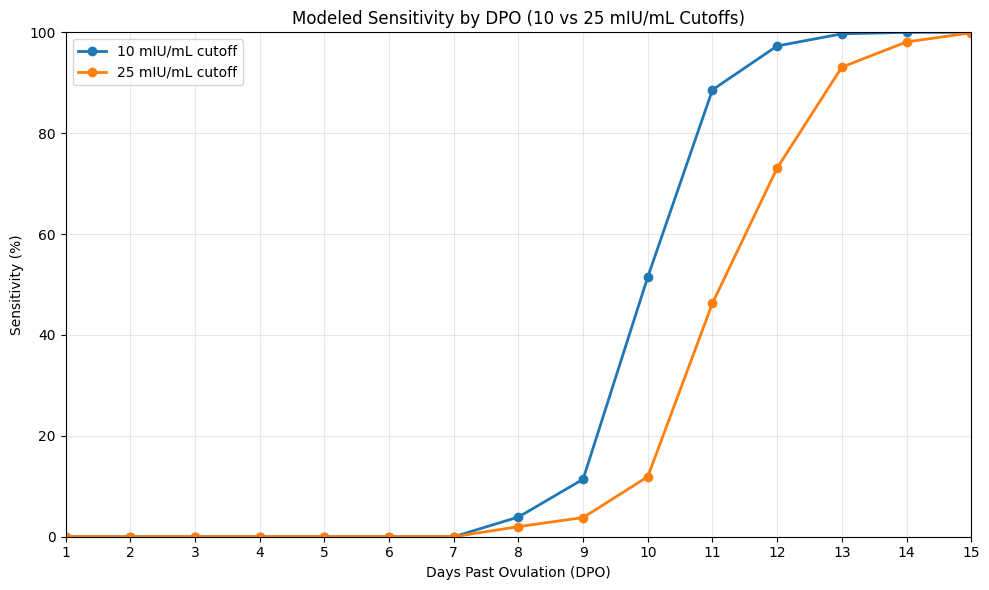
Results: Modeled sensitivity is very low before 9 DPO and rises steeply from DPO 9 to DPO 12. In the modeled cohort, a 10 mIU/mL cutoff reaches about 97% sensitivity by 12 DPO and about 100% by 13 to 14 DPO [1]. A 25 mIU/mL cutoff rises later, reaching about 73% at 12 DPO and about 98% by 14 DPO [1]. Many pregnancies are not detected until around the expected period date, and some may still be undetectable at the first missed period because implantation timing varies [3].
Conclusions: Early home tests can miss pregnancies because sensitivity depends on biologic timing and test cutoff. A negative result in the very early luteal phase should be followed by repeat testing or medical follow-up. Australian guidance to test from the first missed period is supported. People with symptoms should be evaluated regardless of a negative home test [18,19,21].
Introduction
Home urine pregnancy tests are qualitative immunoassays that react to hCG, a hormone produced by the placenta after implantation starts. In typical pregnancies, implantation occurs around 8 to 10 days after ovulation, and hCG levels double roughly every 1 to 3 days thereafter [1]. Therefore, there is a biological limit on how early a urine test can detect pregnancy. False-negative results are common in the very early luteal phase when hCG is still low [1,4].
Many public health sources advise people to test from the first missed period for best accuracy. Negative results are less reliable when testing earlier [18,19]. Australian pregnancy guidance similarly recommends waiting until the expected period day [18].
Calendar-based “days before expected period” claims by manufacturers can be misleading if ovulation timing varies. For example, a pregnancy with late ovulation might not be detectable by the expected period date. A JAMA cohort study found that about 10% of pregnancies had not yet implanted by the first missed menses, so a test of any sensitivity could not detect those pregnancies on that calendar day [3]. In contrast, aligning by DPO accounts for ovulation timing and provides a clearer biologic framework.
This manuscript provides DPO-based sensitivity estimates for common test cutoffs and compares them with major brands’ early-testing claims, including a Fertility2Family 25 mIU/mL strip test. It also discusses the trade-off between earlier detection and detection of very early nonviable pregnancies.
Methods
Primary hCG source: Urinary intact hCG percentiles by DPO were taken from Gnoth & Johnson (2014), a prospective cohort where day 1 equals LH surge plus 1. The table provided median, 10th percentile, 90th percentile, and sample size for DPO 7 to 15 [1].
Modeled cutoffs: Two fixed cutoffs were used:
- 10 mIU/mL: represents high-sensitivity tests, for example Clearblue Ultra Early [12].
- 25 mIU/mL: represents standard tests, for example Clearblue Rapid and Fertility2Family strips [13,16].
These were treated as decision thresholds. Real devices may have a range around the stated cutoff.
Lognormal fit: For DPO 9 to 15, a lognormal distribution of hCG was fitted so that the modeled 10th and 90th percentiles matched the published values on the log scale [1]. Sensitivity at cutoff C was then computed as the probability that hCG was greater than or equal to C.
Handling DPO 7 to 8: In Gnoth’s data, the 10th percentile was 0.00 for DPO 7 and 8. For DPO 7, the 90th percentile was well below 10 mIU/mL, so sensitivity was essentially 0%. For DPO 8, a mixture model with a point mass at 0 and a positive tail was used in Monte Carlo simulation to approximate the distribution. This yielded very low sensitivities and wider confidence intervals at DPO 8 [1].
Monte Carlo uncertainty: Ninety-five percent uncertainty intervals were obtained by repeated sampling using the reported daily sample sizes. For DPO 8, the uncertainty accounts for both sampling variability and the zero-inflated mixture model.
Missed period day: The missed period day is often defined as the first day after the expected period date. For an average 14-day luteal phase, this corresponds to about 15 DPO. Table 1 includes a row for 15 DPO labeled “Missed period day” with this assumption [13].
Manufacturer claims: Cutoff values and early detection claims were extracted from FDA 510(k) documents and manufacturer leaflets. Fertility2Family 25 mIU/mL instructions were obtained directly. Fertility2Family provided early detection rates, 52%, 89%, 97%, and 98%, for 4, 3, 2, and 1 days before the expected period as manufacturer-supplied data [16].
Results
Sensitivity by DPO
Table 1 shows modeled sensitivity by DPO for both 10 mIU/mL and 25 mIU/mL cutoffs, with 95% intervals. DPO 1 to 6 are marked “unspecified” because the source data begin at DPO 7. These days are before the normal implantation window, so pregnancy detection is not expected. All estimates assume correct ovulation timing, one correctly performed test with properly concentrated urine, and a device meeting its nominal cutoff [1,12,13,16].
On smaller screens, swipe horizontally to view the full table.
| DPO | 10 mIU/mL sensitivity (%, 95% CI) |
25 mIU/mL sensitivity (%, 95% CI) |
Sources | Notes (assumptions apply to all rows) |
|---|---|---|---|---|
| 1–6 | Unspecified | Unspecified | Gnoth 2014 [1] (no data for DPO <7) | No data available. DPO <7 are before implantation; tests would be negative [1]. |
| 7 | 0.0 (0.0–0.5) | 0.0 (0.0–0.5) | Gnoth 2014 [1] | 10th = 0.0; 90th ≪ 10; sensitivity ≈ 0%. A few very early implantations may occur [1]. |
| 8 | 3.9 (1.0–8.8) | 2.0 (0.0–4.9) | Gnoth 2014 [1] | Mixture model due to 10th = 0.0; nonzero tail gives low sensitivity [1]. |
| 9 | 11.4 (5.3–17.5) | 3.8 (0.1–7.4) | Gnoth 2014 [1] | Lognormal fit used. Early hCG rise starts [1]. |
| 10 | 51.5 (41.9–61.2) | 11.9 (5.7–18.2) | Gnoth 2014 [1] | Sharp rise; 10 mIU detects about half, 25 mIU fewer [1]. |
| 11 | 88.6 (82.5–94.7) | 46.3 (36.7–55.8) | Gnoth 2014 [1] | Most exceed 10 mIU; many still below 25 mIU [1]. |
| 12 | 97.3 (94.1–100) | 73.1 (64.4–81.9) | Gnoth 2014 [1] | Nearly all exceed 10 mIU; 25 mIU still catching up [1]. |
| 13 | 99.7 (98.5–100) | 93.1 (88.1–98.0) | Gnoth 2014 [1] | Almost all pregnancies exceed both cutoffs [1]. |
| 14 | 100.0 (99.5–100) | 98.1 (95.5–100) | Gnoth 2014 [1] | In a 14-day luteal phase, around the expected period day [3]. |
| Missed period day (~15 DPO) | 100.0 (100.0–100) | 99.9 (99.4–100) | Gnoth 2014 [1]; Wilcox 1999 [2] | Defined as the day after the expected period. Some late implantations remain undetectable by the first missed day [3]. |
Sensitivity curve vs. DPO
Manufacturer and regulator claims
Table 2 compares major brands’ claimed earliest testing and cutoff. Fertility2Family strips, 25 mIU/mL, are added with their label cutoff and manufacturer-provided early detection rates. These claims are indexed to expected or missed period timing, not DPO [12,13,16].
On smaller screens, swipe horizontally to view the full table.
| Product | Earliest testing window | Sensitivity cutoff | Early detection claims (by days before expected period) | Source |
|---|---|---|---|---|
| Clearblue Ultra Early | Up to 6 days before missed period (5 before expected) [12] | 10 mIU/mL | Chart only; no numeric claim given in leaflet | Manufacturer instructions [12] |
| Clearblue Rapid Detection | Up to 4 days before expected period [13] | 25 mIU/mL | 56% at 4 days before, 88% at 3, 97% at 2, 98% at 1 day before [13] | Manufacturer instructions [13] |
| First Response Early Result | Up to 6 days before missed (5 before expected) [14] | ~10 mIU/mL (not explicitly given) | 76% at 5 days before; 96% at 4; >99% at 3, 2, and 1 days before [14] | Manufacturer info page [14] |
| Fertility2Family Strip | From the first day of missed period [16] | 25 mIU/mL [16] | 52% at 4 days before; 89% at 3; 97% at 2; 98% at 1 day before (manufacturer-supplied) |
Company leaflet and data [16] |
Flowchart of methods

Discussion
Cutoff choice and early losses
Tests with a 10 mIU/mL cutoff detect rising hCG earlier, so they can yield a positive result at lower hCG levels. This increases the chance of detecting a pregnancy very early, including pregnancies that ultimately do not continue, such as chemical pregnancies [26,27,16]. A chemical pregnancy is an early loss after implantation but before 5 weeks; it typically shows as a very early positive home test followed by a negative test and bleeding [26].
Some users prefer a 25 mIU/mL test because it generally turns positive closer to the time of a missed period, which may reduce early transient positives. In other words, a 25 mIU/mL cutoff is less likely to show a positive result in the lowest-hCG early conceptions. This is a user preference or trade-off: 25 mIU/mL tests give a later positive but may avoid the confusion of very early chemical pregnancies, whereas 10 mIU/mL tests can confirm pregnancy sooner but may detect those early losses [26,27,16]. This difference is about testing timing, not health outcomes.
Clinical implications
If an early home test is negative but pregnancy is suspected, repeating the test around the expected period is reasonable. Australian guidance advises retesting if menstruation remains absent [18,19]. A negative result before the missed period should not be assumed to mean there is no pregnancy.
Importantly, a negative urine test does not exclude ectopic pregnancy or other complications in a symptomatic patient. Any concerning symptoms, such as significant pain or bleeding, should prompt medical evaluation even if the home test is negative [21,22,23].
Australia follows international practice for early pregnancy evaluation: if pregnancy status or location is uncertain, quantitative serum hCG testing and timely ultrasound, following ASUM guidance, are used [21,22,23].
Frequently asked questions
Can a pregnancy test be positive at 9 DPO?
Yes, it is possible, but it is still early. In the modeled dataset, some pregnancies were detectable at 9 DPO, especially with lower-cutoff tests, but most were still below the threshold for a positive result. A negative test at 9 DPO does not rule out pregnancy.
Is 10 DPO too early to test?
For many people, yes. A 10 mIU/mL test may detect about half of pregnancies in the modeled dataset at 10 DPO, while a 25 mIU/mL test still misses most. A negative result at this stage does not rule out pregnancy, so repeat testing later is often needed.
Why do “days before expected period” claims differ from DPO?
Because “days before expected period” is based on calendar timing, while DPO is based on ovulation timing. If ovulation occurred earlier or later than expected, the same calendar day may represent a different biologic stage of pregnancy. That is why expected-period claims do not directly convert to DPO.
Can a negative early home test still mean pregnancy?
Yes. Early negative results are common because implantation and hCG rise may not yet have progressed far enough for urine detection. If menstruation does not begin, or if symptoms are present, repeat testing or clinical follow-up is appropriate.
Limitations
The main limitation is that the sensitivity estimates are based on one published dataset of DPO-aligned urine hCG, Gnoth 2014 [1]. Variation in populations, assays, and testing conditions may affect real-world sensitivity. This page models ideal use under controlled assumptions. Actual device performance varies by brand, lot, and user, and regulatory alerts have shown market variation [24,25].
DPO 1 to 6 are unspecified because the source data begin at 7 DPO. In practice, pregnancy tests would almost always be negative at those very early days [1].
First-morning or otherwise concentrated urine was assumed for early testing. Diluted urine and user errors were not modeled and would reduce early sensitivity further.
Fertility2Family’s early detection rates in Table 2 were provided by the company. They fit the pattern of other tests but have not been published in a peer-reviewed source. They are presented as manufacturer data for transparency.
References
- Gnoth C, Johnson S. Strips of Hope: Accuracy of Home Pregnancy Tests and New Developments. Geburtsh Frauenheilkd. 2014;74(7):661-669. DOI:10.1055/s-0034-1368589.
- Wilcox AJ, Baird DD, Weinberg CR. Time of implantation of the conceptus and loss of pregnancy. N Engl J Med. 1999;340(23):1796-1799.
- Wilcox AJ, Baird DD, Dunson DB, et al. Natural limits of pregnancy testing in relation to the expected menstrual period. JAMA. 2001;286(14):1759-1761.
- Cole LA, Khanlian SA, Sutton JM, et al. Accuracy of home pregnancy tests at the time of missed menses. Am J Obstet Gynecol. 2004;190(1):100-105.
- Cole LA, Sutton-Riley JM, Khanlian SA, et al. Sensitivity of over-the-counter pregnancy tests: comparison of performance and marketing claims. J Am Pharm Assoc. 2005;45(4):477-482.
- Bastian LA, Nanda K, Hasselblad V, Simel DL. Diagnostic efficiency of home pregnancy test kits: a meta-analysis. Arch Fam Med. 1998;7(5):465-471.
- Centers for Disease Control and Prevention. Urine Pregnancy Laboratory Method (NHANES 2021-2022); 2022. Available at: CDC.
- National Institute for Biological Standards and Control (NIBSC). WHO International Standard 75/589 for hCG (Pregnancy Test Calibration). 2020. Available at: NIBSC.
- Mayo Clinic. Home Pregnancy Tests: Can You Trust the Results? Mayo Clinic Health System. 2022. Available at: Mayo Clinic.
- The Royal Women’s Hospital. Am I really pregnant? (Patient info). 2022. Available at: The Women’s.
Show remaining references
- Pregnancy, Birth and Baby (Australian Government). Pregnancy tests. 2023. Available at: Pregnancy, Birth & Baby.
- The Royal Australian College of General Practitioners (RACGP). Early pregnancy bleeding (AFP, May 2016). Available at: RACGP.
- Clearblue (Australia). Ultra Early Pregnancy Test Instructions for Use (10 mIU/mL cutoff). 2020. Available at: Clearblue leaflet (PDF).
- Clearblue (Australia). Rapid Detection Pregnancy Test Instructions for Use (25 mIU/mL cutoff and early testing chart). 2020. Available at: Clearblue leaflet (PDF).
- First Response. Early Result Pregnancy Test (product information). 2023. Available at: First Response.
- Fertility2Family. Pregnancy Test Strip Instructions for Use (25 mIU/mL sensitivity). 2021 (accessed 2026). Available at: Fertility2Family instructions.
- Fertility2Family. Pregnancy Test Strip (25 mIU/mL) product page. Available at: Fertility2Family.
- NHS (UK). Doing a Pregnancy Test. 2022. Available at: NHS.uk.
- Better Health Channel (Victoria). Pregnancy testing. 2023. Available at: Better Health Channel.
- healthdirect Australia. hCG Test. 2023. Available at: healthdirect.
- Royal College of Pathologists of Australasia. RCPA Manual, HCG. 2021. Available at: RCPA Manual.
- ASUM (Aust.) & AIDT (NZ). Guidelines for First Trimester Ultrasound (1–13 weeks +6 days). 2020. Available at: ASUM.
- RANZCOG. Miscarriage and Ectopic Pregnancy Guidelines (C-Obs 14). 2020. Available at: RANZCOG PDF.
- Therapeutic Goods Administration (TGA). Medical devices: overview of regulation. 2023. Available at: TGA.
- Therapeutic Goods Administration (TGA). Regulation of in vitro diagnostic devices. 2023. Available at: TGA.
- Therapeutic Goods Administration (TGA). Safety alert: ConceivePlease One-Step hCG urine pregnancy test (false negatives). 2019. Available at: TGA Alert.
- Therapeutic Goods Administration (TGA). Suspension notice: QuickVue One-Step hCG urine test. 2016. Available at: TGA Notice.
- Cleveland Clinic. Chemical Pregnancy. 2023. Available at: Cleveland Clinic.
- Tommy’s (UK Pregnancy Loss Charity). Chemical Pregnancy. 2023. Available at: Tommy’s.
- Miscarriage Association (UK). Chemical Pregnancy. 2023. Available at: Miscarriage Assoc.
- Kennedy CE, Yeh PT, Gholbzouri K, Narasimhan M. Self-testing for pregnancy: a systematic review. BMJ Open. 2022;12(2):e054120. DOI:10.1136/bmjopen-2021-054120.
- Pike J, Godbert S, Johnson S. Comparison of volunteers’ experience using different home pregnancy test formats. Expert Opin Med Diagn. 2013;7(2):153-158.
- Gronowski AM, Cervinski MA, Rosano TG, et al. False-negative results in point-of-care qualitative hCG devices due to excess β-core fragment. Clin Chem. 2009;55(8):1501-1506.
- Nerenz RD, Gronowski AM. Susceptibility of qualitative hCG devices to hook effect and variant β-hCG. Clin Chem. 2013;59(5):946-954.
- Centers for Disease Control and Prevention (CDC). NHANES 2013-2014: Human Pregnancy and Fertility Methods. 2015. Available at: CDC report.
- World Health Organization (WHO). International Standard 75/589 for hCG (Pregnancy Test Calibration). 2014. Available at: WHO.