
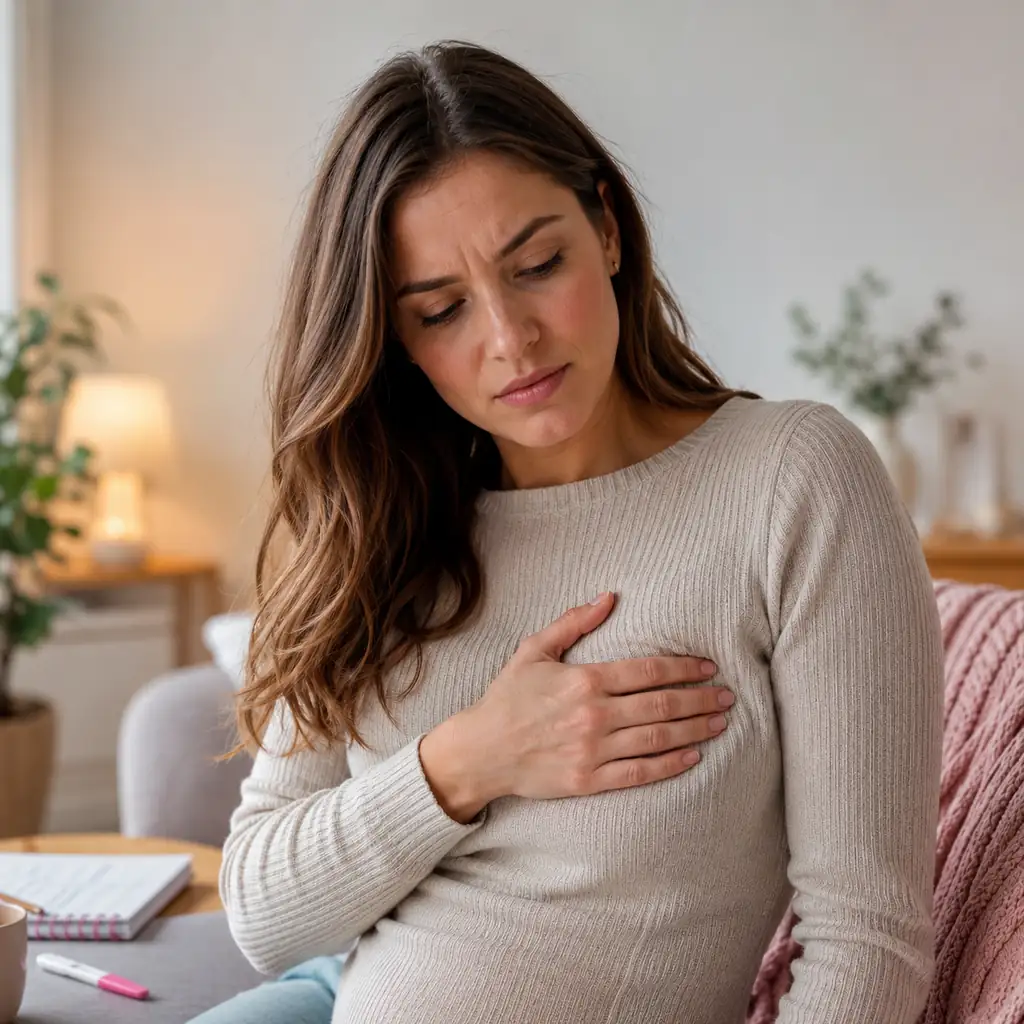

Yes, sore breasts can happen around the time you expect ovulation, but the symptom does not confirm that ovulation has happened or that you are pregnant. A cycle-linked pattern often becomes more noticeable after ovulation and in the days before the next period.
If you are tracking ovulation, the confusing part is that the same ache can appear in more than one part of the cycle. It may feel heavy, full, aching, swollen or tender, sometimes extending towards the underarms, and some people notice nipple sensitivity as well.
What matters most is the pattern. New persistent pain in one fixed area, a new lump, spontaneous nipple discharge, nipple inversion, skin dimpling or unusual redness should be checked rather than attributed to ovulation.
Quick answers about sore breasts during ovulation
Can ovulation cause sore breasts?
Yes. Breast tenderness can occur around the time you expect ovulation, but a cyclical pattern often becomes more noticeable after ovulation and before the period. The symptom does not confirm egg release or pregnancy.
Can breast soreness tell you exactly when ovulation happened?
No. You can ovulate without breast tenderness, and soreness can occur without confirmed ovulation. Use cycle timing and urinary LH to estimate the fertile window rather than using breast pain as an ovulation test.
When should breast pain be checked?
Book a GP appointment for a new lump, persistent focal pain, spontaneous nipple discharge, or a new skin or nipple change. Seek prompt care for a red, hot or swollen breast with fever or feeling unwell.

Breast Pain Before, During and After Ovulation: What Does the Timing Mean?
Breast tissue can respond to hormonal changes across more than one part of the cycle, so there is no single “ovulation breast pain day”. Some people notice tenderness before the expected fertile window, some around mid-cycle and others mainly through the luteal phase before the period.
Before predicted ovulation: cycle hormones are changing, but soreness cannot tell you that an LH surge or egg release is about to occur.
Around the fertile window: some people notice breast or nipple sensitivity around mid-cycle. The symptom cannot identify the exact time of ovulation, fertilisation or pregnancy.
After ovulation: post-ovulation hormone changes may contribute as the luteal phase progresses. Tenderness at this stage cannot show whether conception or implantation occurred.
Before the period: cyclical mastalgia often becomes more noticeable in the second half of the cycle and may ease once bleeding starts.
If your app, cervical mucus and symptoms point to different days, compare those clues with fertile-window and ovulation timing rather than relying on breast soreness to set an exact ovulation date.
Why can hormones make breasts feel sore?
Breast tissue is hormone-responsive. Oestrogen and progesterone change across the cycle, and individual breast tissue differs in how strongly it responds. That can affect fullness, swelling and sensitivity to touch or movement.
The important limitation is that breast pain cannot tell you which hormone is “high” or “low”. Symptoms make more sense alongside FSH, LH, oestrogen and progesterone across the menstrual cycle, where timing and clinical context matter more than one sensation.
A 2025 peer-reviewed analysis followed breast tenderness and swelling across 720 recorded cycles in 53 healthy premenopausal women. Symptoms were mild on average and most noticeable late in the luteal phase. Within the same woman, tenderness did not reliably distinguish normally ovulatory cycles from cycles with ovulatory disturbance. The study supports using breast soreness as a pattern, not as an ovulation test.
How long do your breasts stay sore after ovulation?
For some people, breast tenderness lasts only a few days; for others, a cyclical pattern can continue for one to two weeks until the period begins. There is no universal number of days that applies to every cycle.
A familiar pattern that builds in the second half of the cycle and settles with the period is more consistent with cyclical mastalgia. A new pattern deserves more attention when it lasts beyond your usual timing, becomes severe, stays in one fixed area or affects sleep, exercise, work or intimacy.
If you are trying to place the soreness after egg release, map it against luteal phase length and cycle timing. The duration of breast soreness alone cannot diagnose low progesterone or a luteal-phase problem.

Why are my nipples sore during or after ovulation?
Nipple soreness can be part of the same cycle-related breast sensitivity, but the nipple surface also has its own possible causes. Friction from clothing or exercise, a poorly fitting bra, dry or irritated skin, breastfeeding and infection can all make the nipple or areola tender.
Notice whether the discomfort is mainly on the skin or deeper in the breast, and whether pressure, clothing or exercise makes it worse. New crusting, ulceration, a nipple that has newly turned in, or spontaneous clear or bloody discharge should be assessed by a GP.
Because nipple pain is non-specific, it should not be used as a stronger ovulation signal than general breast tenderness. A sensitive nipple can happen around the fertile window without telling you whether an egg has actually been released.
Sore Breasts After Ovulation: PMS or Pregnancy?
Premenstrual changes and early pregnancy can both include breast tenderness, fullness or nipple sensitivity. The sensations overlap too much to tell the difference reliably. Breast soreness after ovulation therefore does not mean pregnancy, and it does not mean you are not pregnant.
If soreness begins at or immediately after a true ovulation date, it would generally be too early to be caused by a pregnancy conceived in that cycle. Later in the luteal phase, symptoms still cannot replace testing because ordinary premenstrual changes and early pregnancy can feel alike.
If tenderness returns with other physical or mood changes before your period, compare the pattern with PMS and PMDD symptoms. At only a few days past ovulation, the timing in 4 DPO symptoms and pregnancy testing is more informative than symptom intensity.
When the period is due or late, use a pregnancy test according to its instructions. If the date is uncertain, enter your ovulation clue or expected period in the Pregnancy Test Timing Calculator before testing again.
Use ovulation tests for timing, not breast pain
If identifying the fertile window matters, use a signal designed for that job. Urinary LH tests can show that an LH rise is occurring and may indicate that ovulation is approaching. They still do not prove the exact moment an egg is released.
If you want a prospective home signal, ovulation tests can be used across the fertile part of the cycle. Interpret a positive, negative or missed surge within the limits of ovulation test accuracy in Australia.
Breast symptoms can sit beside that information in a diary, but they should not overrule a better-supported timing method. Whether soreness is present or absent does not tell you that ovulation was stronger or more successful.
What else can cause breast pain around mid-cycle?
Not every symptom that happens near ovulation is caused by ovulation. A bra that rubs or provides too little support, upper-body exercise, injury, stress, breast cysts or fibroadenomas, some medicines, pregnancy, breastfeeding, perimenopause and chest-wall pain can all contribute.
Chest-wall pain can be felt as though it comes from the breast. It may worsen with movement, lifting, a deep breath, pressure on one point or a particular sleeping position. Persistent one-sided or focal pain should be assessed rather than repeatedly labelled hormonal.
A red, hot, swollen or rapidly worsening breast, particularly with fever, chills, body aches or feeling unwell, needs prompt medical advice because inflammation or infection may be present.
What may help cyclical breast pain?
A supportive, well-fitting bra can reduce movement and heaviness. Some people prefer additional support during exercise or sleep. A warm or cool pack may also help; protect the skin from direct heat or ice.
Temporarily change an activity that clearly worsens the pain and see whether the pattern improves. If movement or pressure consistently reproduces the discomfort, a GP or physiotherapist can help assess whether the source may be the chest wall.
Ask a pharmacist or GP which pain relief is suitable for you, particularly when pregnancy is possible, you are breastfeeding, you take regular medicines or you have another health condition. Evidence for vitamins, dietary changes and evening primrose oil is inconsistent. If you are considering a supplement, check it with a pharmacist or GP, particularly when pregnancy is possible or you take other medicines.

Cycle Breast Pain and GP Record
This is the most useful information to capture if the symptom keeps returning. Print, screenshot or copy the table for two cycles. Do not wait for another cycle before seeking care if you already have a new lump, nipple or skin change, significant redness or another concerning symptom.
| Record | Cycle 1 | Cycle 2 |
|---|---|---|
| First day of period | ____________ | ____________ |
| Best ovulation clue or estimated date | ____________ | ____________ |
| First and last day of breast pain | ____________ | ____________ |
| Left, right or both breasts | ____________ | ____________ |
| Diffuse or one fixed area | ____________ | ____________ |
| Nipple symptoms | ____________ | ____________ |
| Lump, discharge or skin change | ____________ | ____________ |
| Movement, bra or pressure trigger | ____________ | ____________ |
| Medicines, contraception or fertility treatment | ____________ | ____________ |
| Did it settle with the period? | ____________ | ____________ |
A repeating bilateral pattern that builds through the second half of the cycle and settles with the period supports a cyclical explanation. Persistent focal pain or a new physical change still deserves assessment even when its timing overlaps with ovulation.
Australian care pathway: monitor, see a GP or seek urgent help?
Monitor at home: mild, familiar discomfort in both breasts that follows your cycle, has no other breast change and settles as expected can usually be managed with supportive care while you watch the pattern.
Book a GP appointment: arrange assessment for new or persistent focal pain, a new lump or thickening, spontaneous nipple discharge, a newly inverted nipple, skin dimpling, unusual redness or a change in breast size or shape. A new symptom should not be delayed until another ovulation date or routine screening visit.
Seek prompt medical assessment: a red, hot, swollen or rapidly worsening breast, especially with fever, chills, body aches or feeling unwell, may need treatment for inflammation or infection.
Call 000: severe, worsening or prolonged chest pressure or tightness, particularly with breathlessness, nausea, dizziness, sweating or pain spreading to the jaw or arm, needs emergency assessment.
A GP may assess the history, breasts, nipples, skin, underarms and chest wall, then decide whether imaging such as ultrasound or mammography is appropriate. Breast pain alone is rarely the only sign of breast cancer, but a new breast change still needs its own assessment.

Frequently Asked Questions about Sore Breasts During Ovulation in Australia
What if my breasts are not sore after ovulation?
That can be normal. Many ovulatory cycles cause no noticeable breast tenderness, and your pattern can change between cycles. No soreness does not show that ovulation failed or that pregnancy is more or less likely.
Does breast pain after ovulation mean I am not pregnant?
No. Breast pain can occur in pregnant and non-pregnant cycles. Its presence, absence or intensity cannot confirm or exclude pregnancy, so use a pregnancy test at the appropriate time.
Can breast soreness mean a hormone imbalance?
Not by itself. Breast tissue responds to normal cycle hormones, and soreness can also have non-hormonal causes. The symptom cannot diagnose high or low progesterone, oestrogen imbalance or another endocrine condition.
Does breast pain mean infertility?
No. Breast pain alone does not diagnose infertility or an ovulation disorder. If you are concerned about fertility, assessment should focus on cycle history, ovulation evidence and other relevant reproductive factors.
Can one breast hurt more than the other?
Yes. Cyclical pain can be stronger on one side. However, persistent pain in one fixed area, especially with a lump, nipple change, skin change or discharge, should be assessed by a GP.
Can hormonal contraception or fertility medicines cause breast soreness?
Yes. Hormonal medicines can change breast sensitivity in some people. Do not stop or change prescribed contraception or fertility treatment because of breast soreness without discussing it with the prescriber or a pharmacist.
Next Steps in Australia
If the soreness is mild, affects both breasts and follows a familiar cycle pattern, use simple comfort measures and record when it starts and settles. If your period is late and home tests remain negative, compare the timing with late period and negative pregnancy test causes before deciding whether a GP review is needed.
Book a GP appointment sooner for a new, persistent, one-sided or focal change, symptoms affecting daily life, or any lump, nipple or skin change. Seek prompt care for redness, heat, swelling, fever or feeling unwell, and call 000 for life-threatening chest pain or another emergency.
Last reviewed: 4 September 2026
Next scheduled review: September 2027
References
Fertility2Family articles are researched using Australian Government health guidance, professional clinical recommendations and peer-reviewed medical literature. The references below were used to research and medically review this article and provide additional reading for readers who want to read the evidence in more detail.
NSW Government. Mastalgia
Explains cyclical breast pain, typical timing from mid-cycle towards the period, common locations and sensations, symptom charting, supportive measures and reasons to seek medical review.
The Royal Women’s Hospital. Breast soreness
Describes hormonal and non-hormonal breast soreness, cycle-related swelling, medicines, cysts, chest-wall contributors, supportive care and circumstances where breast changes should be checked.
Family Planning NSW. Breast Pain (Mastalgia)
Outlines cyclical, non-cyclical and referred breast pain, one-to-two-week premenstrual patterns, pain-chart use, supportive bras, limited supplement evidence and indications for GP assessment.
BreastScreen WA. Breast pain
Explains that cyclical tenderness can begin around mid-cycle or ovulation and continue until menstruation, while persistent focal or new breast symptoms warrant clinical assessment.
Healthdirect Australia. Breast checks to detect breast cancer
Lists breast and nipple changes that should not be ignored, including new lumps, shape or skin changes, nipple inversion or discharge and pain that does not go away.
Pregnancy, Birth and Baby. Ovulation and fertility
Explains fertile-window timing, urinary LH testing, cervical mucus and temperature tracking, and notes that breast tenderness and other body signs are not reliable fertility predictors.
PLOS ONE. Breast tenderness and swelling experiences related to menstrual cycles and ovulation in healthy premenopausal women: Secondary analysis of the 1-year “Prospective Ovulation Cohort”
A 2025 secondary analysis of 53 healthy premenopausal women across 720 cycles, finding tenderness peaked late in the luteal phase and did not reliably classify ovulation within individuals.
Pregnancy, Birth and Baby. Conception and fetal development
Explains fertilisation, early embryo development and the several-day journey towards implantation, supporting why symptoms at ovulation cannot be attributed to a pregnancy conceived that cycle.
Pregnancy, Birth and Baby. Early signs of pregnancy
Describes possible early-pregnancy symptoms, including breast changes, while emphasising that symptoms vary and pregnancy testing provides more useful evidence than symptom intensity alone.
Pregnancy, Birth and Baby. Pregnancy tests
Explains how urine and blood pregnancy tests detect hCG, when home testing is most useful, why early negative results occur and when repeat testing may be appropriate.
Healthdirect Australia. Mastitis
Describes breast redness, pain, swelling, fever and flu-like symptoms associated with mastitis and advises early medical assessment when inflammation or infection may be present.
Healthdirect Australia. Chest pain
Explains chest-pain warning signs requiring emergency assessment, including severe, worsening or prolonged pressure and pain accompanied by breathlessness, nausea, dizziness, sweating or radiating discomfort.