On this page
If you have a midstream ovulation test in your hand and are wondering whether you started on the right day, wet the tip enough or read a faint line correctly, this guide is for that moment. The aim is simple: use the test correctly, read it on time and know what the result can and cannot tell you.
The steps below follow the official Fertility2Family device leaflet. They cover when to start testing, how to use the test directly in the urine stream, when to read the result and what positive, negative and invalid results mean. The test detects luteinising hormone, or LH, in urine. It can help predict likely ovulation, but it cannot prove that an egg was released, confirm pregnancy, diagnose a fertility condition or be used as contraception.
If the directions supplied with the current pack in your hand differ from this page, follow the current pack. You can also download the official Fertility2Family Midstream Ovulation Test leaflet (PDF) for a printable copy.
Quick answers for using a midstream ovulation test
How do you use a Fertility2Family midstream ovulation test?
Remove the test from its foil pouch, take off the cap and hold the absorbent tip pointing downward. Urinate onto the absorbent tip until it is thoroughly wet, recap the device, lay it flat with the result window facing up, then read it within the stated time window.
When should I start using a midstream ovulation test?
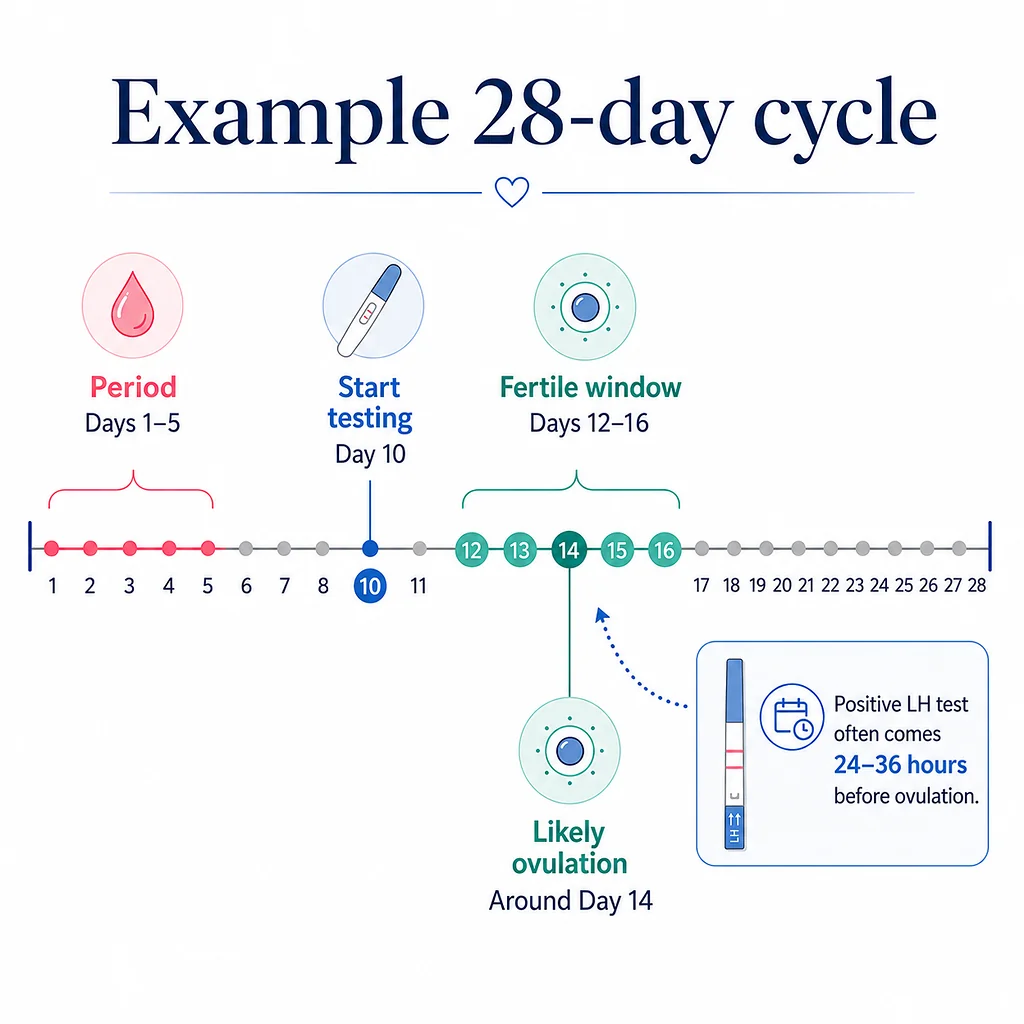
Use your usual cycle length to choose the start day. The official leaflet gives start days for 21 to 38 day cycles; for a 28 day cycle, begin on cycle day 11. Test once daily for up to five days or until the LH surge is detected.
How do I read a midstream ovulation test result?
A positive result means the test line is as dark as or darker than the control line. A lighter test line is negative at that reading. If the control line does not appear, the result is invalid. Read the test at 5 to 10 minutes and do not interpret changes after 10 minutes.
Looking for the product rather than the instructions? Current pack sizes, pricing and availability are on the Midstream Ovulation Tests Australia product page. Stay on this page if you already have the test and need to use or read it.
First, check that you have the midstream format
A Fertility2Family midstream ovulation test is a capped test stick with an absorbent tip and a result window. It is designed for direct urine-stream use. Urine goes onto the absorbent tip, not into the result window.
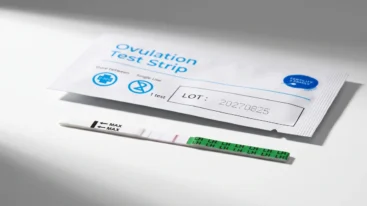
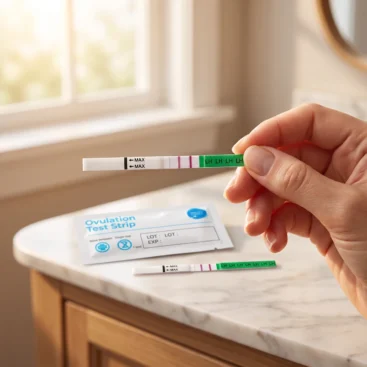
If the test in your hand is a thin dip strip with a MAX line, these are not the correct directions. Use the ovulation test strip instructions instead. The two formats detect urinary LH, but the sample is applied differently.
What does a midstream ovulation test detect?
The device detects luteinising hormone in urine. The official leaflet lists a sensitivity of 25 mIU/mL and says ovulation is likely within about 12 to 48 hours after a positive result. That is a timing signal, not proof that ovulation occurred.
The leaflet also reports greater than 99% accuracy in laboratory studies. That figure refers to laboratory test performance under the stated conditions. It does not mean the test can confirm egg release or guarantee pregnancy.
When should you start testing?
Cycle day 1 is the first day of menstrual bleeding. Work out your usual cycle length from the first day of one period to the day before the next period begins, then use the leaflet’s start-day chart.
| Usual cycle length | Start testing on cycle day |
|---|---|
| 21 days | Day 6 |
| 22 days | Day 6 |
| 23 days | Day 7 |
| 24 days | Day 7 |
| 25 days | Day 8 |
| 26 days | Day 9 |
| 27 days | Day 10 |
| 28 days | Day 11 |
| 29 days | Day 12 |
| 30 days | Day 13 |
| 31 days | Day 14 |
| 32 days | Day 15 |
| 33 days | Day 16 |
| 34 days | Day 17 |
| 35 days | Day 18 |
| 36 days | Day 19 |
| 37 days | Day 20 |
| 38 days | Day 21 |
For a 28 day cycle, start on cycle day 11. The leaflet advises performing one test each day over a five-day period or until the LH surge is detected.
If your cycle is shorter than 21 days or longer than 38 days, the leaflet advises speaking with your doctor. If you do not know your cycle length, it says you may begin testing 11 days after the first day of your period, using 28 days as an average cycle length.
What is the best time of day to test?
For this device, the Fertility2Family leaflet recommends testing between 10 am and 8 pm and at approximately the same time each day.
Do not use first morning urine for this test. The leaflet explains that LH is normally made in the body early in the morning, so it recommends testing later in the day.
Try to reduce fluid intake for about two hours before testing. Drinking a large amount can dilute LH in urine and make the surge harder to detect.
Before you open the pouch
Check the expiry date and make sure the foil pouch is sealed and undamaged. Keep the test sealed until you are ready to use it because prolonged exposure to humidity can affect the device.
Each pouch contains one test stick and one desiccant. Discard the desiccant safely and keep both items out of reach of children.
How to use a midstream ovulation test step by step
- Remove the test stick from the foil pouch only when you are ready to test.
- Remove the cap to expose the absorbent tip. Avoid touching the absorbent end.
- Hold the stick by the thumb grip with the absorbent tip pointing downward.
- Urinate directly onto the absorbent tip only until it is thoroughly wet. Keep the result window out of the urine stream.
- Replace the cap.
- Lay the test flat on a clean surface with the result window facing upward while it develops.
- Use a timer so you read the result inside the valid window.
You may see coloured solution moving across the result window while the test develops. The leaflet describes this as normal.
When should you read the result?
A positive result may begin to appear earlier, but the leaflet’s FAQ says results should be read at 5 to 10 minutes for best results. Wait the full 10 minutes before confirming a negative result.
- Read the result at 5 to 10 minutes.
- If the test still looks negative, wait the full 10 minutes before deciding it is negative.
- Do not interpret new lines, shadows or background changes after 10 minutes.
Some negative tests can develop a faint line as they dry. If a line first appears after the valid reading time, disregard the late change and use a fresh device when another test is needed.
How to read positive, negative and invalid results
Negative result: no LH surge detected
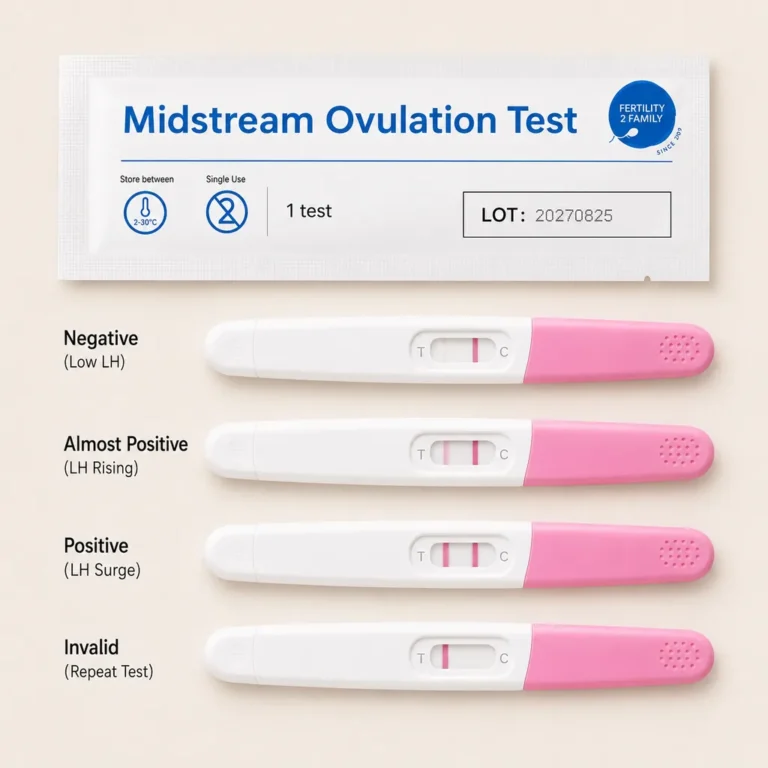
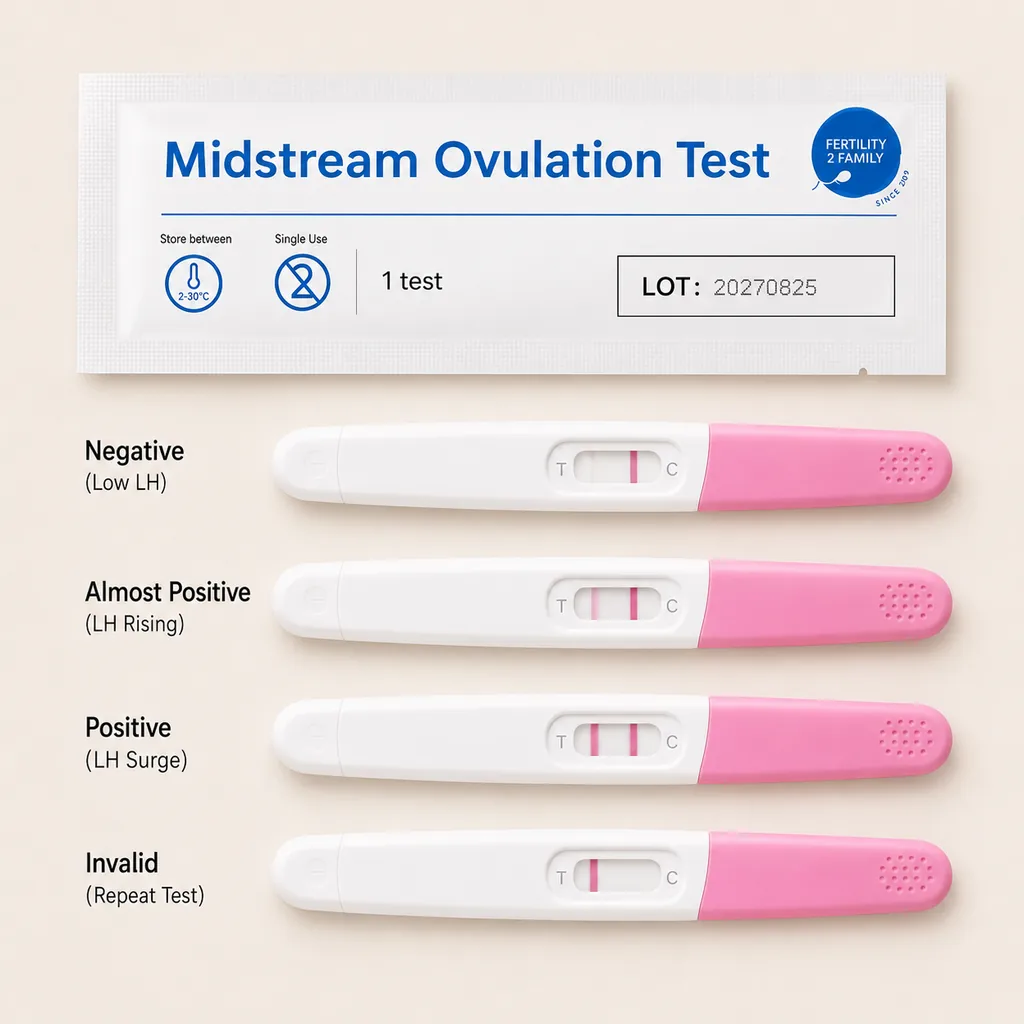
The result is negative when only the control line appears, or when a test line appears but is lighter than the control line.
A faint or darker test line that is still lighter than the control line remains negative at that reading. The leaflet says a light line may appear before the surge, after it, or at other times in the cycle, so line darkness alone does not prove that LH is rising.
Positive result: LH surge detected
The result is positive when two coloured lines are visible and the test line is equal to or darker than the control line. A line that is simply visible is not enough.
The leaflet says ovulation is likely within the next 12 to 48 hours after a positive result. Use that as a fertile-window timing signal rather than a guarantee that an egg has been released.
Invalid result: no control line
If the control line does not appear, the result is invalid. Do not rely on a test line when the control line is missing.
Insufficient urine volume or incorrect test performance are common reasons listed in the leaflet. Repeat with a new device and pay particular attention to wetting the absorbent tip thoroughly, keeping the tip pointing downward and laying the recapped test flat.
A darker line is not automatically positive. Until the test line is as dark as or darker than the control line, the result is still negative for this device.
Troubleshooting common result problems
| What happened | What to check next |
|---|---|
| The test line is very faint | It is still negative unless the test line is as dark as or darker than the control line. Continue testing according to the leaflet. |
| No control line appears | The result is invalid. Use a new device and make sure the absorbent tip is thoroughly wet and the test is performed as directed. |
| The result window looks flooded or unclear | Urine should contact the absorbent tip only. Repeat with a new device if the result cannot be read confidently. |
| A line appears after more than 10 minutes | Ignore the late change. Drying or evaporation can alter the test after the valid reading window. |
| You keep getting negative results | Check your start day, testing time, fluid intake and technique. If well-timed testing repeatedly does not show a clear surge, discuss the pattern with your GP. |
What does a positive result tell you, and what can it not tell you?
A positive result tells you that urinary LH met the positive rule for this test at that time. The leaflet uses the next 12 to 48 hours as the likely ovulation window.
It cannot prove that ovulation actually occurred. It also cannot confirm pregnancy, diagnose PCOS or another hormone condition, tell you whether your fertility is normal or predict whether intercourse will result in pregnancy.
The leaflet also states that the test cannot be used for contraception or gender selection. If avoiding pregnancy is your goal, do not use a positive or negative ovulation test as a stand-alone contraceptive method.
What if you never see a clear positive result?
Before assuming there is a hormone problem, check the basics: start on the correct cycle day, test consistently between 10 am and 8 pm, reduce large fluid intake for about two hours beforehand and wet the absorbent tip thoroughly. A surge can be missed outside the days or times you tested.
If well-timed tests repeatedly never become positive, or your periods are very irregular or absent, take your cycle dates and test history to your GP. One cycle without a detected positive does not diagnose anovulation or low LH.
Can medicines affect the result?
Yes. The device leaflet states that some medicines can affect the test result and advises speaking with a healthcare professional if you are taking medication.
Do not stop a prescribed medicine because of an ovulation-test result. If you are using fertility medicines, hormone treatment or another medicine that may affect your cycle, ask your treating clinician how they want you to use home LH tests.
Storage, single use and safety
Store unopened Fertility2Family midstream ovulation tests at normal room temperature, 4 to 25°C, up to the labelled expiry date. Protect them from direct sunlight, moisture and heat, and do not freeze them.
Keep each test sealed until use. Do not use a damaged or previously opened pouch, and do not reuse the device.
Avoid touching the membrane or used absorbent area. Treat urine and used devices with care, discard the test after use and keep the product out of reach of children.
When should you speak with a GP in Australia?
The product leaflet advises speaking with a doctor if your cycles are shorter than 21 days or longer than 38 days.
See your GP if cycles are very irregular or absent, well-timed testing repeatedly shows no clear surge, a medicine may be affecting results or you are concerned about ovulation.
Australian guidance also advises seeing a doctor after 12 months of trying if you are under 35, or after 6 months if you are 35 or older. Seek advice earlier for a known fertility concern.

Frequently Asked Questions about Midstream Ovulation Test Instructions
Can I use first morning urine for a Fertility2Family midstream ovulation test?
No. The official leaflet says not to use first morning urine. It recommends testing between 10 am and 8 pm and at approximately the same time each day.
How wet should the absorbent tip be?
The leaflet says to urinate onto the absorbent tip until it is thoroughly wet. It does not give a fixed number of seconds. Keep the tip pointing downward and keep urine away from the result window.
What does a faint test line mean on a midstream ovulation test?
A faint test line is not a positive result. The leaflet says a light line may appear before the LH surge, after it, or at other times in the cycle. The test is positive only when the test line is as dark as or darker than the control line.
Can drinking a lot of water affect my ovulation test result?
Yes. A large fluid intake can dilute LH in urine and make the surge harder to detect. The leaflet recommends reducing fluid intake for about two hours before testing.
Can I read a midstream ovulation test after 10 minutes?
No. The leaflet says results should be read at 5 to 10 minutes for best results and changes after 10 minutes should not be interpreted. Drying or evaporation can create later changes outside the valid reading time.
Does a positive midstream ovulation test confirm that I ovulated?
No. A positive result detects an LH surge and the leaflet says ovulation is likely within the next 12 to 48 hours. The test does not prove that an egg was released.
Next Steps in Australia
Keep the process simple. Choose the correct start day, test at about the same time each day, reduce heavy fluid intake beforehand, wet the absorbent tip thoroughly, lay the test flat and use a timer for the reading window.
If the test line is lighter than the control line, it is negative. If it is as dark as or darker than the control line, the LH surge has been detected. If there is no control line, repeat with a new device.
If results stay unclear across more than one well-timed cycle, or your cycle pattern itself concerns you, take your dates and testing notes to your GP. The aim is to get a clearer answer from the cycle pattern rather than asking one home test to answer more than it can.
✓ Medically reviewed by Evan Kurzyp, RNLast reviewed Next review August 2027
References6 sources
Fertility2Family articles are researched using Australian Government health guidance, professional clinical recommendations and peer-reviewed medical literature. The references below were used to research and medically review this article and provide additional reading for readers who want to explore the evidence in more detail.
You can read how we research, write and check our health information in our editorial and medical review policy, and see who reviews our articles and their clinical credentials.
- Fertility2Family. Midstream Ovulation Test
Official device leaflet covering start-day selection, testing time, direct-stream technique, result interpretation, 25 mIU/mL sensitivity, storage requirements, single-use warnings and the valid reading window. - Pregnancy, Birth and Baby. Ovulation and fertility
Australian consumer guidance on ovulation, fertile-window timing, urinary LH testing and the practical limits of using home ovulation predictors to estimate when ovulation may occur. - Healthdirect Australia. Planning for your pregnancy
Australian preconception guidance covering cycle planning, healthy pregnancy preparation and when to seek medical advice if pregnancy has not occurred after the recommended trying-to-conceive timeframe. - RANZCOG. Pre-pregnancy counselling (C-Obs 3a) Clinical Guideline
Australian and New Zealand clinical guidance on pre-pregnancy counselling, including fertility assessment, urinary ovulation detection kits and referral considerations for people having difficulty conceiving. - Royal College of Pathologists of Australasia. Luteinising hormone
Australasian pathology guidance on luteinising hormone physiology, pulsatile secretion, cycle-dependent interpretation and the limits of interpreting LH without the wider clinical and menstrual-cycle context. - Human Reproduction Update. The LH surge and ovulation re-visited: a systematic review and meta-analysis and implications for true natural cycle frozen thawed embryo transfer
2022 systematic review and meta-analysis describing variation in LH-surge patterns and the interval between surge onset and ovulation, supporting caution with fixed timing assumptions.