


FSH, oestradiol, LH and progesterone are best understood as a sequence, not as four isolated “fertility scores”. FSH supports follicle development, rising oestradiol helps signal follicle activity, an LH surge usually precedes ovulation, and progesterone rises after ovulation. A single result can be useful only when its cycle day, units, assay, medicines and clinical question are known.
A hormone report can feel like a list of unrelated numbers. Before speaking with your GP or fertility specialist, organise it by cycle day, units, assay, medicines and the question the test was ordered to answer. There are no universal “ideal” numbers: Australian laboratory ranges differ, hormones fluctuate across the cycle, and one value rarely diagnoses the cause of infertility.
Quick answers about fertility hormones
Which hormone triggers ovulation?
A surge in luteinising hormone (LH) helps trigger the final processes leading to ovulation. A home LH test detects the surge in urine; it predicts that ovulation may follow but does not prove that an egg was released.
What does progesterone show?
Progesterone usually rises after ovulation. A correctly timed blood result can support evidence of recent ovulation, but one result cannot grade the entire luteal phase or prove that implantation will occur.
When are FSH and oestradiol tested?
They are often interpreted early in the cycle, but timing depends on the clinical question. Oestradiol changes substantially across the cycle, and FSH must be read with age, cycle day, oestradiol, AMH, ultrasound and history where relevant.
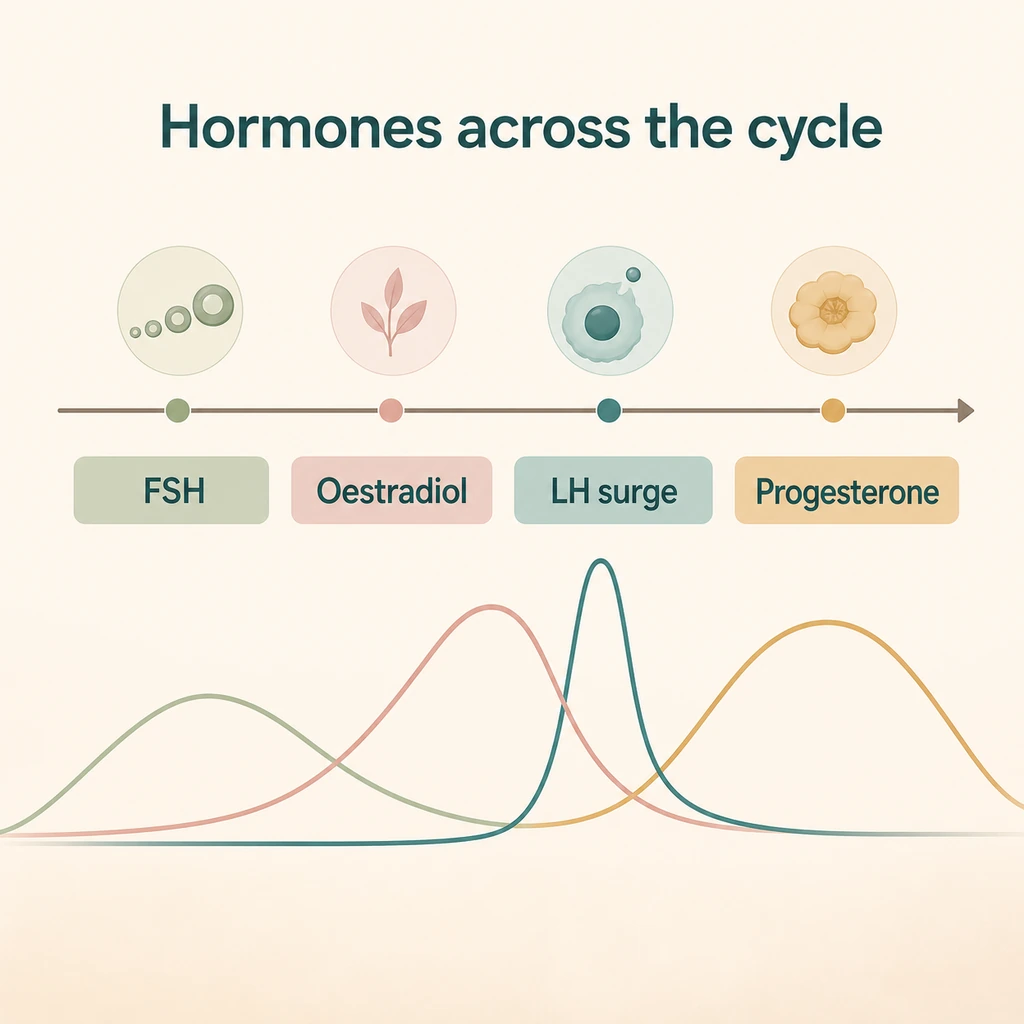
Read the hormones as a cycle sequence
| Hormone | Main cycle role | What a test may help assess | Important limit |
|---|---|---|---|
| FSH | Supports growth and development of ovarian follicles. | Early-cycle pituitary and ovarian signalling, selected ovarian reserve or cycle questions. | A higher or lower result is not a stand-alone fertility diagnosis. |
| Oestradiol (E2) | Produced mainly by developing follicles before ovulation; changes across the cycle. | Follicle activity, cycle stage and response during monitored treatment. | One result without cycle timing or units can be misleading. |
| LH | The mid-cycle surge helps trigger ovulation. | A urine rise can identify a likely fertile phase; blood testing may assist selected diagnoses. | A surge does not prove egg release, and some people have elevated or multiple rises. |
| Progesterone | Rises after ovulation and supports the secretory endometrium. | A timed result can support evidence of recent ovulation or monitor prescribed support. | One value cannot confirm pregnancy, implantation or normal luteal function. |
FSH: useful context, not an ovarian-reserve verdict
Follicle-stimulating hormone is released by the pituitary gland. Early in the cycle, it helps recruit and support follicles. FSH is influenced by feedback from ovarian hormones, particularly oestradiol and inhibins, so the value cannot be read in isolation.
A higher early-cycle FSH may be seen when the ovaries require stronger stimulation to recruit follicles, but it does not mean that conception is impossible. FSH can vary between cycles and laboratories. A clinician may combine it with age, cycle pattern, AMH, antral follicle count and treatment history.
For the broader ovarian-reserve question, read AMH levels and ovarian reserve. AMH and FSH estimate different aspects of ovarian response, and neither measures egg quality directly.
Oestradiol: cycle day and units are essential
Oestradiol is the most relevant oestrogen during the reproductive years. It generally rises as a dominant follicle develops, contributes to endometrial growth and participates in the feedback that leads to the LH surge. It then changes again after ovulation.
Australian reports commonly use pmol/L. A number copied from a US site may use pg/mL and cannot be compared without conversion. Even within the same units, laboratory reference intervals and treatment targets differ. Healthdirect notes that a series of oestrogen tests may be needed because levels change throughout the cycle.
For detailed oestradiol ranges, Australian spelling and units, see the oestradiol and oestrogen guide. Here, oestradiol is shown only as part of the four-hormone sequence.
LH: a fertile-window signal, not proof of ovulation
Home ovulation tests detect an LH rise in urine. Ovulation test strips compare the test line with a control line, while some digital tests use an electronic reader. The interval between the rise and egg release varies, and some cycles have an LH rise without confirmed ovulation. PMOS, perimenopause and some medicines can also make the pattern harder to interpret.
If a home result does not match the cycle, read what ovulation tests can and cannot show. The low LH and ovulation guide covers persistently low or absent signals without treating one home strip as a diagnosis.
Progesterone: timing matters more than a generic “day 21”
Progesterone is secreted mainly by the corpus luteum after ovulation. A blood test intended to assess recent ovulation should be timed to the individual cycle, often around the mid-luteal phase, rather than automatically on calendar day 21. Day 21 is only mid-luteal for a limited set of cycle lengths.
Progesterone is released in pulses, so the concentration can change over a short period. A single appropriately timed result may support that ovulation occurred recently, but it cannot prove that the luteal phase is adequate for implantation or predict pregnancy.
For cycle calculation, use how to calculate luteal-phase length. For investigation and treatment of a repeatedly short interval, use the short luteal-phase assessment guide.

Why one abnormal result may not be the diagnosis
- Cycle day may be wrong. Later ovulation can make an apparently “luteal” test pre-ovulatory.
- Units or reference intervals may differ. Compare the result with the laboratory’s own range and clinical context.
- Hormonal contraception changes the axis. Results may not represent an untreated natural cycle.
- Fertility medicines change expected values. Stimulation, trigger injections and luteal support require clinic-specific interpretation.
- Pregnancy, breastfeeding, perimenopause and illness alter hormones. The clinical question must be stated.
- One result may need repetition or a different test. Trends, ultrasound and symptoms can be more informative than a solitary value.
Common hormone patterns and the questions they raise
| Finding | Possible questions | What not to conclude |
|---|---|---|
| Irregular cycles with clinical or biochemical androgen excess | Could PMOS be present, and have other causes been excluded? | That an LH:FSH ratio or high AMH alone confirms PMOS. |
| High early-cycle FSH | Was oestradiol also elevated? Was the cycle day correct? Is ovarian response being assessed? | That no eggs remain or pregnancy is impossible. |
| No detected LH surge | Was testing timed correctly? Was urine diluted? Are cycles irregular or anovulatory? | That ovulation definitely did not occur in every cycle. |
| Low timed progesterone | Was the sample truly mid-luteal? Did ovulation occur later? Does the result need repetition? | That implantation failed or supplements are automatically required. |
| High or low oestradiol | Which cycle day, units, symptoms and treatment context apply? | That one number diagnoses endometriosis, menopause, PMOS or pregnancy. |
How an Australian clinician may investigate a hormone concern
The GP or specialist starts with the reason for testing: irregular periods, absent ovulation, infertility, symptoms of androgen excess, suspected ovarian insufficiency, treatment monitoring or another concern. They may review cycle history, pregnancy possibility, weight change, eating and exercise patterns, stress, medicines, contraception, thyroid or prolactin symptoms and family history.
Tests can include pregnancy testing, FSH, LH, oestradiol, progesterone, thyroid function, prolactin, androgens, AMH or ultrasound, but not every person needs every test. The order should be driven by the clinical question.
For PMOS diagnosis, read where AMH fits in the Australian PMOS criteria. A four-hormone panel is not a substitute for the complete diagnostic algorithm.
Turn the report into a useful appointment
- Write down the first day of the period and the blood-collection date.
- Record cycle length, LH-test dates and whether ovulation was clinically monitored.
- Bring the complete pathology report with its units and laboratory reference intervals.
- List hormonal contraception, fertility treatment, supplements and prescription medicines.
- Ask what clinical question each result answers and whether it changes management.
- Ask whether a repeat sample, ultrasound or no further testing is the appropriate next step.

Frequently Asked Questions about Fertility Hormones in Australia
How many days am I fertile after a positive LH test?
An LH rise suggests the fertile window is open, but the time to ovulation varies and egg release is not proven by the test. Having sex across the fertile window is more robust than relying on one exact day.
Can I have regular periods but not ovulate?
Usually regular cycles make ovulation more likely, but they do not prove it in every cycle. Clinical assessment may use cycle history, timed progesterone, ultrasound or other context when confirmation matters.
What if progesterone is low on one test?
First check whether the sample was correctly timed. Progesterone fluctuates, and a single result may need repetition or a different assessment before treatment is considered.
Does high FSH mean I cannot conceive?
No. A high result may indicate altered ovarian response in context, but it is not a stand-alone prediction of natural conception or treatment outcome.
Do supplements fix a hormone imbalance?
Not as a general rule. Treatment depends on the cause. Some supplements have limited evidence for selected conditions and can interact with medicines; they should not replace diagnosis.
Can these four hormones diagnose endometriosis?
No. FSH, LH, oestradiol and progesterone do not diagnose endometriosis. In Australia, assessment starts with symptoms and clinical review, with transvaginal ultrasound usually recommended as the first-line investigation. MRI or laparoscopy may be considered in selected circumstances.
Next Steps in Australia
Before interpreting a result, confirm the cycle day, units, reference interval, medicines and clinical reason for testing. Ask the GP or fertility specialist what the result changes. Avoid starting progesterone, ovulation medicine or a high-dose supplement solely from one number, and do not use a home LH result as proof that ovulation occurred.
If pregnancy is possible, check the timing guidance in the false-negative pregnancy test guide. hCG is the hormone detected for pregnancy; the four hormones discussed here cannot replace an hCG pregnancy test.
Last reviewed: 31 July 2026
Next scheduled review: July 2027
References
Fertility2Family articles are researched using Australian Government health guidance, professional clinical recommendations and peer-reviewed medical literature. The references below were used to research and medically review this article and provide additional reading for readers who want to read the evidence in more detail.
Pregnancy, Birth and Baby / Healthdirect Australia Ovulation and fertility
Explains ovulation, the fertile window, cycle signs and home ovulation testing, including why an LH rise predicts a fertile phase but does not confirm egg release.
Healthdirect Australia Follicle stimulating hormone
Explains FSH production, menstrual-cycle variation, blood testing and fertility-related indications, including why FSH is commonly interpreted alongside other hormones and clinical findings.
Healthdirect Australia hCG test
Explains urine and blood hCG testing for pregnancy detection and monitoring, clarifying that hCG is distinct from FSH, LH, oestradiol and progesterone.
Monash University PCOS Guideline/ PMOS Guideline
Provides the international evidence-based PMOS guideline and supporting resources, including diagnostic recommendations and why isolated AMH, LH or FSH findings cannot establish the diagnosis.
Healthdirect Australia Oestrogen blood test
Explains oestradiol testing, menstrual-cycle variation and why serial measurements may be needed, supporting interpretation using cycle phase, symptoms and the laboratory reference interval.
Australian Journal of General Practice An update on fertility assistance and assisted reproductive technologies
Reviews fertility assessment in Australian general practice, including cycle-day hormone testing and timing progesterone approximately seven days after ovulation rather than automatically on day 21.
Royal College of Pathologists of Australasia Follicle stimulating hormone
Provides Australasian pathology guidance on FSH specimens, assay-dependent reference intervals, clinical applications and interpretation, including the importance of menstrual-cycle and pituitary-ovarian context.
Royal College of Pathologists of Australasia Luteinising hormone
Provides Australasian pathology guidance on LH testing for infertility and gonadal or pituitary assessment, with results interpreted according to cycle stage and related hormone findings.
Royal College of Pathologists of Australasia Oestradiol
Provides Australasian pathology guidance on oestradiol assays, cycle-related reference intervals, ovulation-induction monitoring and assessment of suspected ovarian, hypothalamic or pituitary disorders.
Royal College of Pathologists of Australasia Progesterone
Provides Australasian pathology guidance on serum progesterone collection, method-dependent reference intervals and interpretation when investigating ovulation, infertility or corpus-luteum function.
Royal Australian and New Zealand College of Obstetricians and Gynaecologists Australian Living Evidence Guideline: Endometriosis
Provides current Australian recommendations for endometriosis assessment and management, including transvaginal ultrasound as first-line investigation and selective use of MRI or diagnostic laparoscopy.
Journal of Applied Physiology Menstrual cycle hormones and oral contraceptives: a multimethod systems physiology-based review of their impact on key aspects of female physiology
Reviews menstrual-cycle changes in oestrogen, progesterone, LH and FSH and the physiological effects of oral contraceptives across multiple body systems.
Human Reproduction Update The LH surge and ovulation re-visited: a systematic review and meta-analysis
Systematically reviews the timing and variability of LH surges relative to ovulation, demonstrating why one urinary or serum LH rise cannot prove exact ovulation timing.
Human Reproduction Prospective 1-year assessment of within-woman variability of follicular and luteal phase lengths in healthy women prescreened to have normal menstrual cycle and luteal phase lengths
Reports within-person variability in follicular and luteal phase lengths over one year, supporting cautious interpretation of calendar-derived ovulation and mid-luteal testing dates.
The Journal of Clinical Endocrinology & Metabolism Recommendations From the 2023 International Evidence-based Guideline for the Assessment and Management of Polycystic Ovary Syndrome
Presents Australian-led international recommendations for PMOS diagnosis and management, including exclusion of alternative causes and use of the complete diagnostic algorithm rather than isolated hormones.
Fertility and Sterility Diagnosis and treatment of luteal phase deficiency: a Committee Opinion
Reviews current evidence and uncertainty surrounding luteal phase deficiency, including progesterone pulsatility, limitations of single measurements and the absence of a reliable stand-alone diagnostic test.