


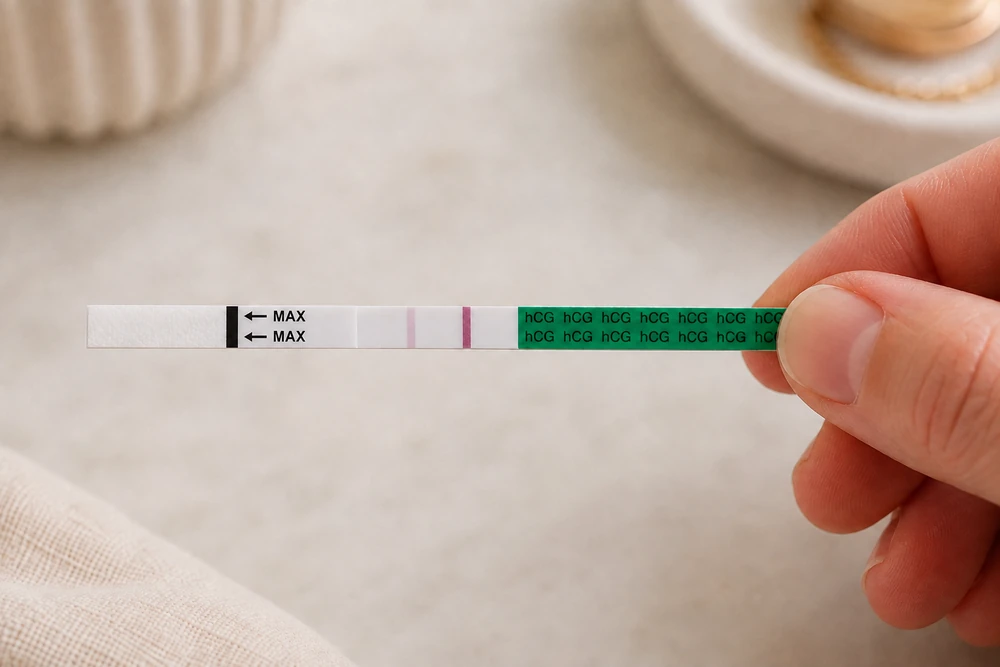
You have taken a pregnancy test and there are two lines, but the second is so faint that you are not sure it counts. A faint coloured line in the correct test area that appeared within the device’s valid reading window should be treated as a possible positive when the control shows the test worked. A mark first noticed after the cut-off is not a valid new result.
A true positive can be very light when testing is early or urine is dilute. Line darkness cannot measure the exact hCG level, show where a pregnancy is located or prove that it is developing normally.
Check the instructions for the test you used, then repeat with a fresh device when advised or arrange GP follow-up after a positive result. Bleeding, significant pain, shoulder-tip pain, dizziness or fainting changes the next step and needs medical assessment.
Quick answers about faint pregnancy test lines
Does a faint line on a pregnancy test mean you are pregnant?
A faint coloured test line that appeared within the valid reading window may mean hCG was detected. Treat it as a possible positive when the control indicator is valid and the line matches the instructions for that device.
How can you tell whether a faint line is valid?
Check when the line appeared, whether the control indicator appeared, whether the mark is in the stated test area and whether it has the expected colour and shape. A late, colourless, incomplete or smeared mark needs a fresh test rather than more inspection.
When should you retest or seek medical care?
Follow the interval in the product directions. If an early result is unclear, waiting about 48 hours is usually more useful than repeated same-day testing. Contact a GP for mixed results or bleeding, and seek urgent care for strong pain, heavy bleeding, shoulder-tip pain, dizziness or fainting.
Pregnancy test line checker
Pregnancy Test Line Result Guide
Check one pregnancy test by control, timing and line appearance. No photo upload is required.
Timed result check
Check one pregnancy test in the right order
Safety, device validity, timing and exact format come before line darkness.
No photo is needed for this guide.
Your result
Next step:
Use four checks before trusting a faint line
Start with the reading time, then check the control indicator, the position of the mark and whether it has the expected colour and shape. These details are more useful than asking whether the line is dark enough.
| Check | What supports a possible positive | What needs a fresh test |
|---|---|---|
| Timing | The line appeared inside the stated reading window. | The mark was first noticed after the cut-off or after the test dried. |
| Control | The control indicator appeared as the instructions describe. | The control is absent or does not meet that device’s validity rule. |
| Position | The line is in the stated test-line area. | The mark sits outside the result area or runs across the background. |
| Appearance | The line has the expected dye and forms in the test area. | It is colourless, unusually thin, incomplete, smeared or pooled. |
| Next action | Treat it as a possible positive and follow the device directions. | Set the old test aside and repeat with a new, in-date device. |
A valid control shows that the test developed as intended. It does not measure hCG or make an out-of-window line reliable.
How faint can a positive pregnancy-test line be?
There is no universal minimum darkness that you can judge by eye. A very faint or almost invisible coloured line may still be a possible positive when it appears in the correct place, inside the valid reading window and with a valid control.
Early in pregnancy, urine hCG may be close to the device’s detection threshold, so less dye collects in the test area. A sample taken after a large amount of fluid can also be lighter. First-morning urine is often useful for an early repeat because it is usually more concentrated.
Different brands and formats can use different thresholds, dyes and displays. Compare each result with its own instructions rather than comparing line shade across devices.
Faint positive or evaporation line: which detail matters most?
Timing comes first. A coloured line that developed during the permitted result window may indicate hCG. A mark first noticed after the window has closed should not be promoted to a positive because it later looks pink, blue or darker.
The dedicated guide to an evaporation line on a pregnancy test explains late drying marks, indents and dye changes in more detail. For the test in front of you, record when the mark first appeared and stop interpreting it after the stated cut-off.
A phone photograph can preserve the in-window appearance, but it cannot prove the timing, sample technique or control validity. Lighting, contrast and filters can also make a weak mark look stronger.
What do a faint control line, partial line or blurry mark mean?
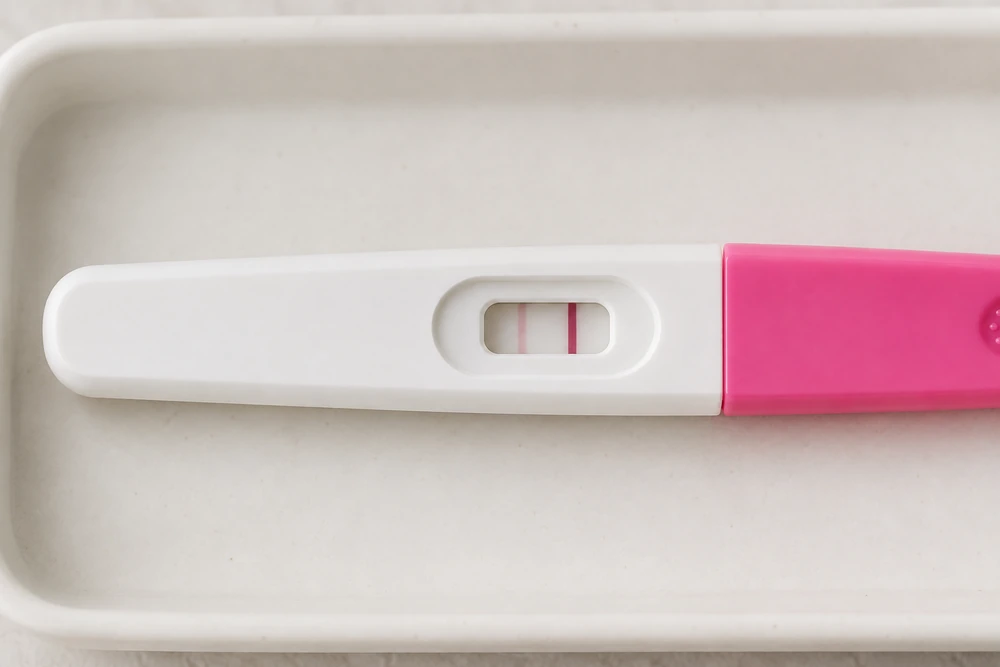
A faint control line is about test validity, not pregnancy hormone level. If it appears in the way the instructions define as valid, assess the test area normally. If the control is missing or abnormal under those instructions, the result is invalid.
A half line, hair-thin groove, blurred patch, dye run or pooled background does not have one universal meaning. Uneven sample flow, too much or too little urine, an expired device or a test fault can make the result difficult to read. Use a fresh test rather than trying to diagnose the shape.
When should you retest after a faint or unclear result?
Use the repeat interval supplied with the exact test. For an early unclear result, that interval is often about 48 hours; multiple same-day tests mainly add differences in urine concentration.
- Record the original result. Note the sample time, control result and exact minute the line first appeared.
- Use a fresh, in-date device. Do not reuse or re-dip the old test.
- Reduce avoidable dilution. First-morning urine can be useful when testing early, and deliberately drinking a large amount beforehand can make interpretation harder.
- Read once, on time. Use a timer and stop interpreting changes after the cut-off.
- Escalate when the context changes. Contact a GP or fertility clinic for repeated mixed results, a positive result followed by bleeding, recent hCG treatment or a recent pregnancy.
The Pregnancy Test Timing Calculator can help choose a more useful date from an ovulation clue or expected period. An early negative may still be provisional when ovulation or implantation occurred later than estimated.
Can line progression show whether the pregnancy is healthy?
No. A home urine test is qualitative. It reports whether hCG was detected above that device’s threshold, not the exact concentration or a medically reliable doubling pattern.
A line can look darker because urine is more concentrated, the device differs or the image was taken under different lighting. A similar or lighter line does not diagnose a problem, and a dark line does not prove viability, pregnancy location or twins.
If a clinician needs to assess an early pregnancy, quantitative blood hCG and ultrasound may be used for a defined clinical question. The guide to hCG doubling time explains why blood trends are interpreted with dates, symptoms and imaging rather than one universal rule.
What if a faint positive is followed by a negative test?
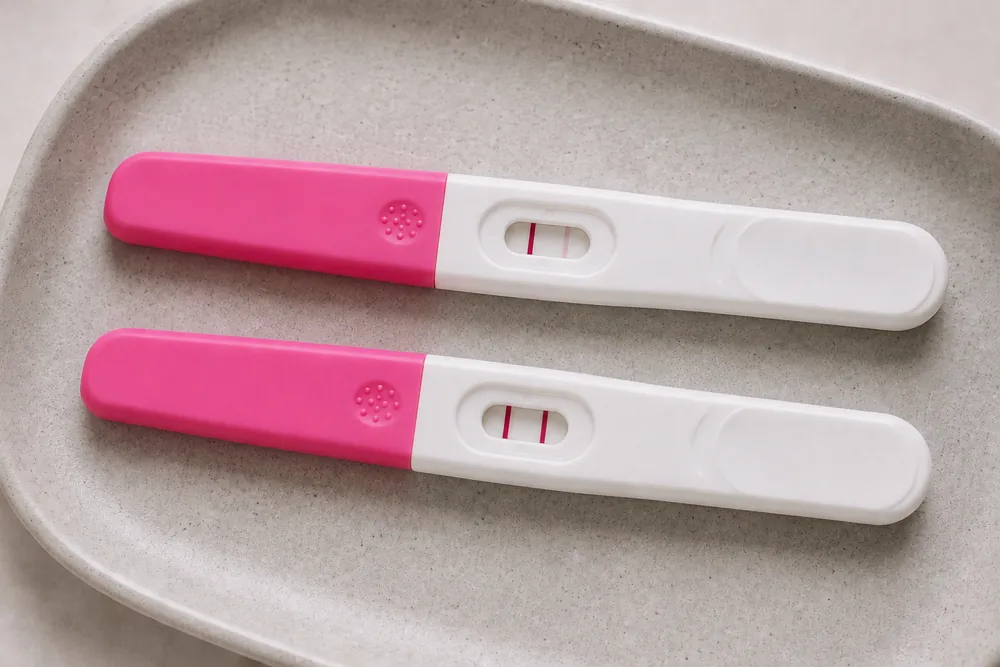
Mixed results can reflect a more dilute second sample, different device thresholds, a result read outside its window or a pregnancy in which hCG is changing. A very early pregnancy that is no longer progressing is another possibility, but home-test photographs cannot establish the cause.
If the first result was clearly coloured, appeared on time and had a valid control, contact a GP when later results are negative or inconsistent, especially if there is bleeding or pain. When the first test may simply have been early, the false-negative pregnancy-test guide explains how timing, dilution and use errors can affect a negative result.
How do fertility treatment and a recent pregnancy change the result?
Some fertility medicines contain hCG, the same hormone detected by a pregnancy test. Current Australian Ovidrel information states that it may interfere with urine or blood hCG testing for up to ten days and produce a false-positive result. Follow the clinic’s nominated test date rather than trying to judge whether an injection line is fading.
The Ovidrel and trigger-shot guide explains why clinic-directed timing matters. Do not stop progesterone or another prescribed fertility medicine because of one home result unless the treating clinic tells you to do so.
hCG can also remain detectable for a time after a recent pregnancy or pregnancy loss while levels fall. The guide to how hCG falls after miscarriage explains why a persistent faint line needs to be interpreted with the timeline and symptoms.
What if there is bleeding or pain?
Contact a GP, midwife, fertility clinic or early-pregnancy service when a valid positive is accompanied by bleeding, even if the bleeding is light and you otherwise feel well. Line strength cannot show where the pregnancy is located or whether the bleeding is harmless.
Go to an emergency department for worsening or heavy bleeding, significant abdominal or one-sided pelvic pain, shoulder-tip pain, dizziness, faintness or feeling very unwell. A faint or negative home result does not rule out ectopic pregnancy when concerning symptoms are present.
Call triple zero on 000 for very heavy bleeding, strong pain with fainting or collapse, or another immediate or life-threatening emergency.
Pregnancy tests and ovulation tests answer different questions
A pregnancy test detects hCG. By contrast, ovulation tests detect urinary luteinising hormone, or LH, to help estimate when ovulation may be approaching. An ovulation test is not designed or validated to confirm pregnancy, even when its test line looks dark.
Keep the collection method, reading rule and interpretation for each device separate. A faint OPK line follows that product’s LH instructions and should not be read as a pregnancy result.
Which pregnancy-test format is easiest to repeat correctly?
Choose the format you can use accurately. A strip uses collected urine and requires careful dipping. A midstream test receives urine directly. A digital test displays words or symbols instead of asking you to judge a visible test line, but it can still be negative when testing is too early.
Use the current pregnancy test strip instructions for dip tests and the separate midstream pregnancy test instructions for direct-use tests. Do not borrow the timing or sample method from another format.
What should you record before asking for help?
Keep the brand and format, expiry date, sample time, expected period or estimated days past ovulation, control result and exact minute the second line first appeared. Also note whether urine may have been dilute, whether hCG fertility medicine was used, any recent pregnancy and any bleeding or pain.
If your period remains late while repeat tests are negative, the guide to no period with a negative pregnancy test covers timing and other reasons the result may not match what you expected.
Frequently Asked Questions about Faint Pregnancy Test Lines in Australia
Can a faint line be negative?
Yes, when the mark is a late drying change, a colourless indent, a dye run or part of an invalid result. A faint coloured line that appeared on time with a valid control should instead be treated as a possible positive.
Can a faint line appear before a missed period?
Yes. A pregnancy may produce an in-window faint line before the period is due, but an early negative is less conclusive. Follow the device directions and repeat at the recommended interval if needed.
Can a faint line mean twins?
No. Home-test line darkness cannot diagnose twins or count embryos. hCG varies widely, and urine concentration and device design affect the line. Multiple pregnancy is confirmed by ultrasound, not by a darker or earlier test.
Can an expired pregnancy test show a faint line?
An expired or damaged test may not perform reliably, so do not use its line to decide whether you are pregnant. Repeat the result with a fresh, in-date device and follow the instructions supplied with that test.
Can a phone photo or app confirm a faint positive?
No. A photo cannot show when the line first appeared, whether the control was valid or whether the test was used correctly. Lighting, contrast and filters can also change a faint mark, so confirm an unclear result with a fresh, correctly timed test.
Should I test again tomorrow after a faint line?
Follow the directions for the test you used. When a result is very early or unclear, waiting about 48 hours is often more informative than testing the next morning because urine concentration and small timing differences can change the appearance.
Next Steps in Australia
Set the used test aside after its reading window. Treat a valid in-window faint coloured line as a possible positive, repeat with a fresh test when the device instructions advise it and arrange healthcare follow-up rather than using line darkness as a pregnancy-health measure.
After a clear positive result, the next steps after a positive pregnancy test can help you prepare for Australian pregnancy care. Contact a healthcare professional sooner for mixed results, fertility-treatment questions, recent pregnancy loss, bleeding or pain.
Last reviewed: 5 September 2026
Next scheduled review: September 2027
References
Fertility2Family articles are researched using Australian Government health guidance, current medicine and device information, professional clinical recommendations and peer-reviewed medical literature. The references below were used to research and review this article and provide additional reading for readers who want to explore the evidence in more detail.
Pregnancy, Birth and Baby. Pregnancy tests
Australian guidance on home pregnancy testing, hCG detection, test timing, first-morning urine, early false negatives, following device instructions and arranging medical follow-up after a positive result.
Healthdirect Australia. Human chorionic gonadotropin (hCG) test – pregnancy
Australian guidance distinguishing qualitative urine tests from quantitative blood tests, including urine dilution, first-morning testing, early false negatives, repeat testing and GP review when results seem incorrect.
Better Health Channel. Pregnancy testing
Victorian Government guidance on home pregnancy-test timing, faint positive results, first-morning urine, following manufacturer instructions, causes of inaccurate tests and medical confirmation after a positive result.
Pregnancy, Birth and Baby. hCG levels
Australian information on hCG in urine and blood, biological variation, early pregnancy detection and why one result or home-test line cannot establish pregnancy location or viability.
Healthdirect Australia. Ectopic pregnancy
Australian guidance on ectopic-pregnancy symptoms, diagnosis and urgent assessment, including abdominal pain, shoulder-tip pain, vaginal bleeding, dizziness, fainting and when emergency care is required.
Pregnancy, Birth and Baby. Bleeding during pregnancy
Australian guidance explaining that pregnancy bleeding has several possible causes, should be discussed with a doctor or midwife, and can require urgent assessment when significant symptoms occur.
Healthdirect Australia. Miscarriage
Australian guidance on pregnancy-loss symptoms, testing, follow-up and urgent care, supporting cautious interpretation when a positive home result is followed by bleeding or a later negative test.
Australian Commission on Safety and Quality in Health Care. Ovidrel Pen
Current Australian medicine information stating that choriogonadotropin alfa may interfere with serum or urine hCG testing for up to ten days and produce a false-positive pregnancy test.
Pregnancy, Birth and Baby. Ovulation and fertility
Australian consumer guidance on ovulation, the fertile window and urinary LH testing, supporting the distinction between an ovulation predictor result and an hCG pregnancy test.
Fertility2Family. Pregnancy Test Strip Instructions: How to Dip and Read
Current Fertility2Family directions covering clean sample collection, dipping depth and time, reading-window limits, control-line validity, retesting and positive, negative and invalid strip results.
Fertility2Family. Midstream Pregnancy Test Instructions: How to Use and Read
Current Fertility2Family directions covering direct urine application, reading-window limits, control-line validity, retesting and the interpretation limits of midstream home pregnancy testing.
Obstetrics and Gynecology International. β-Human Chorionic Gonadotropin Dynamics in Early Gestational Events: A Practical and Updated Reappraisal
Peer-reviewed 2024 review distinguishing qualitative urine detection from quantitative serum measurement and explaining why hCG results require interpretation with symptoms, dates and ultrasound in early pregnancy.
Fertility and Sterility. Home Pregnancy Test Sensitivity by Test Timing and Cycle Length with Real-World Use Among Pregnancy Planners who Conceived
Prospective real-world research showing that home pregnancy-test sensitivity changes with testing day and cycle length, supporting caution with early negative results and one-size-fits-all testing assumptions.