
When could implantation happen?
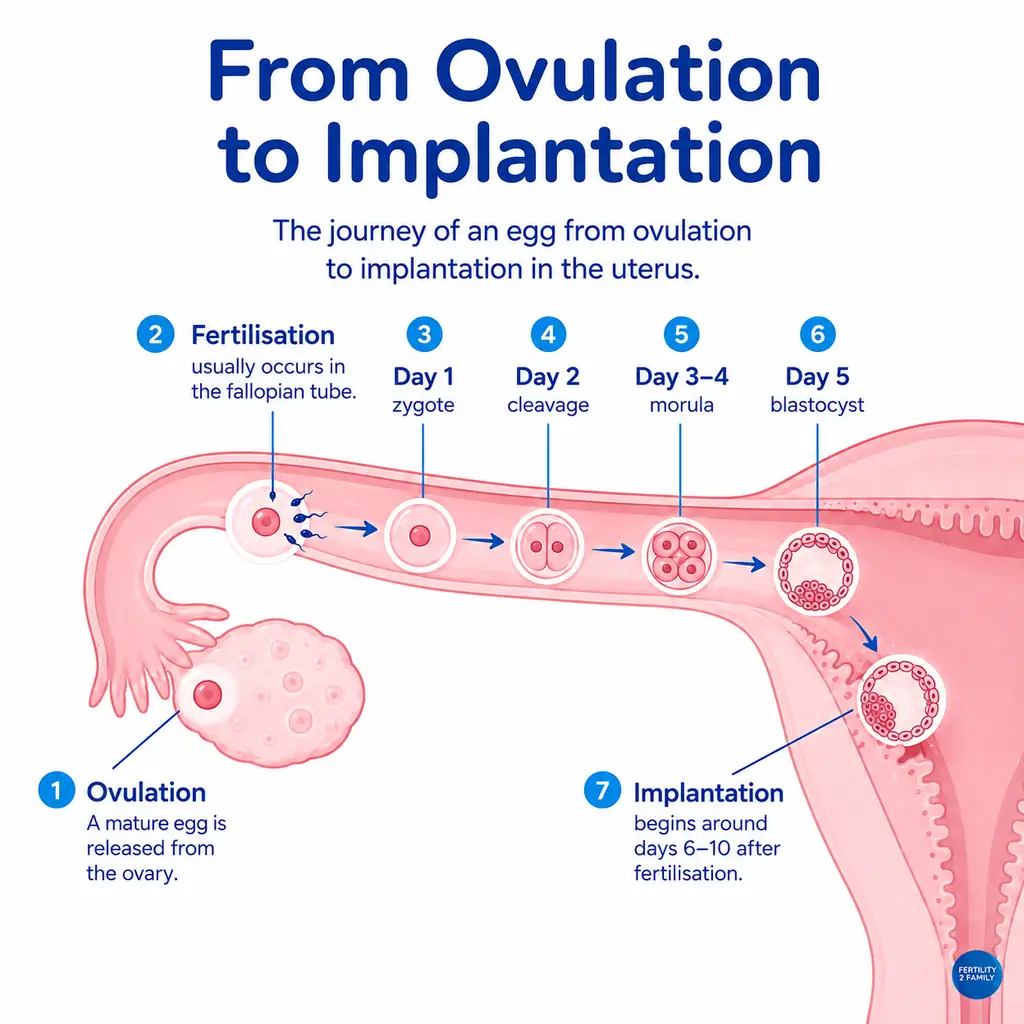
Implantation most often happens 8 to 10 days after ovulation, with a wider possible window of 6 to 12 days. A home test cannot detect hCG until after implantation.

Implantation Calculator
Your date estimate
Your possible implantation window
Possible implantation timing
What to do next:
Where today sits
Next useful decision
Spotting, cramps or a temperature dip cannot confirm implantation
A date estimate cannot identify the cause of bleeding or pain. Seek prompt medical advice for heavy bleeding, severe or one-sided pain, shoulder-tip pain, dizziness or fainting.
Use this calculator to see when implantation could happen and when a test could first show it.
Everything behind the result
 How this tool worksWhy implantation timing sets the earliest useful test day
How this tool works
Why implantation timing sets the earliest useful test day
After fertilisation the embryo travels for several days and attaches to the uterine lining between 6 and 12 days past ovulation, most often days 8 to 10.
The calculator maps that window onto your calendar and shows the earliest day a home test could realistically detect hCG.

The full data tableEvery row this tool reads from.

Implantation day and earliest possible positive test, by DPO
Every implantation day this calculator treats as possible, with the earliest day a urine test could begin to detect hCG for that day.
| Implantation day | How common | hCG detectable from about | What a negative test before that means |
|---|---|---|---|
| 6 DPO | Possible, uncommon | 9 to 10 DPO | Too early to rule pregnancy out |
| 7 DPO | Possible | 10 to 11 DPO | Too early to rule pregnancy out |
| 8 DPO | Most common (84% occur on days 8, 9 and 10) | 11 to 12 DPO | Too early to rule pregnancy out |
| 9 DPO | Most common (mean day 9.1) | 12 to 13 DPO | Too early to rule pregnancy out |
| 10 DPO | Most common | 13 to 14 DPO | Too early to rule pregnancy out |
| 11 DPO | Possible | 14 to 15 DPO | Too early to rule pregnancy out |
| 12 DPO | Possible, uncommon | 15 to 16 DPO | Too early to rule pregnancy out |
Implantation timing is from Wilcox 1999 (N Engl J Med 1999;340:1796-9). The detection interval is from Chard 1992 (Hum Reprod 1992;7:701-10) for a 25 mIU/mL urine test. These are population figures; they do not give an individual chance of pregnancy, and no home test can confirm that implantation occurred.
Test instructionsFertility2Family, or the instructions with your own pack.

Test instructions
Timing and reading rules come from the instructions supplied with the test you are using.
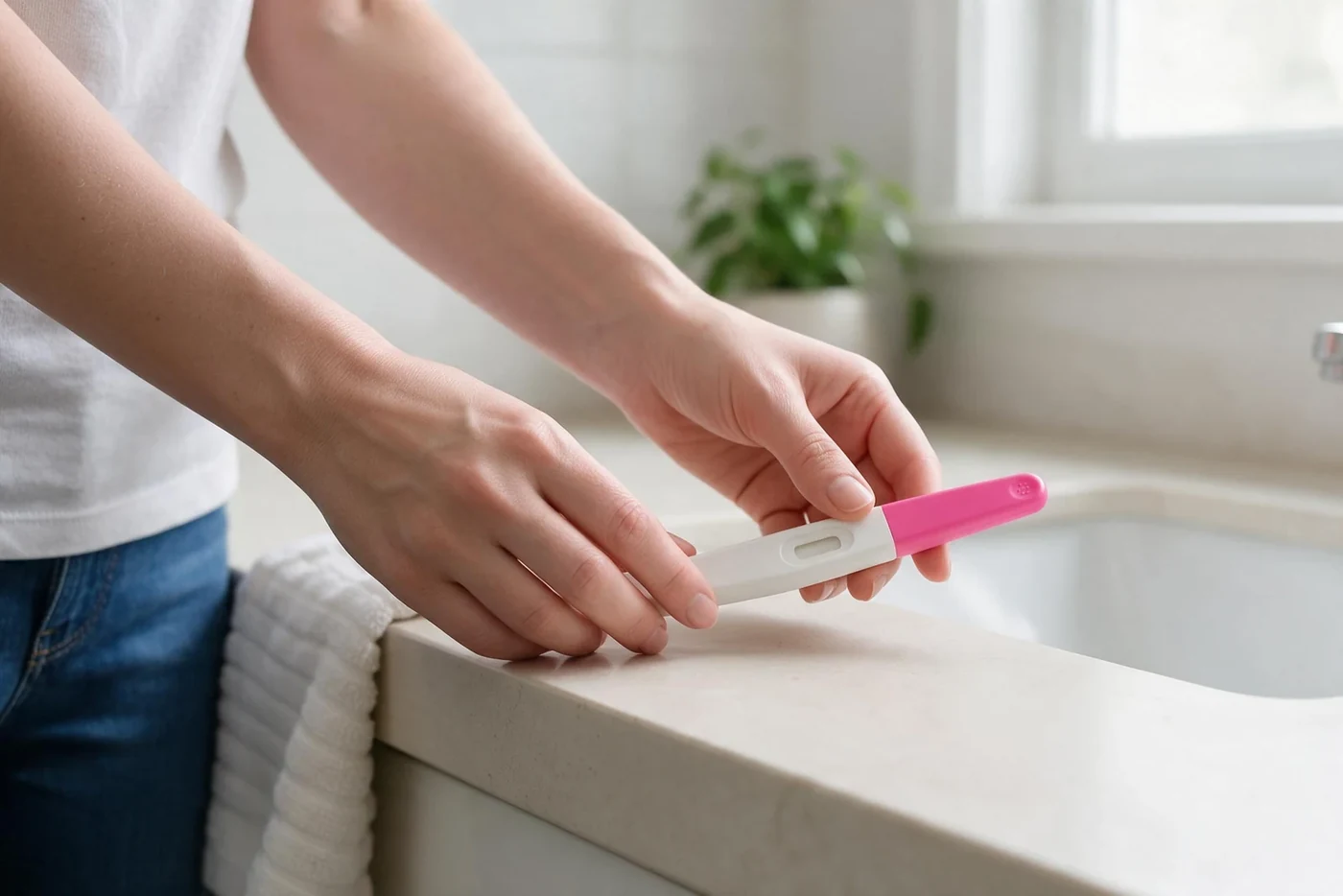
- Read the result at 5 minutes.
- A mark appearing after 10 minutes does not count.
- Follow the instruction sheet supplied with the pack.
- Read the result at 5 minutes.
- A mark appearing after 10 minutes does not count.
- Follow the instruction sheet supplied with the pack.
Use the instruction sheet that came with that product. Reading times differ between brands, so the timings above do not apply.
The full referenceEverything this tool draws on, in detail.Show the detail
A useful timeline without false certainty
See the broad window, the common days and what comes next
The calculator starts from estimated ovulation, then separates the possible window from the dates that appeared most often in observational research.
Quick answers
What an implantation window can and cannot show
Broad research window
About 6 to 12 DPO
This describes observed timing across pregnancies, not a predicted event for one person.
More common timing
Research observations clustered around 8 to 10 DPO
Common does not mean guaranteed.
Symptoms
Spotting and cramps cannot confirm implantation
Calendar timing cannot identify the cause of bleeding or pain.
Pregnancy testing
Use the expected period as the practical milestone
A calculated implantation day is not a reliable home-test date.
Understanding the estimate
Why an implantation calculator can only show a window
Implantation timing is not directly visible at home. The calculator begins with an estimated ovulation range, then adds the broad 6 to 12 DPO interval observed in foundational research. It separately highlights 8 to 10 DPO because those days accounted for most ongoing pregnancies in that study.
Why a 28-day cycle does not guarantee one date
A 28-day cycle does not prove that ovulation occurred on cycle day 14. Follicular timing varies, and LH or calendar estimates retain uncertainty. An ovulation date provides a narrower estimate than an expected period because fewer assumptions are required.
Do not use spotting or symptoms as confirmation
Spotting, cramps, discharge changes or a single BBT dip cannot identify implantation. Bleeding and pain should be assessed according to their severity and context rather than being labelled from a calculated window.
Use the tool that matches the next decision
From ovulation estimate to a possible implantation window
Continue with the right resource
Implantation, DPO and testing resources for the next stage

Related tool
Pregnancy Test Timing Calculator
Use the expected period, LH result or ovulation date to choose a practical test date.
Plan pregnancy testing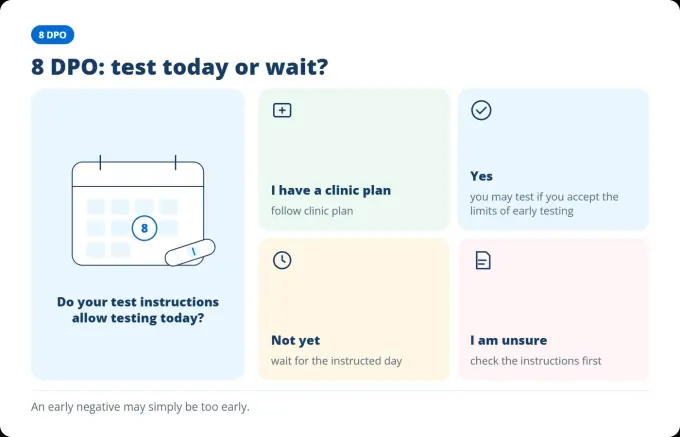
Related tool
DPO Calculator
Calculate where today or another date sits after estimated ovulation.
Calculate your likely DPO
Bleeding guide
Implantation bleeding information
Review what spotting can and cannot tell you, plus when medical assessment matters.
Read the bleeding guide
Cycle guide
Luteal phase length
Understand the phase between ovulation and the next period.
Read the luteal phase guideAustralian evidence and resources
These sources provide general Australian or product context. They do not replace advice from a qualified clinician.
- Implantation timing research
PubMed / NEJM Primary research on implantation timing; not an Australian guideline and not proof of implantation in an individual.
- hCG levels
Healthdirect Australia The timing limits of hCG detection and why an early result may not settle a pregnancy question.
- Ectopic pregnancy
Healthdirect Australia Pregnancy-related warning symptoms and when urgent assessment or triple zero (000) is needed.
Frequently asked questions
- Can I feel implantation?
- No reliably. Cramping and spotting happen in cycles with and without pregnancy.
- Does implantation bleeding mean I am pregnant?
- Not on its own. Only a positive test at the right time can show that.
- When should I test after the window?
- Two to three days after the last day of the window, with first-morning urine.
- Does late implantation affect the pregnancy?
- Later implantation is associated with a higher loss rate in studies, but many late implanters have healthy pregnancies. Your GP can advise.


Australian evidence and resourcesShow sources
This is an educational timing aid, not a diagnosis.
Sources: Healthdirect Australia · Therapeutic Goods Administration · Fertility2Family
Early testing, sample dilution and following the exact test instructions.healthdirect.gov.au ↗
The timing limits of detection and why an early result may not settle the question.healthdirect.gov.au ↗
Warning symptoms and when urgent assessment or triple zero is needed.healthdirect.gov.au ↗
hCG cross-reactivity and treatment-cycle interpretation limits.tga.gov.au ↗
Collection, reading window and product limits for strips.PDF ↗
Collection, reading window and product limits for midstream tests.PDF ↗