
13 min read
Dec 1, 2025
What Are Evaporation Lines?

Written by
Fertility2Family Team

Medically reviewed by
Evan Kurzyp, RN (AHPRA), BSN, Master of Nursing
Seeing a very faint second line on a home pregnancy test can be thrilling or nerve-racking. Many people believe any second line means a definite pregnancy, but that is not always right. A faint, colourless mark can be an evaporation line. These lines form as urine dries on the test strip and can be mistaken for a positive result. The key difference is that real positives contain dye that matches the control line, even if the test line is lighter. Understanding what an evaporation line is, why it appears, and how to reduce the chance of seeing one will save worry and repeat testing. This guide explains timing, technique, and when to see a GP in Australia. It also shows how at-home tests fit into a careful fertility plan.
Quick Answers About Evaporation Lines
What is an evaporation line on a pregnancy test?
An evaporation line is a faint, colourless or grey mark that can appear as urine dries on the test strip. It does not contain dye. It often shows up after the reading window has passed or when the test is over-saturated.
How can I tell an evaporation line from a positive result?
A true positive line contains dye that matches the colour of the control line, even if it is light. It appears within the stated time on the instructions. An evaporation line looks grey or colourless and often shows up after the time limit.
Can an evaporation line appear within the reading window?
It is uncommon but possible, especially if the test is very wet or the sample is dilute. Careful timing, correct dipping, and reading the result within the stated minutes reduce this chance. If unsure, test again in 48 to 72 hours.
What Are Evaporation Lines on a Pregnancy Test
An evaporation line is a mark that forms as liquid dries on the test strip. Home pregnancy tests detect human chorionic gonadotrophin, or hCG, a hormone made during pregnancy. The test area contains antibodies that change colour when hCG is present. When urine dries on that area without the hormone being present, drying can sometimes leave a faint streak or shadow that looks like a line. This is not a positive result. It is a drying artefact. You can read more about general pregnancy testing at this overview. For a deeper look at evaporation lines specifically, see this explanation of evaporation lines.
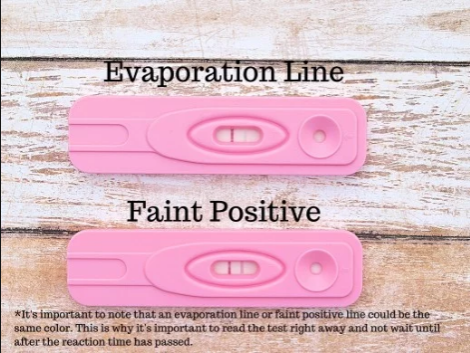
Evaporation lines are more likely if the test is read outside the stated timeframe. Many brands suggest reading at three to five minutes. Some people check again after ten or twenty minutes and see a shadow that was not there earlier. That late line is likely an evaporation line and not a positive. The safest approach is to follow the timing on the box and disregard any change after the reading window.
Why Evaporation Lines Happen
Evaporation lines are about drying and contrast, not pregnancy. As urine dries, minerals and other components can leave a faint residue where the test reagents sit. Lighting can make these lines more obvious. A bright light or a photo edit can pull out shadows that were not visible at first glance. Testing with very dilute urine may add to confusion because the control line can look lighter and the background can show more streaks as it dries.
Reading outside the time limit is the main reason people see evaporation lines. Over-saturation of the test strip is another reason. If too much urine floods the window the fluid can pool and dry unevenly. Storing tests in hot cars or humid bathrooms can harm the reagents and make false lines more likely. Using a brand with blue dye can increase the chance of greyish shadows that trick the eye. Many people prefer pink dye tests because faint positives are easier to see and faint greys are easier to ignore.
How Pregnancy Tests Are Read and Timed
Every test brand sets a reading window. For pregnancy tests sold in Australia, it is often three to five minutes. Some early-result tests suggest waiting up to ten minutes. The instructions outline how long to dip, how long to wait, and when the result is valid. Reading before the earliest time can miss a true positive. Reading after the latest time invites evaporation lines. The middle of the window is usually the safest time to read.
Technique matters. Collect urine in a clean collection cup to control saturation. Dip only to the indicated line for the specified seconds. Keep the test flat while it develops. Use first morning urine when testing early because it is more concentrated. If you have been drinking a lot of water, wait two to three hours before testing so the sample is not too dilute.
Always check the control line. If the control does not appear or looks abnormal the test is invalid. Discard and repeat with a new test. You can review step by step instructions specific to strips here: pregnancy test strip guide. Keeping to the stated process reduces both false negatives and misleading evaporation marks.
Evaporation Line Or Positive Result
A true positive has colour. On a pink dye test it will look light pink through to dark pink. On a blue dye test it will look light blue through to dark blue. The test line should sit where the brand places its positive line and should have similar thickness to the control. It may be lighter than the control early in pregnancy. What matters is that it is visible, has colour, and appears within the reading window stated in the instructions.
An evaporation line looks grey, silver, or colourless. It may look like an indent or a shiny streak. It often appears after the time limit. If a mark only becomes obvious under a lamp or in a highly edited photo it is more likely an evaporation line. When in doubt, wait 48 to 72 hours and test again. During early pregnancy hCG roughly doubles every two to three days. A real positive usually becomes darker across that period, while an evaporation line does not follow that pattern. If repeated home tests remain unclear, a GP can arrange a blood test to check hCG directly.

How To Lower The Chance of Evaporation Lines At Home
Time your test well. If you are testing before a missed period, use first morning urine, as it is more concentrated. Early testing increases the chance of squinting at faint lines that are hard to judge. If you test early and see a very light line that is hard to read, wait two days and test again. If it is real, it should gain colour. You can reduce confusion by waiting until after your missed period.
Select the right tool for the job. Many find pink dye tests easier to read than blue dye tests because greyish streaks are less confusing. Choose a sensitive test if you plan to test early. Online options such as Fertility2Family pregnancy tests are designed to detect lower hCG levels, which can be helpful when testing before your period is due, though early positives can also pick up chemical pregnancies. These early losses are common and usually do not point to a long term fertility problem. If you have had a recent loss and are trying again, this guide may help: pregnancy after miscarriage.
Follow the instructions closely. Do not overfill the sample area. Dip for the exact seconds stated. Keep the test flat. Read at the right time and discard afterwards. Avoid expired tests and store new tests away from heat and humidity. If you are concerned about splashing, collect urine in a clean cup and dip the strip.
Digital Tests, Strips, and Midstream Sticks
Digital pregnancy tests display words, such as pregnant or not pregnant, rather than lines. They do not show evaporation lines in the window because they rely on an internal sensor that interprets the signal and displays text. They can still give false negatives if used too early or if the urine sample is too dilute. Strips and midstream sticks show lines and are more prone to user interpretation. Many people use strips for early, frequent testing and confirm later with a digital device after a missed period.
Midstream options are convenient when you prefer not to use a cup. Many Australians choose midstream pregnancy tests for simplicity at home. If you are also tracking ovulation to time intercourse, an ovulation test can help identify your fertile window. Using both together can shorten time to pregnancy, which studies suggest can reduce stress for some people. Always keep expectations realistic. No home test can guarantee conception within a set timeframe.
When To See A GP Or Arrange Tests In Australia
See your GP if repeated home results are unclear, if you have symptoms of pregnancy with negative tests, or if you have pain or bleeding. Your GP can order a blood test that measures hCG in units per litre, which gives a clear result and can be repeated after two days to check for expected rise. This is useful after a faint home test or when the result could be a chemical pregnancy. If you have missed a period and tests remain negative, you may need a review to look at cycle changes, stress, thyroid, prolactin, or other causes.
If you suspect an ectopic pregnancy, which can cause one sided pain or bleeding, seek urgent care at an emergency department. If you are actively trying to conceive and have not conceived after twelve months, or after six months if you are 35 or older, talk with your GP about a fertility assessment and a referral to a specialist as per Australian practice guidelines. Early support can save time and worry.
Reading Technique: Step By Step Without Second Guessing
Before opening the test, check the expiry date. Wash your hands and set a timer on your phone for the reading window. Collect urine in a clean cup if using strips. Dip only to the indicated line and for the stated seconds. Place the test flat on a clean surface. Watch for the fluid to run across the window. Do not lift or tilt the test while it develops. Wait until the earliest reading time, then check the result in good natural light. If the time window is three to five minutes, read at about four minutes. If the control line does not appear, the test is invalid. Discard and repeat with a new device.
If your result is negative but you tested early, wait two to three days and try again using first morning urine. Avoid drinking large amounts of water before the test. Do not read the test after the window. Any mark that appears later should be ignored. If a faint coloured line appears within the time, repeat after two days. A real positive usually becomes easier to see over that interval.
Where Pregnancy and Ovulation Tests Fit Into the Bigger Picture
At-home testing is a helpful part of a wider plan. Ovulation tests can help you time intercourse around your most fertile days. Pregnancy tests confirm the outcome of that cycle. Using a sensitive brand for early testing can give answers sooner, though this can pick up pregnancies that would have otherwise gone unnoticed. Many Australians use affordable strip tests for day to day use and then confirm with a digital test after a missed period. You can find a range of pregnancy tests and ovulation tests to match your routine.
If you are on fertility medication or have had fertility treatment, talk with your clinic about the right time to test. Some treatments use hCG injections that can remain in the body for days. Testing too soon after an injection may give a false positive. Your care team will guide you on timing that avoids confusion.
Frequently Asked Questions About Evaporation Lines Australia
Does the thickness of the line help me decide if it is positive or evaporation?
Thickness can be misleading. A true positive can be thin or thick depending on the test design and how the dye runs. Colour is the key. If the line has pink or blue dye that matches the control and appears within the window, it is likely positive.
Can an evaporation line ever look slightly coloured?
By definition evaporation lines are colourless or grey. Lighting can trick the eye, and photos can add a tint. If you are unsure whether a faint line has colour, repeat the test in 48 to 72 hours with first morning urine. Growth over time supports a true positive.
Are some brands more likely to show evaporation lines?
Any brand that uses a line display can show drying marks if read too late or over-saturated. Many people find pink dye tests easier to judge than blue dye tests because grey shadows are less confusing against a white background. Always follow the timing on the insert.
Can testing too early cause evaporation lines?
Early testing does not create evaporation lines but it increases the chance you will examine faint marks and second guess the result. The earlier you test the lower the hCG, which can produce very light true positives. Waiting a few days reduces ambiguity.
Do digital tests avoid all errors?
Digital tests avoid evaporation lines because they show words. They can still give false negatives if used too early or with dilute urine, and they can give rare false positives due to device faults. If the result does not match your symptoms, repeat or see your GP.
What if I get mixed results across brands in the same week?
Different tests have different sensitivities. A more sensitive test might detect hCG a day or two earlier than a less sensitive one. Test again after two days with first morning urine. If results remain mixed, ask your GP about a blood test to clarify the result.
Your Next Step
If you think a line might be an evaporation line, pause, take a breath, and come back to the basics. Read the instructions on your test, set a timer, use first morning urine, and check the result in the reading window only. If you see a coloured line that appears on time, repeat in two to three days to confirm that it is getting stronger. If your tests are inconsistent or your period is late, ask your GP about a blood hCG test and any next steps. If you are testing early each cycle, a sensitive option can be useful. Pink dye choices such as Fertility2Family pregnancy tests and easy to use midstream tests can fit most routines. If you also want to time intercourse, add ovulation tests so you are testing at the right points in your cycle. Clear technique and good timing will help you feel more confident about what the line means.
References
https://www.healthdirect.gov.au/pregnancy-tests
https://www.racgp.org.au/afp/2017/july/beta-hcg-testing-in-pregnancy
https://www.ranzcog.edu.au/womens-health/patient-information-resources/pregnancy-testing
https://www.jeanhailes.org.au/health-a-z/pregnancy/pregnancy-testing
https://www.betterhealth.vic.gov.au/health/healthyliving/pregnancy-tests
https://www.health.gov.au/topics/pregnancy/trying-for-a-baby
https://www.pregnancybirthbaby.org.au/pregnancy-tests
https://www.qld.gov.au/health/children/pregnancy/health-tests/pregnancy-test
https://www.nsw.gov.au/health/sexual-health/fertility/pregnancy-tests


