On this page
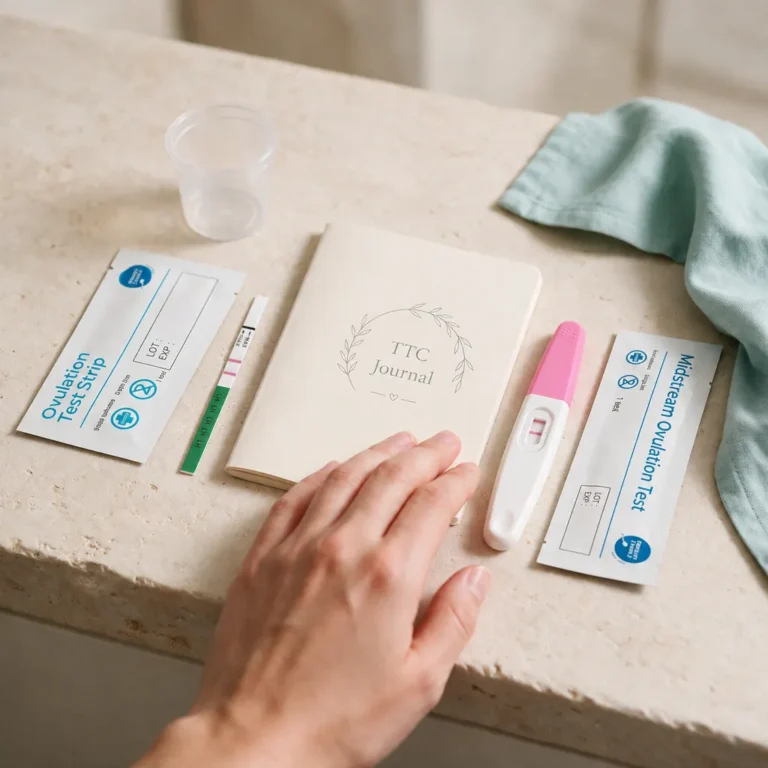
Ovulation tests that stay positive, never turn positive or disagree with an app can make PCOS tracking frustrating. You can track fertile days with PCOS, but predicting ovulation and checking whether it happened are different tasks. Start with period dates and a manageable routine using correctly timed luteinising hormone (LH) tests and cervical mucus observations. Basal body temperature (BBT) is an optional way to look back for a post-ovulation pattern, not a requirement.
The aim is to get enough useful information to time intercourse or choose the next test. If periods are irregular or absent, involve your GP early rather than extending home testing indefinitely.
Quick answers about tracking ovulation with PCOS
How do I track ovulation with PCOS?
Record period dates, follow the instructions for your LH test and note changes in cervical mucus. BBT can add a retrospective clue if consistent measurements are practical. Choose methods that help you make a timing decision; unpredictable cycles may need a GP-arranged monitoring plan.
Does a positive ovulation test prove I ovulated?
No. An ovulation test detects LH, not egg release. Some people with PCOS have elevated baseline LH that makes positive results misleading. Appropriately timed progesterone testing or ultrasound monitoring may help when a clinician needs clearer evidence about ovulation.
When should I seek help instead of continuing to track?
Arrange GP advice early if you are trying to conceive with irregular or absent periods. Three months without a period needs review, but you do not have to wait that long, complete a year of trying or collect several charts before discussing an ovulation concern.
How should you start tracking ovulation with PCOS?
PCOS can delay ovulation or mean it does not happen in some cycles. Irregular periods do not mean you never ovulate or cannot conceive naturally. They do make a calendar prediction less dependable.
Polyendocrine metabolic ovarian syndrome (PMOS) is the current name for the condition previously called polycystic ovary syndrome (PCOS). Monash University confirms the name changed on 12 May 2026. This guide keeps PCOS in some headings because it remains a common search term, while PMOS refers to the same condition.
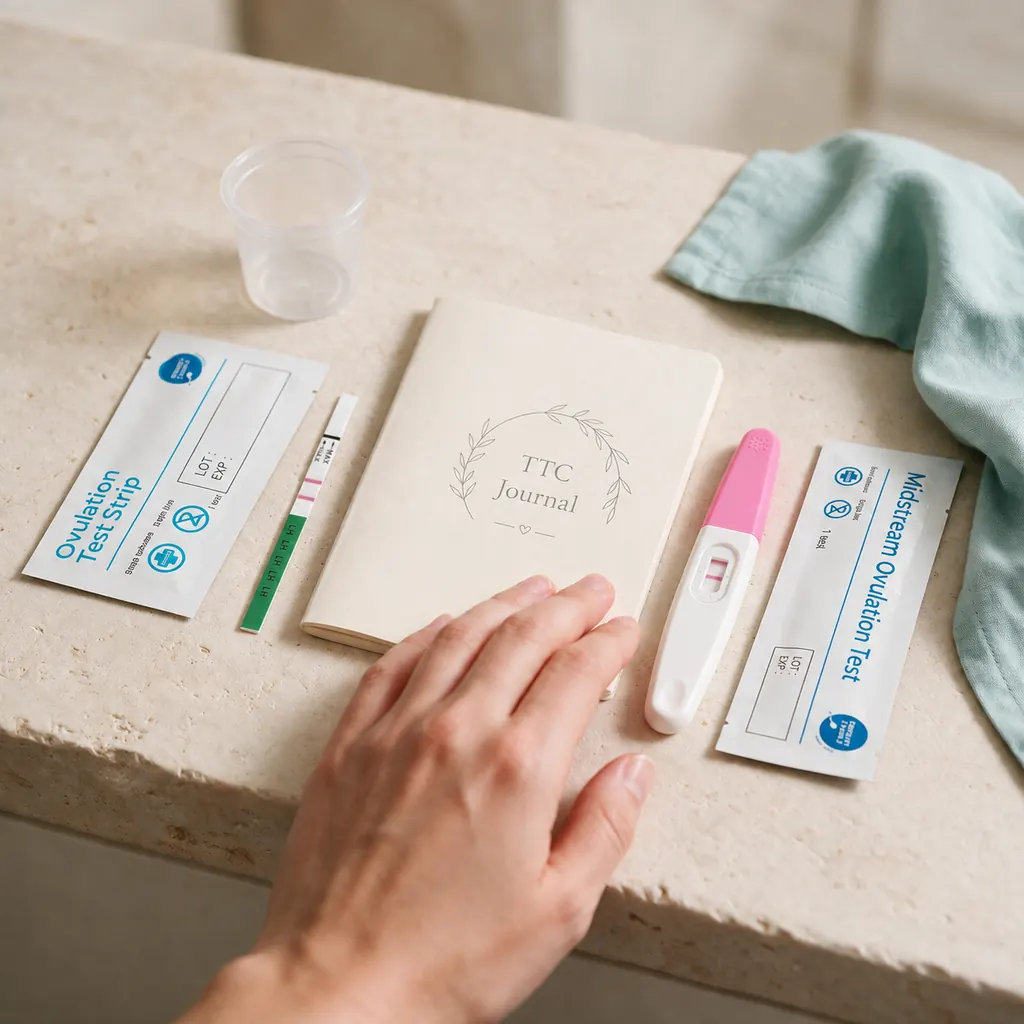
Check your actual cycle range. Record the first day of full period bleeding as day one, with spotting noted separately. Keep individual period dates rather than only an average cycle length.
Choose a workable method. Mucus observations and an LH-testing plan may help with timing. Add waking temperatures only if they are practical and useful to you.
Set the start day and reading rules. Use the directions for your exact test, including its advice for variable cycles. Do not automatically assume ovulation is on day 14.
Record valid observations. Note when a test was taken and read. Keep an on-time photograph if helpful, but do not reinterpret dried strips later.
Decide when to review the plan. Repeated uncertainty, irregular periods or testing that becomes costly or distressing are reasons to discuss another approach with your GP.
If PCOS has not been diagnosed, cycle dates alone cannot diagnose it. The broader PCOS and PMOS symptom pattern helps identify what to discuss at an assessment.
Write “positive LH test” rather than “confirmed ovulation”. Keeping observations separate from interpretations makes the record easier to use later.
Which signs help before ovulation, and which look back?
The best tracking method depends on the information you need. Measuring more things is worthwhile only when the extra information changes your next step.
| Method | What it can tell you | Main limit |
|---|---|---|
| Period dates or calendar app | Records cycle variation and predicts a window. | Does not observe this cycle’s ovulation. |
| Urinary LH test | Detects a hormone rise that may precede ovulation. | Baseline LH and missed surges can complicate PCOS results. |
| Cervical mucus | Slippery or stretchy mucus suggests a potentially fertile interval. | Does not establish egg release. |
| BBT | A sustained higher pattern may support recent ovulation. | Looks backwards and can be difficult to interpret. |
| Clinician-directed tests | Progesterone or ultrasound can address a clinical question. | Timing and interpretation matter; not everyone needs both. |
When should you start ovulation tests with PCOS?
Start from your device’s instructions and recent cycle lengths, not a universal PCOS schedule. Fertility2Family’s strip guidance uses shorter recent cycles when lengths vary. Its example for a 28-day cycle starts testing around day 11.
The Fertility2Family start-day chart covers 21–38-day cycles and advises speaking with a doctor outside that range. That is a product-use chart, not a definition of normal periods. In adults more than three years after their first period, the international guideline regards cycles longer than 35 days as irregular. A chart covering your cycle length does not remove a reason for medical review.
How should you use an ovulation test correctly?
For Fertility2Family LH strips, collect urine between 10 am and 8 pm, dip for five seconds without passing the MAX line, then lay the strip on a clean, dry, non-absorbent surface. Read between five and ten minutes and disregard later changes. Avoid unusually large drinks before testing. The complete ovulation test strip instructions and the directions supplied with your current pack are your references.
Other formats can differ. Clearblue Advanced Digital specifies the first urine after the longest sleep, for example. Do not transfer a strip’s collection time to a different device.
When choosing a format, you can compare ovulation tests. Choose for suitability and ease of correct use, not an expectation that a different display will resolve every hormone pattern.
What do positive, faint or negative ovulation test results mean with PCOS?
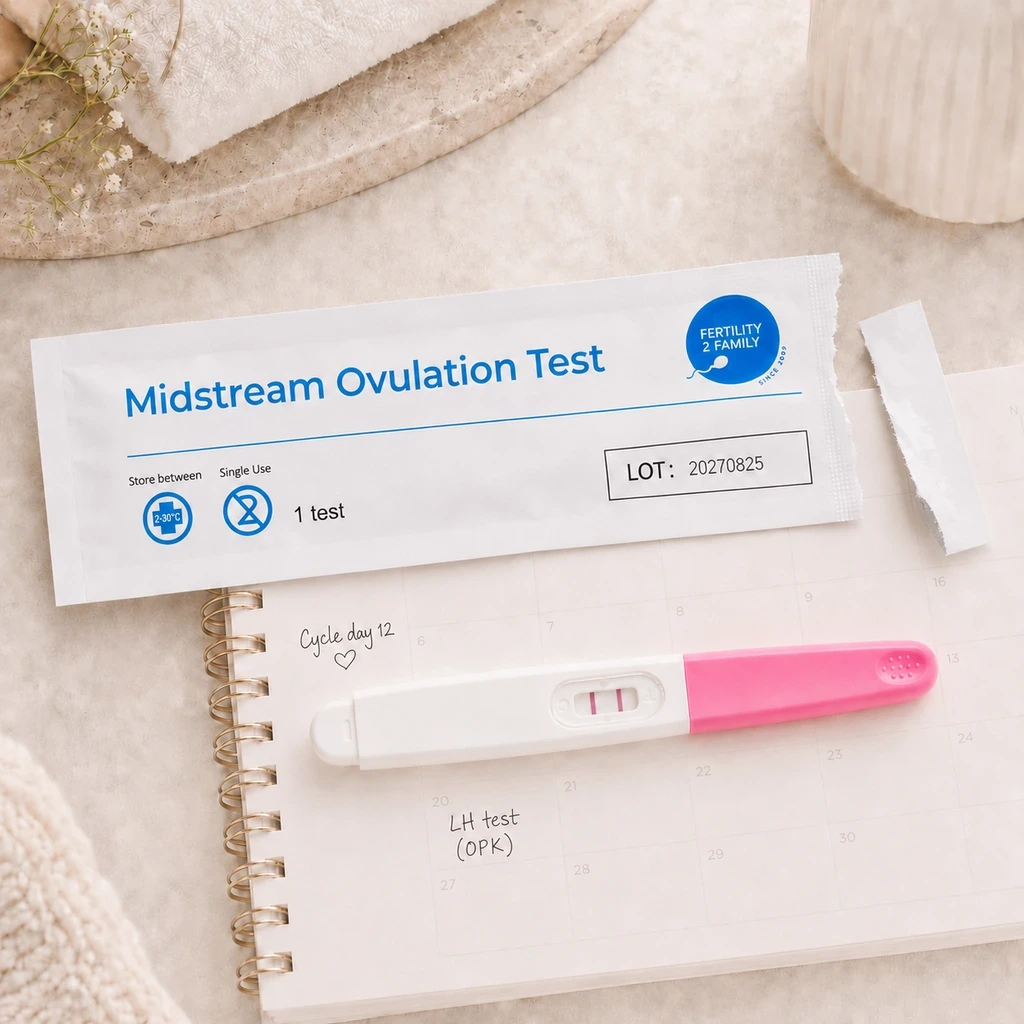
First check that the test is valid and was read on time. For visual LH strips using the usual line-comparison rule, the following distinctions apply. Digital devices must be read using their own display instructions.
| What you see | Result | Next action |
|---|---|---|
| Valid control; test line as dark as or darker than the control | Positive LH result. | Use as a possible timing signal, not proof of ovulation. |
| Valid control; faint test line or no test line | Negative at that testing time. | Check the planned testing window and sampling technique. |
| No control line | Invalid result. | Disregard it and repeat with a new device. |
| A change first noticed after the reading limit | Outside the valid interpretation window. | Keep the original on-time result, not the later appearance. |
A faint LH line is not interpreted like a faint pregnancy-test line. Our faint ovulation test line guide explains that difference.
Why can ovulation tests look always positive with PCOS?
Some people have elevated baseline LH, so the test may repeatedly detect enough hormone to appear positive. This is often called a false-positive ovulation prediction: LH may genuinely be present, but the result does not establish that egg release will follow.
Several dark tests, or a positive–negative–positive sequence, cannot identify several separate ovulations. Record the dates rather than assigning each positive an ovulation day. If this is your recurring pattern, ask whether an LH-only kit is useful for you.
What if you never catch a positive ovulation test?
You may be testing before delayed ovulation, missing a short surge between samples or using diluted urine. A cycle without ovulation is another possibility. A sequence of negative strips cannot distinguish these explanations by itself.
Check the practical reasons for negative ovulation tests. Repeating the same unhelpful routine for weeks is less useful than reviewing the timing and the need for clinical assessment.
What if mucus, temperature and the app disagree?
What can cervical mucus tell you with PCOS?
Clear, slippery or stretchy mucus can help with timing. Semen, arousal fluid, medicines and vaginal conditions may make observations harder to interpret. Mucus and LH results do not have to change at exactly the same time.
The guide to fertile cervical mucus without confirmed ovulation explores that mismatch. New irritation, unusual discharge or persistent pain warrants assessment rather than being labelled a fertile sign.
What can BBT tell you after ovulation?
Measure BBT on waking, before getting out of bed. A sustained higher pattern may support recent ovulation, but waiting for the rise before having sex can miss the most fertile days. Illness, alcohol, broken sleep and inconsistent measurement conditions can obscure the chart.
Some people who ovulate do not record a clearly readable two-phase pattern. An unclear chart therefore does not prove anovulation. The BBT charting guide explains the technique; shift work or disrupted sleep may make another approach more practical.
For example, an app may predict day-14 ovulation, mucus may become slippery on day 18, and an LH strip may be positive on day 20 while temperatures are inconsistent after poor sleep. Record the day-20 positive, but leave the ovulation date uncertain. The app may have predicted too early; the temperature chart cannot settle the date.
Would a digital test, PdG monitor or wearable help with PCOS tracking?
A useful upgrade should answer a question your current method cannot, or reduce the effort of collecting information. There is no single best ovulation test for everyone with PCOS.
Digital displays can avoid judging line darkness, and some devices also detect an oestrogen-related signal to identify additional potentially fertile days. However, Clearblue specifically warns that PCOS can cause misleading results with its Advanced Digital test. Check the exact product’s suitability before purchasing.
Multi-hormone monitors can provide a broader record by measuring urinary LH alongside E3G, an oestrogen metabolite, and PdG, a progesterone metabolite. A post-LH PdG rise can provide retrospective information about progesterone activity. A device’s “ovulation confirmed” label still depends on its algorithm and testing protocol; it is not an ultrasound observation.
One manufacturer-associated validation study selected people with relatively consistent cycles and no previously diagnosed infertility, limiting its relevance to unpredictable PCOS cycles. It studied hormone measurement and patterns, not whether purchasing the monitor improves pregnancy outcomes in this group.
Wearables can reduce recording effort. A temperature-sensing wearable may be easier than taking a waking measurement, although finger skin temperature is not the same measurement as oral BBT. A company-authored Oura study compared estimates with self-reported LH-test timing, not direct observation of egg release, and excluded anovulatory cycles. A missing wearable estimate therefore does not prove that ovulation did not occur; the authors advised caution in menstrual disorders including PCOS.
Before upgrading, ask whether the device was evaluated in people with cycles like yours, what its result actually measures, and whether it would change your next step. Include ongoing tests or subscriptions in the decision. More measurements should not postpone care for absent periods.
How should you time intercourse when ovulation is unpredictable?
The fertile window includes the five days before ovulation and the day of ovulation. With irregular cycles, intercourse every two to three days, when comfortable and appropriate, is a practical alternative to relying on one positive strip.
When a positive LH result is a useful signal for you, intercourse that day and the following day can cover likely timing. Pregnancy, Birth and Baby describes about 24–36 hours from a positive result to ovulation, but this is general guidance, not a guarantee with PCOS.
The guide to sex after an LH surge explains the window. Timing cannot treat a cycle without ovulation, and this tracking approach should not be used to identify “safe days” for unprotected sex when avoiding pregnancy.
When should you take a pregnancy test with irregular PCOS cycles?
Use an hCG pregnancy test when you need to check for pregnancy. If your expected period date is reasonably clear, test from the missed period. An early negative can simply be too early.
If you cannot predict your period, Australian sexual-health guidance uses a negative urine pregnancy test plus no unprotected sex in the previous three weeks as one way pregnancy can be reasonably excluded. A test taken less than 21 days after an episode of unprotected sex may still be falsely negative. With ongoing intercourse, a negative result cannot exclude a pregnancy arising from more recent sex.
Follow the kit instructions; first-morning urine can help reduce dilution. Healthdirect advises repeating in a week if the test is negative and the period has not started. Persistent uncertainty needs GP advice. The no period but negative pregnancy test guide covers that next decision.
When a fresh test is needed, pregnancy tests answer a different question from LH tests. After a valid positive, arrange pregnancy follow-up rather than monitoring line darkness.
Seek urgent medical assessment if pregnancy is possible and you develop severe or one-sided pelvic pain, shoulder-tip pain, heavy bleeding, marked dizziness or fainting. Do not wait for another home result. Call 000 for collapse, severe pain, very heavy bleeding or if you are very unwell.
What can a GP check when home tracking is inconclusive?
Your GP can review your period dates, symptoms, medicines and time trying to conceive, then choose investigations that answer a specific question. Depending on your history, these may include selected hormone tests, thyroid or prolactin testing, or ultrasound. Other fertility factors, including sperm and fallopian-tube factors, may also need consideration.
When should progesterone be tested to check recent ovulation?
When testing for recent ovulation is useful, progesterone is usually measured about seven days before the next expected period. The fertility hormone testing guide explains how cycle timing changes the collection date.
Ask how to time the sample if dates are uncertain and whether repeat testing is needed. A low result taken too early may leave the question unresolved. One progesterone result cannot grade egg quality or the whole luteal phase.
When does PCOS need more than home ovulation tracking?
With prolonged absent periods, care may also include protecting the uterine lining, not just finding fertile days. Your GP can discuss cycle management that fits your pregnancy goals.
For infertility caused by anovulatory PCOS without other infertility factors, the international guideline recommends letrozole as first-line medication. This requires clinical assessment and prescribing. Inositol remains experimental as an infertility treatment, with uncertain benefits and risks. Neither supplements nor a new monitor should substitute for that assessment. Our guide to PCOS and PMOS fertility options covers that separate treatment discussion.
Frequently asked questions about tracking ovulation with PCOS in Australia
Can a line-reading app tell me my blood LH level?
No. A photograph or test-line ratio is not a serum LH measurement. Reading time, lighting and test format can affect the comparison. A purpose-built quantitative urine monitor is a different system, but its urinary measurements should not be treated as interchangeable with blood results.
Does getting a period mean I definitely ovulated?
No. Bleeding does not establish that every cycle included ovulation, and ovulatory dysfunction can occur even with regular cycles. If the distinction matters to your fertility assessment, your GP can decide whether appropriately timed progesterone testing would help. You do not need to investigate every ordinary period at home.
Should my first positive LH test count as day zero for DPO?
Not as a confirmed ovulation date. DPO means days past ovulation, while an LH positive usually precedes ovulation and can be misleading with PCOS. Keep the positive-test date separate from an estimated ovulation date, especially before interpreting an early negative pregnancy test.
Does an AMH blood test show whether I am ovulating?
No. AMH is used in assessing ovarian reserve and, in specific adult diagnostic pathways, ovarian features associated with PCOS. It is not a test showing whether an egg was released this cycle. The AMH and fertility guide explains what the result can and cannot establish.
Can pelvic pain tell me an egg has been released?
No. Mild discomfort can occur around ovulation, but pain does not confirm egg release or identify its cause. Discuss persistent, recurring or new pelvic pain with your GP. Severe pain or pain with faintness, heavy bleeding or other warning symptoms needs urgent assessment.
How does fertility treatment change home tracking?
Follow your clinic’s monitoring, intercourse and pregnancy-testing plan. Fertility medicines can affect home results. Australian Ovidrel information warns that this hCG trigger can interfere with urine or blood pregnancy tests for up to ten days. Do not change prescribed medicines because an OPK or early pregnancy test looks unexpected.
Next Steps in Australia
Choose the next action that answers your question: check your LH test’s start-day plan, choose an appropriate pregnancy-testing date, or book a GP appointment about irregular or absent periods.
Bring your one-cycle record and ask: “Would testing for ovulation change my care plan, when should any progesterone sample be taken, and when should I return if my period does not come?” Mention cost, effort and the effect of tracking on your wellbeing.
If referral is appropriate, our guide to when to see a fertility specialist in Australia explains the pathway. You can start that conversation with the information you already have.
✓ Medically reviewed by Evan Kurzyp, RNLast reviewed Next review September 2027
References17 sources
Fertility2Family articles are researched using Australian Government health guidance, professional clinical recommendations and peer-reviewed medical literature. The references below were used to research and medically review this article and provide additional reading for readers who want to explore the evidence in more detail.
You can read how we research, write and check our health information in our editorial and medical review policy, and see who reviews our articles and their clinical credentials.
- Monash University. PCOS Guideline/ PMOS Guideline
Australian-led guideline hub documenting the May 2026 change from PCOS to PMOS and providing international evidence-based resources for assessment, management and shared care decisions. - Jean Hailes for Women’s Health. How does PMOS affect fertility and pregnancy?
Australian information explaining how PMOS can affect ovulation, why natural conception remains possible, and why fertility assessment should also consider factors beyond the condition. - American Society for Reproductive Medicine. Fertility evaluation of infertile women: a committee opinion (2021)
Professional guidance distinguishing urinary LH prediction, temperature observations and clinical ovulation assessment, including elevated baseline LH in PCOS and limitations of a single progesterone result. - Pregnancy, Birth and Baby. Ovulation and fertility
Australian guidance on fertile-window timing, LH tests, cervical mucus and temperature changes, including practical reasons to seek medical advice when conception or cycle timing is difficult. - Fertility2Family. Ovulation Test Strip Instructions: How to Dip and Read
Current Fertility2Family instructions covering urine collection, start-day guidance, five-second dipping, the five-to-ten-minute reading window and interpretation of positive, negative and invalid LH strip results. - Healthdirect Australia. Fertility awareness (natural family planning)
Australian guidance describing mucus, temperature and calendar observations, including how sleep, illness, medicines and other circumstances can make fertility signs more difficult to interpret. - Your Fertility. How to increase your chance of getting pregnant
Australian fertility education explaining intercourse timing and an every-two-to-three-days approach when irregular periods make ovulation difficult to predict, alongside general advice for preparing for pregnancy. - Australian Journal of General Practice. Assessment of female fertility in the general practice setting
Australian general-practice guidance covering fertility history, targeted investigations and progesterone testing about seven days before the expected period rather than on one universal cycle day. - Healthdirect Australia. hCG test
Australian guidance on urine and blood pregnancy tests, early false negatives, urine concentration and repeat testing when the period has not started after a negative result. - Sexual Health Victoria. Quick Start Contraception Protocol
Current Australian sexual-health protocol explaining pregnancy-exclusion timing, including why a urine pregnancy test taken less than 21 days after unprotected sex may still be falsely negative. - Healthdirect Australia. Ectopic pregnancy
Australian guidance describing ectopic pregnancy symptoms and urgent assessment, including pelvic or shoulder-tip pain, bleeding, dizziness and fainting, with emergency advice for severe symptoms. - Healthdirect Australia. Irregular periods
Australian advice on irregular and absent periods, review after three months without bleeding, useful cycle records and investigations selected according to symptoms and medical history. - American Society for Reproductive Medicine. Recommendations from the 2023 International Evidence-based Guideline for the Assessment and Management of Polyendocrine Metabolic Ovarian Syndrome (2023)
Current international recommendations covering irregular cycles, ovulatory dysfunction, endometrial protection, first-line letrozole for selected anovulatory infertility and the experimental status of inositol for PMOS infertility. - Clearblue Australia. Advanced Digital Ovulation Test
Manufacturer information for a specific digital ovulation test, including first-urine collection instructions and warnings that PCOS and some fertility medicines can produce misleading results. - Australian Commission on Safety and Quality in Health Care. Ovidrel Pen
Australian medicine information for choriogonadotropin alfa, including potential interference with urine or blood hCG pregnancy tests for up to ten days after administration. - Scientific Reports. Validation of urinary reproductive hormone measurements using a novel smartphone connected reader
A manufacturer-associated validation study of urinary LH, E3G and PdG measurements, with participant-selection limits relevant when applying its findings to unpredictable PCOS cycles. - Journal of Medical Internet Research. Oura Ring as a Tool for Ovulation Detection: Validation Analysis
A company-authored study comparing wearable ovulation estimates with LH-test timing, reporting limitations and caution when interpreting estimated dates in people with menstrual disorders including PCOS.