On this page
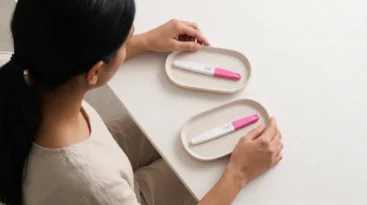
Seeing a negative pregnancy test at 9 DPO can feel like an answer, especially after several days of watching for symptoms. At this point, it is usually one early result rather than the cycle’s final answer. A valid negative means hCG was not detected in that sample under the conditions of that test. Pregnancy may still be possible.
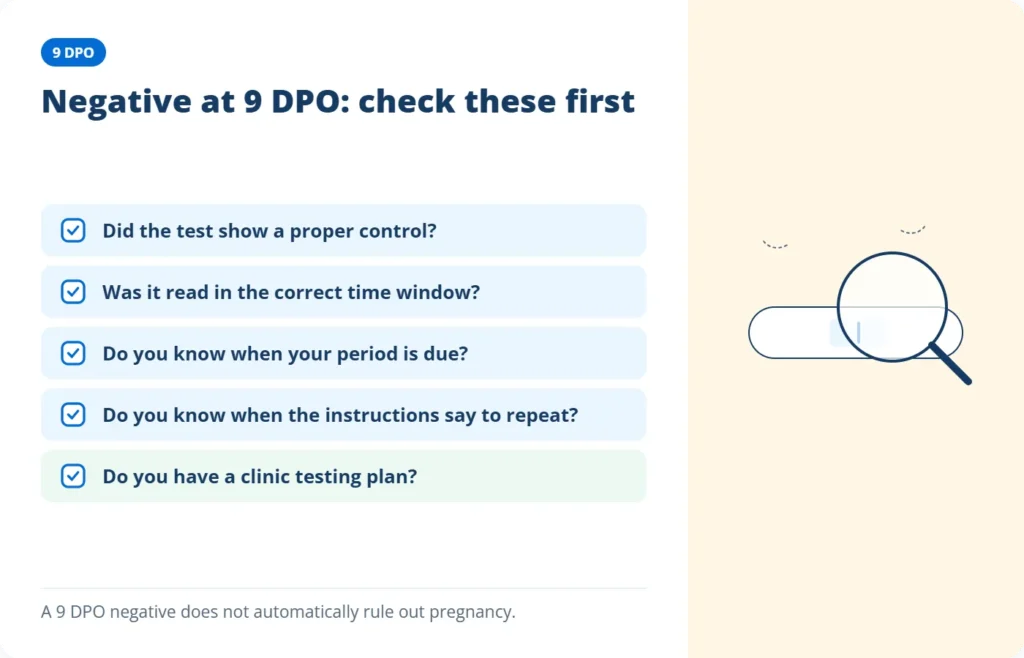
The useful next step is to check how well the 9 DPO date is supported, whether the test was valid, when another result could add information, and whether any symptom means you should seek care instead of waiting.
Quick answers about 9 DPO symptoms and pregnancy testing
Could I still be pregnant after a negative pregnancy test at 9 DPO?
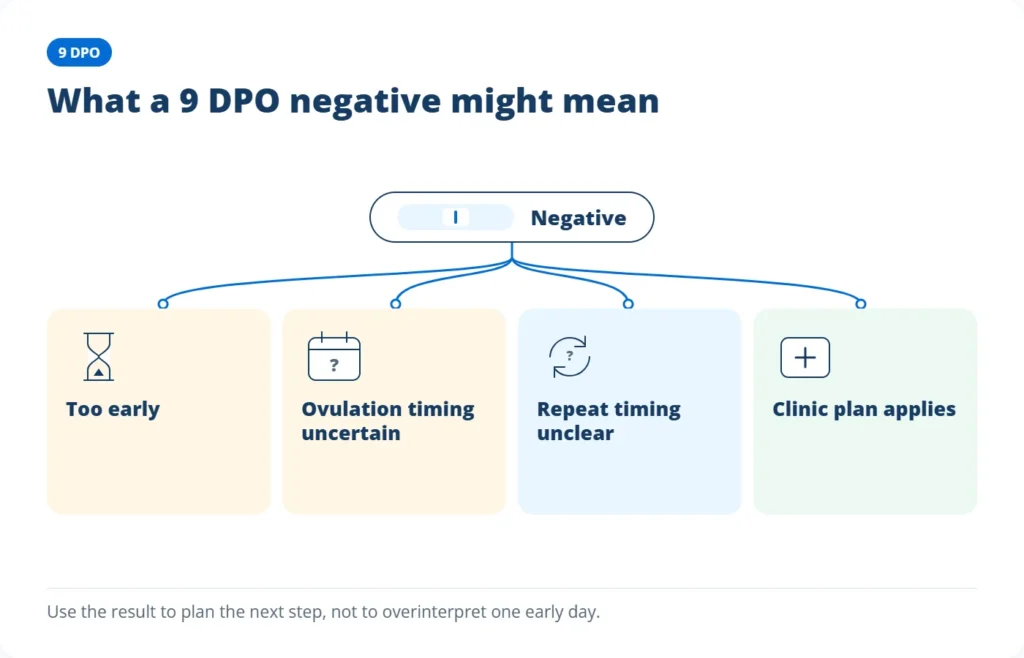
Yes. Even when the control is valid and you read the result on time, urine hCG may not yet be detectable at 9 DPO. Treat it as an early non-detection, then use the four-check pathway below to choose the next step.
Do 9 DPO symptoms or discharge show whether I am pregnant?
No. Breast tenderness, bloating, tiredness, mild cramps, no symptoms and changes in discharge can occur in cycles that do and do not become pregnant. Symptoms and discharge appearance cannot confirm pregnancy or predict a later positive test.
When should I seek care instead of waiting to retest?
See a doctor for ongoing or recurring abdominal or pelvic pain. Seek urgent medical attention for worsening pain, pain lasting several hours, or abdominal pain with persistent vomiting or fever. Get immediate medical attention from a doctor or emergency department if you cannot keep water down, can manage only a few sips of fluid or have signs of dehydration. Severe pain, heavy bleeding, fainting or feeling very unwell requires immediate emergency-department or 000 care.
What does 9 DPO mean, and how certain is the date?
DPO means days past ovulation. Ovulation day is counted as 0 DPO, so 9 DPO is nine calendar days later. You may also see it written as 9DPO. Fertility2Family’s DPO calculator can place your cycle clues on a timeline, but it cannot confirm the exact moment ovulation occurred.
An app or calendar predicts from previous cycle dates. A urine LH test detects a hormone rise that usually comes before ovulation. Basal body temperature looks back for a sustained shift after ovulation. Clinical ultrasound and hormone monitoring can add different timing information, but their interpretation depends on what was measured and when. None of these methods creates a universally exact ovulation timestamp.
Non-Australian research using cervical mucus and basal temperature to estimate ovulation found variation within individuals. It supports keeping an uncertain date provisional, not an Australian prevalence estimate or a personal probability that your date is wrong.
What does a negative pregnancy test at 9 DPO actually mean?
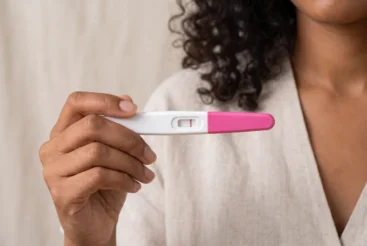
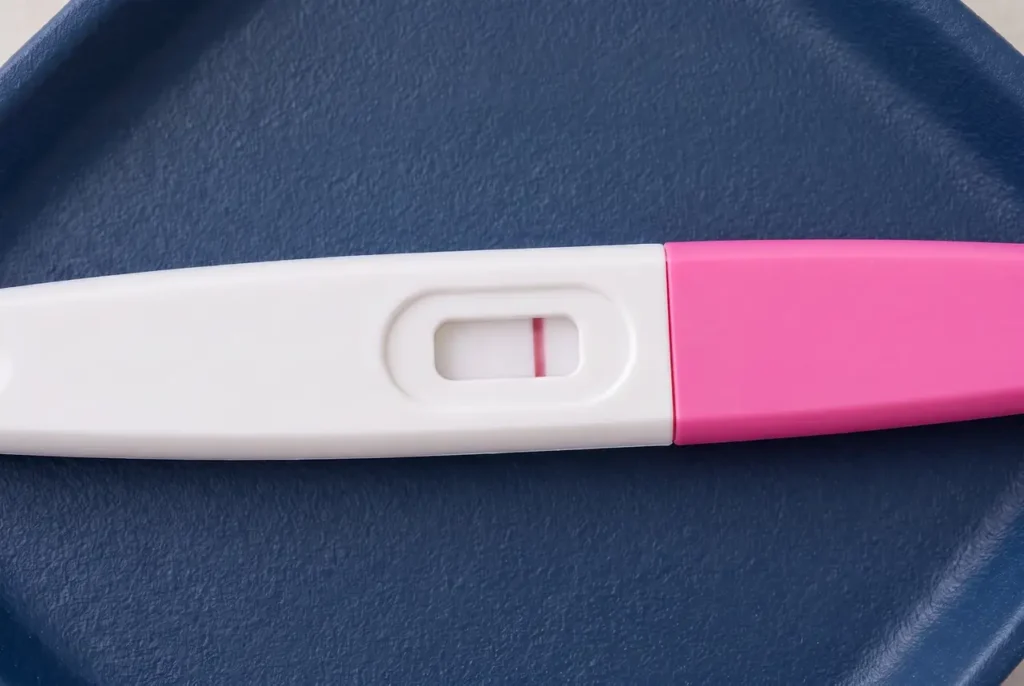
Home pregnancy tests are qualitative urine hCG tests. A valid negative means the device did not detect hCG in that sample according to its threshold and instructions. Testing early can produce a negative result before urine hCG is detectable.
If you are deciding whether the previous day was too early, revisit the 8 DPO test-versus-wait decision.
The result cannot date implantation, prove the ovulation day, locate a pregnancy or show how a pregnancy is developing. A missing control or device error is not a negative; use step 2 below.
How should you plan the next step after a negative test at 9 DPO?
Use these checks to plan your next step.
Which four checks matter after a negative pregnancy test at 9 DPO?
- Check the confidence in the date. Use the timing clues described above. An app-only date usually leaves more uncertainty than a cycle with additional LH, temperature or clinical information, but no method proves one exact ovulation moment.
- Check whether the test was valid. Confirm the expiry date, sample method, required control and reading window for that device. First-morning urine is often more concentrated, while drinking a large amount beforehand can dilute the sample. If the required control is missing or the device reports an error, discard that result and repeat with a fresh device according to its instructions.
- Choose one useful repeat point. Follow the retest interval supplied with the device and any fertility-clinic plan first. Testing at 10 DPO may add information but can still be early. Waiting until the expected period usually gives the result more timing context. The timing calculator for the next useful test date can help you choose a planned date.
- Let symptoms change the waiting plan. Use the care section below if pain, bleeding, vomiting, dehydration, dizziness or feeling unwell changes the urgency. Do not wait for another home result when symptoms need assessment.
The 10 DPO guide to reading a pregnancy-test result explains the next testing stage without treating one extra day as a guarantee.
How can you work through an early negative at 9 DPO?
A negative this early can leave you with more questions than answers. Four practical checks can turn that uncertainty into a specific next step while keeping symptoms on their own care pathway.
Review how certain the date is, whether the test met all validity requirements, the instructed time for one repeat test and the symptoms that change the care plan.
Our free DPO calculator can work out how many days past ovulation you are and when a pregnancy test is more likely to give a clear answer.

What can symptoms and discharge tell you at 9 DPO?
Breast tenderness, bloating, tiredness, headaches and mild cramps can occur before a period. Early pregnancy can also feel different, familiar or completely symptom-free. That overlap is why no 9 DPO symptom pattern can confirm pregnancy or predict whether a later test will be positive.
People trying to conceive often call a negative result a BFN and a positive result a BFP. A later BFP shows that hCG was detectable at that later test. It does not prove that an earlier cramp, headache or breast change was caused by pregnancy. The two-week-wait stage-by-stage guide can help separate noticing a symptom from using it as a test.
Can discharge appearance identify pregnancy at 9 DPO?
After ovulation, discharge often becomes thicker or less noticeable. Normal discharge may be clear, white or creamy, and pregnancy can change its amount and type. None of those appearances can identify whether a 9 DPO cycle is pregnant. The guide to milky white discharge explains the wider pattern without treating colour or texture as a pregnancy diagnosis.
See a doctor if discharge looks or smells different from what is usual for you, particularly when it comes with itching, irritation, pain, bleeding, fever or lower abdominal pain. Those features need assessment for their own cause.
What should you do after a positive, faint, late or invalid result?
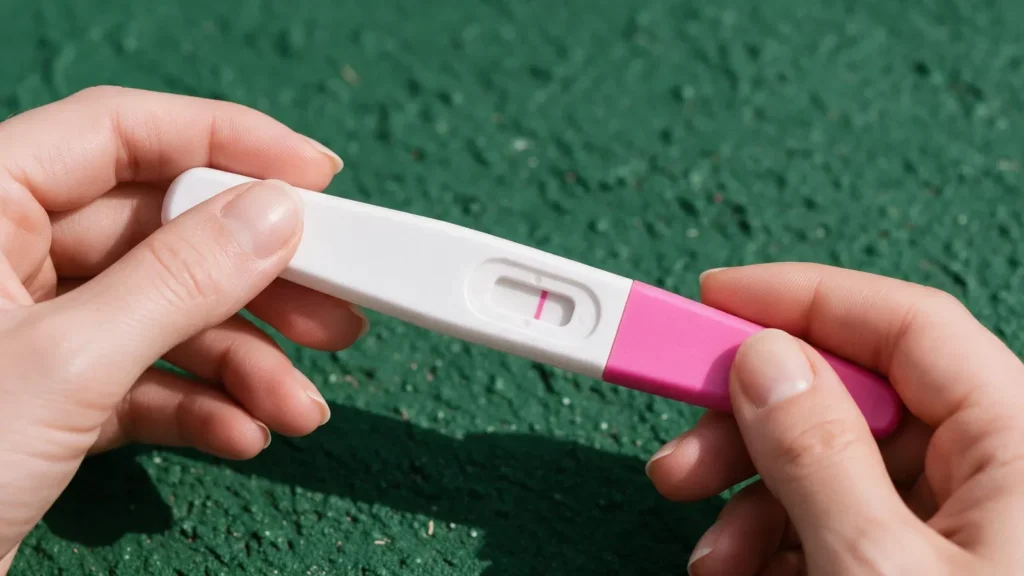
If the required control appeared and the device shows a positive result within its valid reading window, arrange confirmation and follow-up with your GP or fertility clinic. This applies to every valid positive, including a faint positive interpreted according to the instructions. You do not need to wait for the line to darken. Fertility2Family’s guide to what to do after a positive pregnancy test in Australia covers that care pathway.
The faint pregnancy-test line guide helps when you are unsure whether an on-time line met the device’s positive rule. It does not use line darkness to judge pregnancy health.
A mark first noticed after the reading window has passed should not change how you interpret the earlier result. The guide to evaporation lines and late marks explains why timing comes before appearance.
A missing control or device error means the test has not produced a valid result; return to pathway step 2. Do not use home line progression to assess pregnancy health.

How do fertility treatment and Ovidrel change the plan?
If you are in an IVF, IUI, ovulation-induction or other monitored cycle, follow the fertility clinic’s test date and medicine instructions. A general 9 DPO article cannot replace a treatment-specific plan. Do not stop or change prescribed fertility medicine because of an early home result; contact the clinic first.
Ovidrel contains choriogonadotropin alfa, a form of hCG. Current Australian product information states that, after administration, it can interfere with serum or urine hCG testing for up to ten days and produce a false-positive pregnancy test. Contact the clinic when a home result conflicts with its schedule.
When should symptoms change the plan?
A brief mild cramp does not automatically make this an emergency. See a doctor when abdominal or pelvic pain is ongoing or keeps returning. Seek urgent medical attention if pain is worsening or has lasted several hours, or if abdominal pain occurs with persistent vomiting or fever.
Seek immediate medical attention from a doctor or emergency department if vomiting comes with signs of dehydration, you cannot take in more than a few sips of fluid, or you cannot keep water down. If pregnancy is possible and you have severe abdominal or pelvic pain, strong one-sided pelvic pain, heavy bleeding, shoulder-tip pain, marked dizziness, fainting or feel very unwell, go immediately to your nearest emergency department or call 000 for an ambulance.
These symptoms have several possible causes and are not diagnosed from a DPO label. A negative home test, including a later negative, must not delay symptom-based assessment. For a stable testing question, the no period but negative pregnancy test guide covers the later missed-period decision.
Frequently asked questions about 9 DPO symptoms and pregnancy testing in Australia
Does a negative test at 9 DPO mean implantation did not happen?
No. A home urine test cannot tell you whether implantation happened or when it occurred. It only reports whether hCG was detected in that sample, and very early timing can make the result difficult to place on a biological timeline.
Should I test again at 10 DPO or wait until my expected period?
Follow the device or clinic interval. If neither sets one, step 3 above explains why the expected-period date usually provides more timing context than 10 DPO.
Once you have chosen an appropriate repeat point, you can compare home pregnancy-test formats available in Australia. A replacement device cannot make an early negative definitive, and its own instructions still take priority.
Can diluted urine affect a negative result at 9 DPO?
Yes. Dilution can contribute to non-detection when hCG is low. A more concentrated sample cannot correct an inaccurate ovulation estimate or make an early negative conclusive.
Can an invalid pregnancy test be counted as a negative?
No. A failed validity check cannot be used as evidence that hCG was absent. Step 2 explains how to repeat with a fresh device.
What should I do if my period is late but pregnancy tests stay negative?
Follow any device or clinic retest instructions first. If these do not give a clear interval, Healthdirect advises repeating a negative test in one week if the period still has not started. Contact your GP earlier if results conflict, the delay is unusual for you or symptoms need assessment. The 16 DPO no-period and negative-test guide covers that later situation in more detail.
What if my fertility clinic gave me a different pregnancy-test date?
Follow the clinic’s date and medicine plan. Contact the clinic if the result conflicts, and do not change prescribed medicine unless the clinic advises it.
Next Steps in Australia
Once the valid reading window has passed, set the used test aside. Any clearer answer must come from a later valid test or clinical assessment, not from re-reading the same strip.
An early negative can feel final even when the timing is still provisional. With the four checks recorded, follow the planned repeat date and contact plan unless symptoms need earlier care.
✓ Medically reviewed by Evan Kurzyp, RNLast reviewed Next review September 2027
References12 sources
Fertility2Family articles are researched using Australian Government health guidance, professional clinical recommendations and peer-reviewed medical literature. The references below were used to research and medically review this article and provide additional reading for readers who want to explore the evidence in more detail.
You can read how we research, write and check our health information in our editorial and medical review policy, and see who reviews our articles and their clinical credentials.
- Healthdirect Australia Human chorionic gonadotropin (hCG) test – pregnancy
Australian guidance on home urine hCG testing, early false negatives, morning urine, dilution, device instructions, fallback retesting after an absent period and medical checking of conflicting results. - Better Health Channel Pregnancy testing
Victorian public health guidance on pregnancy-test timing, strict device instructions, first-morning urine, false negatives and GP or family-planning-clinic confirmation after any positive, including a faint positive. - Therapeutic Goods Administration Meeting clinical evidence requirements for in vitro diagnostic (IVD) medical devices
Australian regulatory guidance explaining self-test validity controls, including that a missing pregnancy-test control means the result is invalid and the user should retest with a different device. - Pregnancy, Birth and Baby Ovulation and fertility
Australian guidance on cycle variation and the different timing information provided by calendar estimates, cervical mucus, basal body temperature and urinary LH testing. - Human Reproduction Variations in ovulation time and menstrual cycle characteristics: analysis of a prospective long-term cohort study
A 2026 publication analysing 12,612 prospectively collected cycle records from 1,051 women between 1985 and 2019, with ovulation estimated using cervical mucus and basal temperature. - Healthdirect Australia Premenstrual syndrome (PMS)
Australian guidance describing common premenstrual symptoms, including bloating, breast tenderness, headaches and tiredness, which can overlap with experiences noticed during the two-week wait. - Better Health Channel Pregnancy stages and changes
Victorian public health guidance explaining that early-pregnancy experiences vary widely and may include some, many or no noticeable symptoms, so symptom absence alone is not diagnostic. - Healthdirect Australia Vaginal discharge
Australian guidance on normal cycle-related discharge, changes that may indicate irritation or infection, and when smell, itching, pain, bleeding or fever warrants medical assessment. - Healthdirect Australia Abdominal pain
Australian guidance distinguishing recurring, worsening and severe abdominal pain, including urgent attention for pain lasting several hours and immediate emergency-department or 000 access for severe pain. - Healthdirect Australia Ectopic pregnancy
Australian guidance on ectopic-pregnancy symptoms and emergency assessment, supporting symptom-based action for strong pain, heavy bleeding, shoulder-tip pain, dizziness, faintness or feeling unwell. - Healthdirect Australia Vomiting
Australian guidance on vomiting and dehydration, including immediate doctor or emergency-department care when a person cannot keep water down, can manage only a few sips or shows dehydration. - Australian Commission on Safety and Quality in Health Care Ovidrel Pen
Current Australian Ovidrel product information stating that, after administration, choriogonadotropin alfa can interfere with serum or urine hCG testing for up to ten days and cause a false-positive result.